
Universal Pipette Tips
Disposable pipette tips designed to fit single and multichannel pipettes from most manufacturers; offer acceptable performance compared to pipette specific tips and can be used with a variety of pipette models.
Single-use universal pipette tips are designed for compatibility with most mechanical and electronic single and multichannel pipettors.
Universal pipette tips are available in a range of types, sizes, colors, styles, and packaging configurations and may be designed for specific purposes or tasks.
- Capacity or volume based on the pipettor size
- Filters to reduce contamination and cross-contamination
- Color
- Sterility or autoclavability
- Tip style: beveled, tapered, wide bore, round, flat, or gel-loading
- Length: short or extended
- Purity: metal-free or DNase-, RNase-, ATP-, Bioburden-, PCR inhibitor-, endotoxin-, or pyrogen-free for genomic and biologic applications
- Surface treatments to reduce retention
- Packaging options to help facilitate re-stocking or eliminate waste

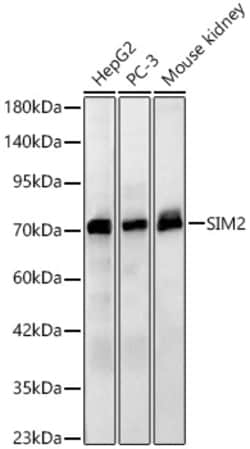
ABclonal Technology SIM2 Rabbit pAb

This gene represents a homolog of the Drosophila single-minded (sim) gene, which encodes a transcription factor that is a master regulator of neurogenesis. The encoded protein is ubiquitinated by RING-IBR-RING-type E3 ubiquitin ligases, including the parkin RBR E3 ubiquitin protein ligase. This gene maps within the so-called Down syndrome chromosomal region, and is thus thought to contribute to some specific Down syndrome phenotypes. Alternative splicing of this gene results in multiple transcript variants.

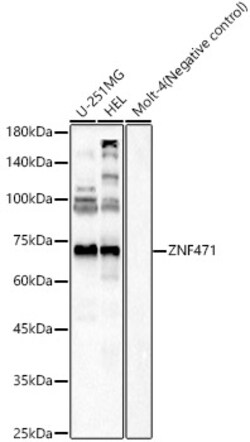
ABclonal Technology ZNF471 Rabbit pAb
Predicted to enable DNA-binding transcription factor activity, RNA polymerase II-specific and RNA polymerase II cis-regulatory region sequence-specific DNA binding activity. Predicted to be involved in regulation of transcription by RNA polymerase II. Located in nucleus.
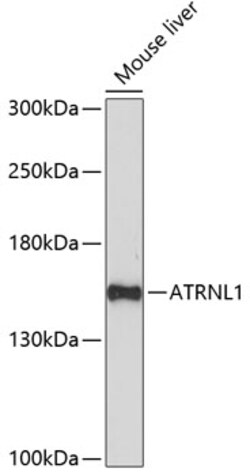
ABclonal Technology ATRNL1 Rabbit pAb
Predicted to enable carbohydrate binding activity. Predicted to be involved in several processes, including animal organ morphogenesis, cell migration, and substrate adhesion-dependent cell spreading. Predicted to act upstream of or within G protein-coupled receptor signaling pathway. Predicted to be located in membrane. Predicted to be integral component of membrane. Predicted to be active in basement membrane.
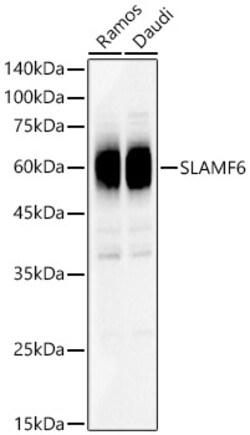
ABclonal Technology SLAMF6 Rabbit pAb
The protein encoded by this gene is a type I transmembrane protein, belonging to the CD2 subfamily of the immunoglobulin superfamily. This encoded protein is expressed on Natural killer (NK), T, and B lymphocytes. It undergoes tyrosine phosphorylation and associates with the Src homology 2 domain-containing protein (SH2D1A) as well as with SH2 domain-containing phosphatases (SHPs). It functions as a coreceptor in the process of NK cell activation. It can also mediate inhibitory signals in NK cells from X-linked lymphoproliferative patients. Alternative splicing results in multiple transcript variants encoding distinct isoforms.
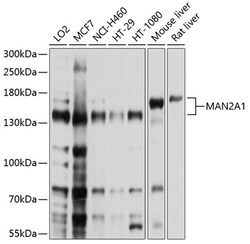
ABclonal Technology MAN2A1 Rabbit pAb
This gene encodes a glycosyl hydrolase that localizes to the Golgi and catalyzes the final hydrolytic step in the asparagine-linked oligosaccharide (N-glycan) maturation pathway. Mutations in the mouse homolog of this gene have been shown to cause a systemic autoimmune disease similar to human systemic lupus erythematosus.
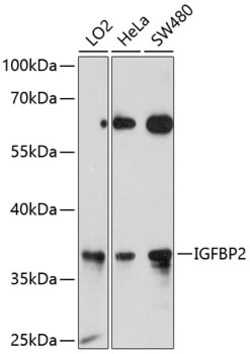
ABclonal Technology IGFBP2 Rabbit pAb
The protein encoded by this gene is one of six similar proteins that bind insulin-like growth factors I and II (IGF-I and IGF-II). The encoded protein can be secreted into the bloodstream, where it binds IGF-I and IGF-II with high affinity, or it can remain intracellular, interacting with many different ligands. High expression levels of this protein promote the growth of several types of tumors and may be predictive of the chances of recovery of the patient. Several transcript variants, one encoding a secreted isoform and the others encoding nonsecreted isoforms, have been found for this gene.
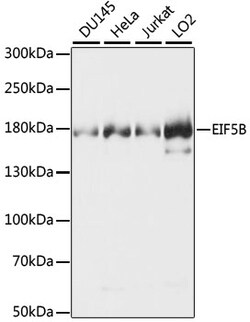
ABclonal Technology EIF5B Rabbit pAb
Accurate initiation of translation in eukaryotes is complex and requires many factors, some of which are composed of multiple subunits. The process is simpler in prokaryotes which have only three initiation factors (IF1, IF2, IF3). Two of these factors are conserved in eukaryotes the homolog of IF1 is eIF1A and the homolog of IF2 is eIF5B. This gene encodes eIF5B. Factors eIF1A and eIF5B interact on the ribosome along with other initiation factors and GTP to position the initiation methionine tRNA on the start codon of the mRNA so that translation initiates accurately.
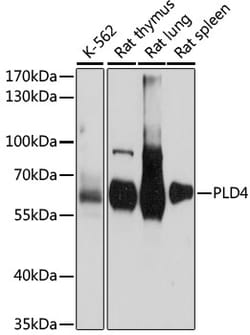
ABclonal Technology PLD4 Rabbit pAb
Predicted to enable single-stranded DNA 5-3 exodeoxyribonuclease activity. Predicted to be involved in hematopoietic progenitor cell differentiation, phagocytosis, and regulation of cytokine production involved in inflammatory response. Predicted to be located in early endosome and endoplasmic reticulum membrane. Predicted to be active in several cellular components, including endoplasmic reticulum, phagocytic vesicle, and trans-Golgi network membrane.
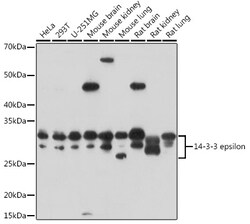
ABclonal Technology 14-3-3 epsilon Rabbit pAb
This gene product belongs to the 14-3-3 family of proteins which mediate signal transduction by binding to phosphoserine-containing proteins. This highly conserved protein family is found in both plants and mammals, and this protein is 100% identical to the mouse ortholog. It interacts with CDC25 phosphatases, RAF1 and IRS1 proteins, suggesting its role in diverse biochemical activities related to signal transduction, such as cell division and regulation of insulin sensitivity. It has also been implicated in the pathogenesis of small cell lung cancer. Two transcript variants, one protein-coding and the other non-protein-coding, have been found for this gene.
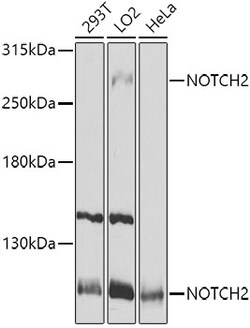
ABclonal Technology NOTCH2 Rabbit pAb
This gene encodes a member of the Notch family, a group of Type 1 transmembrane proteins with an extracellular domain containing multiple epidermal growth factor-like (EGF) repeats and an intracellular domain with diverse domains. Notch family proteins regulate developmental processes by controlling cell fate decisions through an evolutionarily conserved intercellular signaling pathway. In Drosophila, Notch interacts with ligands (delta, serrate) to regulate development, and similar ligands have been identified in humans, though their interactions with human Notch proteins are not fully understood. This protein is cleaved in the trans-Golgi network and presented as a heterodimer on the cell surface, acting as a receptor for membrane-bound ligands. It may be involved in vascular, renal, and hepatic development. Two transcript variants encoding different isoforms have been identified.


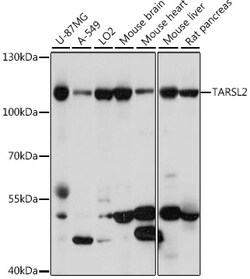
ABclonal Technology TARSL2 Rabbit pAb
Predicted to enable threonine-tRNA ligase activity. Predicted to be involved in threonyl-tRNA aminoacylation. Predicted to be located in cytoplasm and nucleus.
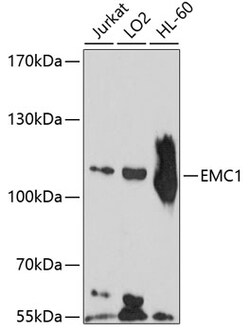
ABclonal Technology EMC1 Rabbit pAb
This gene encodes a single-pass type I transmembrane protein, which is a subunit of the endoplasmic reticulum membrane protein complex (EMC). Multiple alternatively spliced transcript variants encoding different isoforms have been found for this gene.
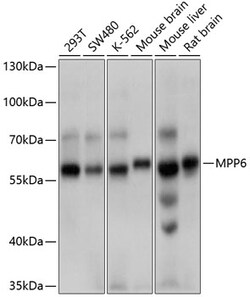
ABclonal Technology MPP6 Rabbit pAb
Members of the peripheral membrane-associated guanylate kinase (MAGUK) family function in tumor suppression and receptor clustering by forming multiprotein complexes containing distinct sets of transmembrane, cytoskeletal, and cytoplasmic signaling proteins. All MAGUKs contain a PDZ-SH3-GUK core and are divided into 4 subfamilies, DLG-like (see DLG1, MIM 601014), ZO1-like (see TJP1, MIM 601009), p55-like (see MPP1, MIM 305360), and LIN2-like (see CASK, MIM 300172), based on their size and the presence of additional domains. MPP6 is a member of the p55-like MAGUK subfamily (Tseng et al., 2001 [PubMed 11311936]).
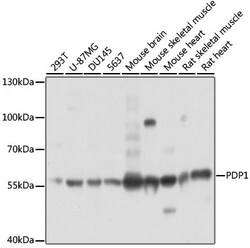
ABclonal Technology PDP1 Rabbit pAb
Pyruvate dehydrogenase (E1) is part of the pyruvate dehydrogenase complex (E1, E2, E3), with E1 activity regulated by phosphorylation and dephosphorylation. Pyruvate dehydrogenase kinases inactivate E1 by phosphorylating serine residues, while pyruvate dehydrogenase phosphatases activate E1 by dephosphorylation. The phosphatase is a heterodimer with catalytic and regulatory subunits. The catalytic subunit encoded by this gene is predominantly expressed in skeletal muscle and belongs to the protein phosphatase 2C (PP2C) superfamily. Located in the mitochondrial matrix, this enzyme, along with pyruvate dehydrogenase and kinases, regulates pyruvate metabolism. Mutations in this gene lead to pyruvate dehydrogenase phosphatase deficiency. Multiple alternatively spliced isoforms have been identified.