Protein Molecular Weight Markers
- (1)
- (1)
- (1)
- (1)
- (1)
- (39)
- (2)
- (19)
- (1)
- (2)
- (1)
- (1)
- (2)
- (2)
- (1)
- (1)
- (2)
- (2)
- (1)
- (2)
- (2)
- (1)
- (4)
- (1)
- (1)
- (1)
- (1)
- (1)
- (2)
- (3)
- (3)
- (1)
- (1)
- (2)
- (2)
- (1)
- (1)
- (2)
- (4)
- (2)
- (1)
- (1)
- (1)
- (4)
- (1)
- (2)
- (3)
- (1)
- (1)
- (2)
- (3)
- (13)
- (1)
- (3)
- (2)
- (5)
- (3)
- (2)
- (9)
- (3)
- (5)
- (2)
- (1)
- (1)
- (3)
- (2)
- (9)
- (9)
- (1)
- (7)
- (2)
- (1)
- (2)
- (2)
- (3)
- (1)
- (24)
Filtered Search Results
ABclonal Technology KIF14 Rabbit pAb
Small and Specialty Supplier Partner
Small and/or specialty supplier based on Federal laws and SBA requirements.
Learn More
Small and/or specialty supplier based on Federal laws and SBA requirements.
Learn More
This gene encodes a member of the kinesin-3 superfamily of microtubule motor proteins. These proteins are involved in numerous processes including vesicle transport, chromosome segregation, mitotic spindle formation, and cytokinesis. In human HeLa-S3 and 293T cells, this protein is localized to the cytoplasm during interphase, to the spindle poles and spindle microtubules during mitosis, and to the midbody during cytokinesis. An internal motor domain displays microtubule-dependent ATPase activity, consistent with its function as a microtubule motor protein. Knockdown of this gene results in failed cytokinesis with endoreplication, which results in multinucleated cells. This gene has been identified as a likely oncogene in breast, lung and ovarian cancers, as well as retinoblastomas and gliomas. Alternative splicing results in multiple transcript variants.
Non-distribution item offered as a customer accommodation; additional freight charges may apply.
Learn More
ABclonal Technology IRF4 Rabbit pAb
Small and Specialty Supplier Partner
Small and/or specialty supplier based on Federal laws and SBA requirements.
Learn More
Small and/or specialty supplier based on Federal laws and SBA requirements.
Learn More
The protein encoded by this gene belongs to the IRF (interferon regulatory factor) family of transcription factors, characterized by an unique tryptophan pentad repeat DNA-binding domain. The IRFs are important in the regulation of interferons in response to infection by virus, and in the regulation of interferon-inducible genes. This family member is lymphocyte specific and negatively regulates Toll-like-receptor (TLR) signaling that is central to the activation of innate and adaptive immune systems. A chromosomal translocation involving this gene and the IgH locus, t(6,14)(p25,q32), may be a cause of multiple myeloma. Alternatively spliced transcript variants have been found for this gene.
Non-distribution item offered as a customer accommodation; additional freight charges may apply.
Learn More
ABclonal Technology Twist Rabbit pAb
Small and Specialty Supplier Partner
Small and/or specialty supplier based on Federal laws and SBA requirements.
Learn More
Small and/or specialty supplier based on Federal laws and SBA requirements.
Learn More
This gene encodes a basic helix-loop-helix (bHLH) transcription factor that plays an important role in embryonic development. The encoded protein forms both homodimers and heterodimers that bind to DNA E box sequences and regulate the transcription of genes involved in cranial suture closure during skull development. This protein may also regulate neural tube closure, limb development and brown fat metabolism. This gene is hypermethylated and overexpressed in multiple human cancers, and the encoded protein promotes tumor cell invasion and metastasis, as well as metastatic recurrence. Mutations in this gene cause Saethre-Chotzen syndrome in human patients, which is characterized by craniosynostosis, ptosis and hypertelorism.
Non-distribution item offered as a customer accommodation; additional freight charges may apply.
Learn More
ABclonal Technology MIIP Rabbit pAb
Small and Specialty Supplier Partner
Small and/or specialty supplier based on Federal laws and SBA requirements.
Learn More
Small and/or specialty supplier based on Federal laws and SBA requirements.
Learn More
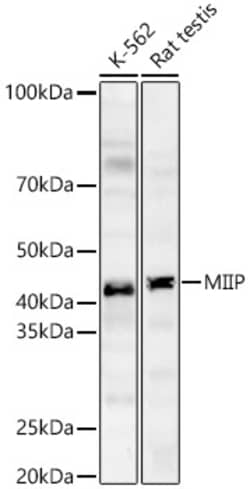
This gene encodes a protein that interacts with the oncogene protein insulin-like growth factor binding protein 2 and may function as an inhibitor of cell migration and invasion. This protein also interacts with the cell division protein 20 and may be involved in regulating mitotic progression. This protein may function as a tumor suppressor by inhibiting the growth or certain cancers.
Non-distribution item offered as a customer accommodation; additional freight charges may apply.
Learn More
ABclonal Technology IBSP Rabbit pAb
Small and Specialty Supplier Partner
Small and/or specialty supplier based on Federal laws and SBA requirements.
Learn More
Small and/or specialty supplier based on Federal laws and SBA requirements.
Learn More
The protein encoded by this gene is a major structural protein of the bone matrix. It constitutes approximately 12% of the noncollagenous proteins in human bone and is synthesized by skeletal-associated cell types, including hypertrophic chondrocytes, osteoblasts, osteocytes, and osteoclasts. The only extraskeletal site of its synthesis is the trophoblast. This protein binds to calcium and hydroxyapatite via its acidic amino acid clusters, and mediates cell attachment through an RGD sequence that recognizes the vitronectin receptor.
Non-distribution item offered as a customer accommodation; additional freight charges may apply.
Learn More
ABclonal Technology CLEC4M Rabbit pAb
Small and Specialty Supplier Partner
Small and/or specialty supplier based on Federal laws and SBA requirements.
Learn More
Small and/or specialty supplier based on Federal laws and SBA requirements.
Learn More
This gene encodes a C-type lectin involved in cell adhesion and pathogen recognition. It recognizes a range of pathogens, including tuberculosis mycobacteria, Ebola, HIV-1, influenza A, West Nile virus, and SARS-CoV. The protein has four domains: a C-terminal carbohydrate recognition domain, a flexible neck domain, a transmembrane region, and an N-terminal cytoplasmic domain for internalization. This gene is related to CD209 (DC-SIGN) but differs in viral recognition and expression. It is highly expressed in endothelial cells of the liver, lymph node, and placenta. Polymorphisms in the neck domain are linked to resistance to SARS infection.
Non-distribution item offered as a customer accommodation; additional freight charges may apply.
Learn More
ABclonal Technology TENM1 Rabbit pAb
Small and Specialty Supplier Partner
Small and/or specialty supplier based on Federal laws and SBA requirements.
Learn More
Small and/or specialty supplier based on Federal laws and SBA requirements.
Learn More
The protein encoded by this gene belongs to the tenascin family and teneurin subfamily. It is expressed in the neurons and may function as a cellular signal transducer. Several alternatively spliced transcript variants encoding different isoforms have been found for this gene.
Non-distribution item offered as a customer accommodation; additional freight charges may apply.
Learn More
ABclonal Technology ASCC1 Rabbit pAb
Small and Specialty Supplier Partner
Small and/or specialty supplier based on Federal laws and SBA requirements.
Learn More
Small and/or specialty supplier based on Federal laws and SBA requirements.
Learn More
This gene encodes a subunit of the activating signal cointegrator 1 (ASC-1) complex. The ASC-1 complex is a transcriptional coactivator that plays an important role in gene transactivation by multiple transcription factors including activating protein 1 (AP-1), nuclear factor kappa-B (NF-kB) and serum response factor (SRF). The encoded protein contains an N-terminal KH-type RNA-binding motif which is required for AP-1 transactivation by the ASC-1 complex. Mutations in this gene are associated with Barrett esophagus and esophageal adenocarcinoma. Alternatively spliced transcripts encoding multiple isoforms have been observed for this gene.
Non-distribution item offered as a customer accommodation; additional freight charges may apply.
Learn More
ABclonal Technology RPL18 Rabbit pAb
Small and Specialty Supplier Partner
Small and/or specialty supplier based on Federal laws and SBA requirements.
Learn More
Small and/or specialty supplier based on Federal laws and SBA requirements.
Learn More
Ribosomes, the organelles that catalyze protein synthesis, consist of a small 40S subunit and a large 60S subunit. Together these subunits are composed of 4 RNA species and approximately 80 structurally distinct proteins. This gene encodes a member of the L18E family of ribosomal proteins that is a component of the 60S subunit. As is typical for genes encoding ribosomal proteins, there are multiple processed pseudogenes of this gene dispersed through the genome. Alternatively spliced transcript variants encoding multiple isoforms have been observed for this gene.
Non-distribution item offered as a customer accommodation; additional freight charges may apply.
Learn More
ABclonal Technology HSCB Rabbit pAb
Small and Specialty Supplier Partner
Small and/or specialty supplier based on Federal laws and SBA requirements.
Learn More
Small and/or specialty supplier based on Federal laws and SBA requirements.
Learn More
This gene encodes a DnaJ-type co-chaperone and member of the heat shock cognate B (HscB) family of proteins. The encoded protein plays a role in the synthesis of iron-sulfur clusters, protein cofactors that are involved in the redox reactions of mitochondrial electron transport and other processes. Cells in which this gene is knocked down exhibit reduced activity of iron-sulfur cluster-dependent enzymes including succinate dehydrogenase and aconitase. The encoded protein may stimulate the ATPase activity of the mitochondrial stress-70 protein. Alternative splicing results in multiple transcript variants.
Non-distribution item offered as a customer accommodation; additional freight charges may apply.
Learn More
ABclonal Technology PLA2R1 Rabbit pAb
Small and Specialty Supplier Partner
Small and/or specialty supplier based on Federal laws and SBA requirements.
Learn More
Small and/or specialty supplier based on Federal laws and SBA requirements.
Learn More
This gene represents a phospholipase A2 receptor. The encoded protein likely exists as both a transmembrane form and a soluble form. The transmembrane receptor may play a role in clearance of phospholipase A2, thereby inhibiting its action. Polymorphisms at this locus have been associated with susceptibility to idiopathic membranous nephropathy. Alternatively spliced transcript variants encoding different isoforms have been identified.
Non-distribution item offered as a customer accommodation; additional freight charges may apply.
Learn More
ABclonal Technology RPRD1B Rabbit pAb
Small and Specialty Supplier Partner
Small and/or specialty supplier based on Federal laws and SBA requirements.
Learn More
Small and/or specialty supplier based on Federal laws and SBA requirements.
Learn More
Enables RNA polymerase II complex binding activity and identical protein binding activity. Involved in positive regulation of cell population proliferation, regulation of cell cycle process, and regulation of transcription by RNA polymerase II. Located in nucleoplasm. Part of RNA polymerase II, holoenzyme.
Non-distribution item offered as a customer accommodation; additional freight charges may apply.
Learn More
ABclonal Technology CSF2RB Rabbit pAb
Small and Specialty Supplier Partner
Small and/or specialty supplier based on Federal laws and SBA requirements.
Learn More
Small and/or specialty supplier based on Federal laws and SBA requirements.
Learn More
The protein encoded by this gene is the common beta chain of the high affinity receptor for IL-3, IL-5 and CSF. Defects in this gene have been reported to be associated with protein alveolar proteinosis (PAP).
Non-distribution item offered as a customer accommodation; additional freight charges may apply.
Learn More
ABclonal Technology GDF15 Rabbit pAb
Small and Specialty Supplier Partner
Small and/or specialty supplier based on Federal laws and SBA requirements.
Learn More
Small and/or specialty supplier based on Federal laws and SBA requirements.
Learn More
This gene encodes a secreted ligand of the TGF-beta (transforming growth factor-beta) superfamily of proteins. Ligands of this family bind various TGF-beta receptors leading to recruitment and activation of SMAD family transcription factors that regulate gene expression. The encoded preproprotein is proteolytically processed to generate each subunit of the disulfide-linked homodimer. The protein is expressed in a broad range of cell types, acts as a pleiotropic cytokine and is involved in the stress response program of cells after cellular injury. Increased protein levels are associated with disease states such as tissue hypoxia, inflammation, acute injury and oxidative stress.
Non-distribution item offered as a customer accommodation; additional freight charges may apply.
Learn More
ABclonal Technology Nitro-Tyrosine Rabbit pAb
Small and Specialty Supplier Partner
Small and/or specialty supplier based on Federal laws and SBA requirements.
Learn More
Small and/or specialty supplier based on Federal laws and SBA requirements.
Learn More
Tyrosine nitration of proteins is one of the most important oxidative post-translational modifications in vivo. A major obstacle for its biochemical and physiological studies is the lack of efficient and chemoselective protein tyrosine nitration reagents.
Non-distribution item offered as a customer accommodation; additional freight charges may apply.
Learn More