
General Cell Lines and Cell Cultures


Amsbio LLC Lyophilized exosomes from Plasma of Healthy donors

Lyophilized exosomes from Plasma of Healthy donors


ACROBiosystems HEK293/Human EpCAM Stable Cell Line
EpCAM is also known as CO171A, EGP, EGP40,GA7332, KSA, M4S, MIC18, MK1, TROP1, hEGP2, and is a pan-epithelial differentiation antigen that is expressed on almost all carcinomas as 17-1A(mAb) antigen. Its constitutional function is being elucidated. It is intricately linked with the Cadherin-Catenin pathway and hence the fundamental WNT pathway responsible for intracellular signaling and polarity. The epithelial cell adhesion molecule (Ep-CAM) is known to express in most epithelial malignancies and was reported as a tumor marker or a candidate of molecular targeting therapy.Ep-CAM cross signaling with N-cadherin involves Pi3K, resulting in the abrogation of the cadherin adhesion complexes in epithelial cells was reported. And Epithelial cell adhesion molecule (Ep-CAM) recently received increased attention as a prognostic factor in breast cancer.

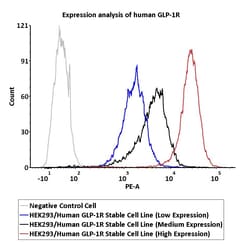
ACROBiosystems HEK293/Human GLP-1R Stable Cell Line (High Expression)
This gene encodes a 7-transmembrane protein that functions as a receptor for glucagon-like peptide 1 (GLP-1) hormone, which stimulates glucose-induced insulin secretion. This receptor, which functions at the cell surface, becomes internalized in response to GLP-1 and GLP-1 analogs, and it plays an important role in the signaling cascades leading to insulin secretion. It also displays neuroprotective effects in animal models. Polymorphisms in this gene are associated with diabetes. The protein is an important drug target for the treatment of type 2 diabetes and stroke.
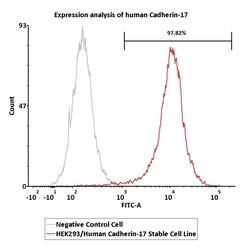
ACROBiosystems HEK293/Human Cadherin-17 Stable Cell Line
Cadherin-17, also known as liver-intestine (LI) Cadherin, belongs to the cadherin family of calcium-dependent cell adhesion molecules. In vivo studies showed CDH17 knockout resulted in apoptotic PC tumor death through activating caspase-3 activity. Taken together, CDH17 functions as an oncogenic molecule critical to PC growth by regulating tumor apoptosis signaling pathways and CDH17 could be targeted to develop an anti-PC therapeutic approach.
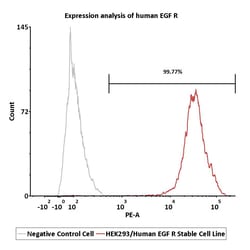
ACROBiosystems HEK293/Human EGF R Stable Cell Line
The epidermal growth factor receptor (EGFR; ErbB-1; HER1 in humans) is the cell-surface receptor for members of the epidermal growth factor family (EGF-family) of extracellular protein ligands. The epidermal growth factor receptor is a member of the ErbB family of receptors, a subfamily of four closely related receptor tyrosine kinases: EGFR (ErbB-1), HER2/c-neu (ErbB-2), Her 3 (ErbB-3) and Her 4 (ErbB-4). Mutations affecting EGFR expression or activity could result in cancer.
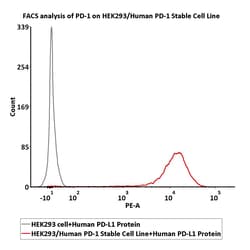
ACROBiosystems HEK293/Human PD-1 Stable Cell Line
Programmed cell death protein 1 (PD-1) is also known as CD279 and PDCD1, is a type I membrane protein and is a member of the extended CD28/CTLA-4 family of T cell regulators. PDCD1 is expressed on the surface of activated T cells, B cells, macrophages, myeloid cells and a subset of thymocytes. PD-1 has two ligands, PD-L1 and PD-L2, which are members of the B7 family. PD-L1 is expressed on almost all murine tumor cell lines, including PA1 myeloma, P815 mastocytoma, and B16 melanoma upon treatment with IFN-γ. PD-L2 expression is more restricted and is expressed mainly by DCs and a few tumor lines. PD1 inhibits the T-cell proliferation and production of related cytokines including IL-1, IL-4, IL-10 and IFN-γ by suppressing the activation and transduction of PI3K/AKT pathway. In addition, coligation of PD1 inhibits BCR-mediating signal by dephosphorylating key signal transducer. In vitro, treatment of anti-CD3 stimulated T cells with PD-L1-Ig results in reduced T cell proliferation and IF

ATCC Gut Microbiome; Whole Cell Mix
NGS Standards are mock microbial communities that mimic mixed metagenomic samples. This product is prepared as an even mixture of whole cells and comprises fully sequenced, characterized, and authenticated bacterial species observed in normal and atypical gut microbial communities. Each order for this product is provided with access to run 10 analyses on One Codex, the leading bioinformatics platform for microbial genomics and metagenomics. Specification Range: 2.4x10⁸ cells/vial ± 1 log* *Whole cell concentrations indicate ATCC manufacturing specifications and are provided as a reference only

ATCC 10 strain mix; whole cell material
NGS Standards are mock microbial communities that mimic mixed metagenomic samples. This product is prepared as a mixture of whole cells and comprises fully sequenced, characterized, and authenticated ATCC Genuine Cultures that were selected based on relevant phenotypic and genotypic attributes, such as Gram stain, GC content, genome size, and spore formation. Each order for this product is provided with access to run 5 analyses on One Codex, the leading bioinformatics platform for microbial genomics and metagenomics. Specification Range: 2x10⁷ cells/vial ± 1 log* *Whole cell concentrations indicate ATCC manufacturing specifications and are provided as a reference only

ATCC Synthetic Hepatitis E; virus RNA
ATCC Genuine Nucleics can be used for assay development, verification, validation, monitoring of day-to-day test variation, and lot-to-lot performance of molecular-based assays. The quantitative format allows for the generation of a standard curve for quantitative PCR (qPCR) to determine viral load. Preparation includes 5’ untranslated region, methyl transferase, Y domain, X domain, helicase, RNA-directed RNA polymerase, and open reading frames 2 and 3 (ORF2 and ORF3).

ATCC Molecular Grade Water 1L
Molecular grade water is DNase, RNase, and Protease free and can be used in all molecular biology procedures that require water, including PCR.

ATCC Purified; Human respiratory; syncytial virus; Strain: 18537
Human respiratory syncytial virus strain 18537 is a high-titer preparation that is propagated in HEp-2 cells (ATCC CCL-23). This strain was isolated in 1962 from the respiratory secretions of a child with acute respiratory disease seen at Children’s Hospital in Washington, DC, and was deposited by the National Institute of Allergy and Infectious Diseases (NIAID). It has applications in virucide testing, respiratory research, assay development and vaccine development.

ATCC Rodent protoparvovirus 1; Strain: prototype (p)
Rodent protoparvovirus 1 strain Prototype (p) is propagated in A9 cells (ATCC CCL-1.4). This strain was plaque-purified from Minute virus of mice strain Crawford and deposited by Yale University School of Medicine.

ATCC Quantitative Genomic; DNA from; Mycoplasma hominis; Strain: PG21
Quantitative genomic DNA from Mycoplasma hominis strain PG21 (ATCC 23114). This whole-genome sequenced product can be used for assay development, verification, and validation as well as monitoring of day-to-day test variation and lot-to-lot performance of molecular-based assays. The quantitative format allows the generation of a standard curve for quantitative PCR (qPCR) to determine bacterial load.