
Donkey Secondary Antibodies

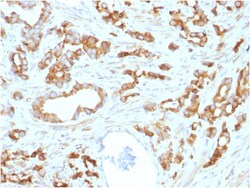
Biotium Aurora B (Proliferation Marker) (AURKB/1593), CF647 conjugate, 0.1mg/mL
This antibody recognizes a protein of 39 kDa, which is identified as Aurora kinase B (or Aurora B). Aurora B is a serine/threonine protein kinase and component of the chromosomal passenger complex (CPC), a complex that acts as a key regulator of mitosis. It is important for accurate chromosome segregation, cytokinesis, protein localization to the centromere and kinetochore, correct microtubule-kinetochore attachment, and regulation of the mitotic checkpoint. Aurora B forms a tight complex with inner centrosome protein and survivin. Inactivation of any of these proteins causes similar defects in chromosome segregation. A significant overexpression of Aurora B has been found in a variety of human tumors including non-small cell lung carcinoma, astrocytoma, seminoma and carcinomas of the colon, prostate, endometrium and thyroid. The expression level of Aurora B is associated with cell proliferation and prognosis in these tumors.Primary antibodies are available purified, or with


Biotium NKX2.8(NKX28/3233R), CF647 conjugate, 0.1mg/mL
The protein encoded by this gene is a homeobox-containing developmental regulator associated with liver development. The encoded protein binds to the alpha-fetoprotein (AFP) gene promoter and increases the expression of AFP. This gene is overexpressed in some lung cancers and is linked to poor patient survival, possibly due to its resistance to cisplatin. This gene is aberrantly methylated in pancreatic cancer, deleted in squamous cell lung carcinomas, and acts as a tumor suppressor in esophageal cancer. Mutations in this gene may also be a cause of neural tube defects. Primary antibodies are available purified, or with a selection of fluorescent CF Dyes and other labels. CF Dyes offer exceptional brightness and photostability. Note: Conjugates of blue fluorescent dyes like CF405S and CF405M are not recommended for detecting low abundance targets, because blue dyes have lower fluorescence and can give higher non-specific background than other dye colors.
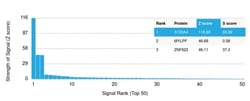
Biotium S100A4 / Metastasin / Calvasculin (Marker of Tumor Metastasis)(CPTC-S100A4-3), CF647 conjugate, 0.1mg/mL
S100A4 belongs to the S100 super-family of proteins containing 2 EF-hand calcium-binding domains. S100A4 has been implicated in the progression and prognosis of several forms of human cancer, e. g. breast, colorectal, gastric, pancreatic and bladder cancer, SCLC and oesophageal squamous cell carcinoma, among others. Poor prognosis associated with high S100A4 expression is accompanied by clear signs of disease progression, e. g. high histological and clinical grades and involvement of lymph nodes. Also indicative of poor prognosis is high S100A4 expression coupled with reduced E-cadherin expression in pancreatic, oral squamous cell carcinoma and in melanoma. S100A4 expression is inversely related with expression of metastasis suppressor nm23 and with prognosis of breast cancer. S100A4 is overexpressed in highly metastatic cancers, which makes it useful as a marker of tumor progression. Primary antibodies are available purified, or with a selection of fluorescent CF Dyes and other

Biotium CDX2 (GI Epithelial Marker) (CDX2/2951R), CF647 conjugate, 0.1mg/mL
The intestine-specific transcription factors CDX1 and CDX2 are important for directing intestinal development, differentiation, proliferation and maintenance of the intestinal phenotype. CDX2 protein expression has been seen in GI carcinomas. Anti-CDX2 has been useful to establish GI origin of metastatic adenocarcinomas and carcinoids and is especially useful to distinguish metastatic colorectal adenocarcinoma from lung adenocarcinoma. However, mucinous carcinomas of the ovary also express CDX2 protein. It limits the usefulness of this marker in the distinction of metastatic colorectal adenocarcinoma from mucinous carcinoma of the ovary.Primary antibodies are available purified, or with a selection of fluorescent CF Dyes and other labels. CF Dyes offer exceptional brightness and photostability. Note: Conjugates of blue fluorescent dyes like CF405S and CF405M are not recommended for detecting low abundance targets, because blue dyes have lower fluorescence and can give higher
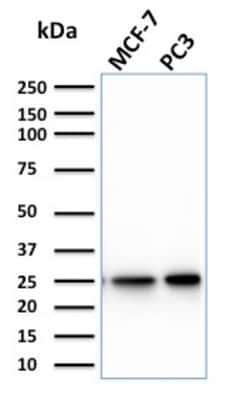
Biotium Calcineurin B homologous protein 2 / HCC Antigen 520(CPTC-CHP2-1), CF647 conjugate, 0.1mg/mL
Calcineurin B homologous protein 2, also known as hepatocellular carcinoma-associated antigen 520, is a 196 amino acid protein that contains 4 EF-hand domains and plays a potential role in transmembrane Na/H exchange. By binding to and activating NHE-1, CHP2 increases the pH and works to protect cells from serum deprivation-induced death. Though not typically detected in normal tissues, CHP2 is highly expressed in malignantly transformed cells and is therefore considered to be a tumor-associated antigen. Ectopic expression of CHP2 promotes proliferation of HEK293 cells and knockdown of CHP2 mRNA in HepG2 cells inhibits cell proliferation. Like calcineurin B, CHP2 can bind to and stimulate phosphatase activity of calcineurin A and activate the calcineurin/NFAT signaling pathway. Primary antibodies are available purified, or with a selection of fluorescent CF Dyes and other labels. CF Dyes offer exceptional brightness and photostability. Note: Conjugates of blue fluorescent dyes
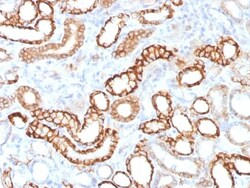
Biotium Ksp-Cadherin (Kidney-Specific Cadherin) / CDH16 (CDH16/1532R), CF647 conjugate, 0.1mg/mL
This MAb recognizes a protein of 130 kDa, identified as Ksp-cadherin. Cadherins form a superfamily of related glycoproteins that mediate calcium-dependent cell adhesion and transmit signals from the extracellular matrix to the cytoplasm. Cadherins have been implicated in embryogenesis, tissue morphogenesis, tissue structure maintenance, cell polarization, neoplastic invasiveness and metastasis, and membrane transport. It is suggested that Ksp-cadherin is a marker for terminal differentiation of the basolateral membranes of renal tubular epithelial cells. Within the kidney, Ksp-Cadherin is found exclusively in the basolateral membrane of renal tubular epithelial cells and collecting duct cells, and not in glomeruli, renal interstitial cells, or blood vessels. Ksp-Cadherin has been suggested to distinguish Chromophobe Renal-Cell Carcinoma from Oncocytoma.Primary antibodies are available purified, or with a selection of fluorescent CF Dyes and other labels. CF Dyes offer excep
Jackson Immuno Research Labs Cy3-AffiniPure Fab Fragment Donkey Anti-Mouse IgG (H+L)
Cy3-AffiniPure Fab Fragment Donkey Anti-Mouse IgG (H+L)
Biotium Cytokeratin 20 (KRT20) (Colorectal Epithelial Marker)(KRT20/1993), CF647 conjugate, 0.1mg/mL
This MAb recognizes an intermediate filament protein of 46 kDa, identified as cytokeratin 20 (KRT20). KRT is abundantly expressed in goblet cells and enterocytes of the gastrointestinal tract. It is a useful marker of pancreatic and colorectal cancer. KRT20 is expressed under normal, hyperplastic and neoplastic conditions. It has been detected in adenocarcinomas of the colon, stomachand biliary tract. Breast carcinomas are generally non-reactive. Primary antibodies are available purified, or with a selection of fluorescent CF Dyes and other labels. CF Dyes offer exceptional brightness and photostability. Note: Conjugates of blue fluorescent dyes like CF405S and CF405M are not recommended for detecting low abundance targets, because blue dyes have lower fluorescence and can give higher non-specific background than other dye colors.
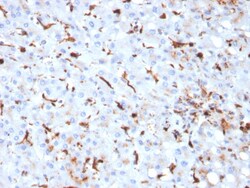
Biotium Cathepsin K (Marker of Tumor Invasiveness)(CTSK/2793), CF647 conjugate, 0.1mg/mL
Cathepsin K is a lysosomal and secreted cysteine proteinase involved in bone remodeling and resorption. This protein, which is a member of the peptidase C1 protein family, is predominantly expressed in osteoclasts. However, the encoded protein is also expressed in a significant fraction of human breast cancers, where it could contribute to tumor invasiveness. Mutations in this gene are the cause of pycnodysostosis, an autosomal recessive disease characterized by osteosclerosis and short stature. Primary antibodies are available purified, or with a selection of fluorescent CF Dyes and other labels. CF Dyes offer exceptional brightness and photostability. Note: Conjugates of blue fluorescent dyes like CF405S and CF405M are not recommended for detecting low abundance targets, because blue dyes have lower fluorescence and can give higher non-specific background than other dye colors.