100 Years of Science Fiction: How One Magazine Helped Launch a World of Imagination
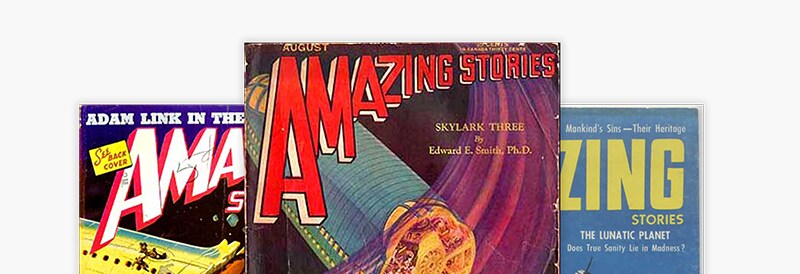
This year marks the 100th anniversary of Amazing Stories, the first magazine devoted entirely to science fiction. When its first issue was printed in 1926, publisher Hugo Gernsback introduced readers to what he called "scientifiction:" stories that blended scientific ideas with adventurous storytelling.
Gernsback hoped these stories would entertain readers while inspiring them to imagine a future shaped by scientific discovery and technological advancement, according to the NPR article by Chris Klimek, "Before sci-fi was everywhere, this pioneering magazine championed 'scientifiction.'" Today, Gernsback's influence is still recognized through the prestigious Hugo Awards, the annual honors presented for outstanding science fiction and fantasy writing and named in his memory.
Although the word "scientifiction" never caught on, in 1929, Gernsback coined the phrase “science fiction,” which did. The terms “sci-fi” and “SF” (or "sf") came along later. “Sci-fi” is credited to editor and writer Forrest J Ackerman, according to his 2008 obituary in The Washington Post. However, in 1993, Australian critic Peter Nicholls declared that "SF" was the preferred term of writers and readers of the genre in his The Encyclopedia of Science Fiction article “SF.”
Dreaming About Tomorrow
Long before spaceships and robots became common in books and movies, writers such as Jules Verne, H.G. Wells, and Edgar Allan Poe imagined extraordinary inventions and faraway worlds. Amazing Stories brought these writers together with 20th century authors in one publication, making it easier for readers to discover tales about science, technology, and the future. Thus, the magazine became the first dedicated incubator for a new genre, according to the Amazing Stories entry in The Encyclopedia of Science Fiction.
Many of today's biggest science fiction themes—time travel, space exploration, artificial intelligence, and life on other planets—grew from ideas explored in those early stories.
Building a Community
The magazine did more than publish science fiction. Readers who wrote letters to one another through the magazine helped form some of the world's first organized fan fiction communities, which still exist today. Those friendships eventually grew beyond correspondence, and evolved into fan and writer clubs, conventions, and collaborations, which helped launch many successful careers.
Science fiction legends Isaac Asimov and Ursula K. Le Guin had their first works published in Amazing Stories, according to Climek.
Why Science Fiction Still Matters
Today, science fiction-themed content appears in books, movies, television shows, and video games. While many stories are exciting adventures, they also encourage readers to ask important questions: How should we use new technology? What might life be like on other planets? How can imagination help solve real-world problems?
One hundred years after Amazing Stories debuted, science fiction continues to remind us that today's dreams can become tomorrow's discoveries.
Written with the help of generative AI.