A Second Life for Plastic Foam
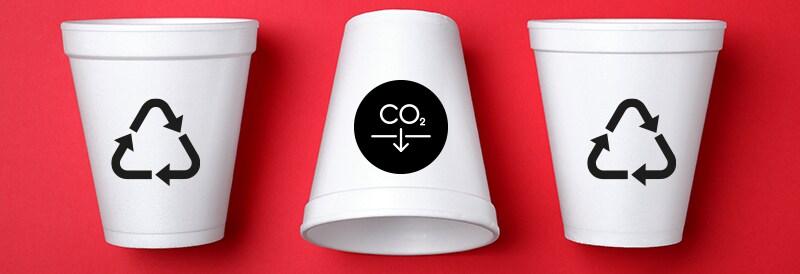
Foam cups, takeout containers, plastic forks, and even old CD cases all have something in common. They're often made from polystyrene, a lightweight, inexpensive plastic that's notoriously difficult to recycle.
According to Sustainable Business Magazine, polystyrene can take hundreds of years to break down. Even then, it doesn't truly biodegrade. Instead, it breaks into smaller and smaller pieces that remain in the environment.
Many communities and businesses are moving away from polystyrene products. However, these products are still common and keep piling up in landfills. Now, scientists think some of that discarded plastic could someday become part of the solution instead of part of the problem.
In a recent study, researchers from Aarhus University in Denmark successfully turned polystyrene waste into a reusable material that captures carbon dioxide (CO₂). The team’s findings were published in Chem Circularity. Although the research is still in its early stages, the results could one day give difficult-to-recycle plastic a valuable second life.
How Plastic Becomes a Carbon Catcher
Instead of melting old plastic into new products, the researchers changed its chemistry.
They attached molecules called amines to the polystyrene. Amines naturally bond with carbon dioxide, and some link together to form tiny pores throughout the material. Those pores create more surface area, giving carbon dioxide more places to stick.
The finished material acts like a sponge. As air or factory exhaust passes through it, it captures carbon dioxide while allowing most other gases to continue flowing.
When the material fills up, heating it releases the trapped carbon dioxide so it can be used again. In laboratory tests, it continued to work through 48 capture-and-release cycles.
From Trash to Technology
To test their process, the researchers used real-world plastics. They transformed expanded foam packaging, food containers, a CD case, a disposable cup, a fork, and a LEGO™* base plate into materials that capture carbon dioxide.
The team also made some of the amines from discarded polyurethane foam, such as old mattress foam. That version captured carbon dioxide too, although it wasn't as effective.
Much more work is needed before the technology can be used on a large scale. Researchers still need to improve its durability, lower production costs, and make manufacturing more practical.
Even so, the study suggests an interesting possibility. Scientists might one day be able to convert hard-to-recycle plastics into materials that help remove greenhouse gases from the air. This could help us see these plastics not just as trash, but as a sustainability solution in the making.
*LEGO is a registered trademark owned by LEGO HOLDING A/S.
Sierra McConnell is a Thermo Fisher Scientific staff writer.
Discussion Questions
- Why is polystyrene so difficult to recycle compared with other types of plastic?
- If you were designing the next step in this research, what question would you try to answer first, and why?
- What challenges do you think scientists might face when trying to produce this material on a large scale?