How Tiny Red Dots Led to Big Questions About Black Holes
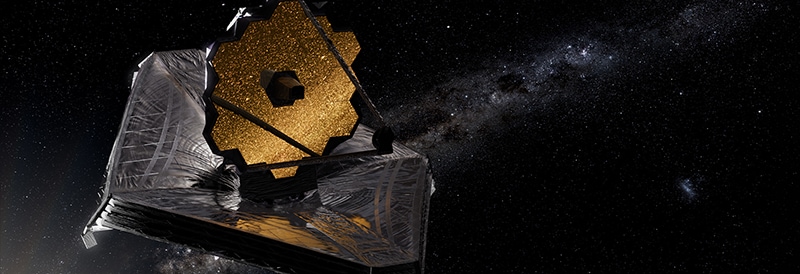
The James Webb Space Telescope (JWST) has given scientists some of the most detailed images of outer space possible while helping to answer some of the biggest galactic mysteries—and uncovering new ones. For example, one of astronomy’s biggest current mysteries began as a handful of tiny red dots.
The Case of the Little Red Dots
Soon after JWST began observing the distant universe, researchers noticed something unusual. Scattered throughout its images were tiny reddish objects that became known as “the little red dots.” They looked like this because they were so far away.
Since their light has traveled for more than 13 billion years to reach Earth, scientists are seeing them as they appeared not long after the Big Bang.
Some researchers thought the dots were compact galaxies packed with stars. Others suspected they were galaxies hidden behind thick clouds of dust. Another possibility was even stranger: They could be rapidly growing supermassive black holes.
The Red Dots Revealed
JWST observations have provided the strongest evidence yet that at least some of these mysterious objects could be enormous black holes surrounded by thick blankets of hot gas.
According to a team of astronomers at the University of Texas at Austin, one of these red dots, called GLIMPSE-17775, appears to be feeding on nearby material while a dense cocoon of gas blocks much of its bright light, making it appear as just a tiny red dot.
The discovery helps explain how giant black holes grew so quickly in the early universe. But scientists still don't know what lies beyond a black hole's event horizon—or what exists at its center.
Inside a Black Hole
When a massive star runs out of fuel, gravity causes it to collapse into a black hole, which is surrounded by an invisible boundary called the event horizon. Once anything crosses that, not even light can escape.
Scientists think the collapsed material is compressed into an unimaginably tiny point called a singularity, but because the laws of physics break down there, no one knows exactly what happens inside.
A Tiny Universe Inside a Star
But what if there isn't a singularity at all?
One new theoretical study inspired by recent JWST observations has researchers theorizing that as a massive star collapses, it could create a tiny new universe inside itself.
According to physicists at Goethe University, the tiny universe would begin expanding immediately according to the American Physical Society article "Formation of gravastars." That outward push could become strong enough to stop the star from collapsing completely and becoming a gravitational vacuum star (or gravastar for short).
A gravastar would still be extremely dense and have many properties like a black hole, but its interior would have an unusual core filled with a form of energy that pushes outward.
Scientists have not yet discovered any gravastars, and many researchers think that singularities are the correct explanation. For now, the idea remains a mathematical model that scientists can continue to test against future JWST observations.
More Answers. More Questions.
The James Webb Space Telescope is helping scientists answer long-standing questions about black holes while raising new ones. From mysterious little red dots to bold new theories about what lies inside these cosmic giants, every discovery is revealing that the universe is more surprising than anyone expected.
Sierra McConnell is a Thermo Fisher Scientific staff writer.
Discussion Questions
- Why were the "little red dots" so difficult for astronomers to identify, and what evidence convinced scientists that some of them are hidden black holes?
- Why do scientists continue to explore ideas like gravastars even though there is no direct evidence that they exist?
- How does the James Webb Space Telescope show that answering one scientific question can often lead to even bigger questions?