Under the Sea: Whale Graveyards and Deep-Ocean Ecosystems
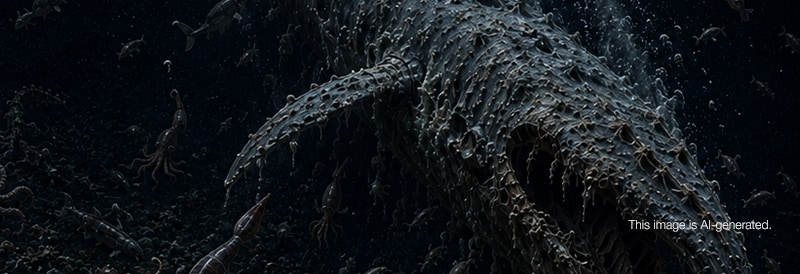
Scientists exploring one of the ocean's darkest regions, the Diamantina Zone in the southeastern Indian Ocean, have made an extraordinary discovery. Researchers piloting the submersible Fendouzhe found the deepest and one of the oldest whale graveyards ever encountered. Even more remarkably, the site continues to support living communities of deep-sea organisms while preserving fossils more than 5 million years old.
Diving to a depth of 11,000 meters (6.8 miles), scientists mapped a 1,200-kilometer (746-mile) stretch of the ocean floor. They also documented five active whale falls—the remains of relatively recent whale carcasses—as well as 476 fossil whale skeletons, making this the largest known collection of whale remains on the deep seafloor, according to Xiaotong Peng, an author of “A 5.3-million-year-old deep-sea whale necropolis in the Diamantina Zone,” published in Nature.
How a Whale Fall Forms
When a whale dies, their body usually fills with gas from decomposition. The bloated carcass floats to the surface, where it is picked over by other animals. Some whale bodies wash ashore, but many more eventually sink to the seabed. This is known as a whale fall. Many known whale falls occur at varying depths, with the deepest recorded to date being 4,204 meters (2.6 miles) in the Atlantic Ocean.
When a whale carcass settles on the ocean floor, its body becomes the foundation of an entire ecosystem. Scavengers first feed on the soft tissues. Later, bacteria begin breaking down the bones, releasing chemicals that support other organisms. The crushing pressure and extreme darkness make this one of Earth's most challenging environments for life, yet a host of creatures can survive on a whale fall for decades.
Why This Whale Graveyard Is Different
Scientists have discovered whale falls before, but this one stands apart for several reasons.
First, it is the deepest known whale-fall community ever documented. Some whale remains were found at depths of about 7,000 meters (4.3 miles), far deeper than any previously studied whale-fall ecosystem. The five active whale falls were covered with microbial mats and bone-boring worms, Osedax, as well as brittle stars, chemosynthetic clams, and snails. Most of the recovered creatures may be new to science.
Second, researchers found evidence of both beaked whales and baleen whales. Beaked whales are toothed whales and deep-diving hunters, so they are rarely seen near the ocean surface, and little is known about their habits. Their skulls taper into slender snouts, resembling those of a dolphin. Most of the fossils belonged to beaked whales, and scientists think that because these whales already spend much of their lives in deep water, they may have been more likely to sink into the Diamantina Zone after death.
The researchers also identified fossils and modern remains from baleen whales, including an Antarctic minke whale. Baleen whales are filter feeders that strain tiny animals such as krill from seawater using comb-like plates instead of teeth.
Finding both major whale groups together provides scientists with a much more complete picture of ancient whale life and evolution.
A Window into the Ocean’s Past
Perhaps the most surprising discovery was the age of the fossils.
Using isotopic dating, scientists determined that whale remains in the area date back at least 5.3 million years, to the Early Pliocene Epoch. That means whale falls have been occurring in this region for millions of years. Instead of representing a single event, the graveyard records countless whale deaths across geological time.
Researchers believe the unique shape of the Diamantina Zone may have helped funnel whale carcasses into the area over millions of years. The deep seafloor also has very little sediment, allowing bones to remain exposed long enough for minerals to preserve many of them as fossils. These conditions have created an extraordinary natural archive of whale evolution.
More Questions Below the Surface
The uncovering of this paleontological treasure raises many new questions. Why did so many whales end up in this one region? How many new deep-sea species are living on these ancient skeletons? Are there other whale falls at similar depths that remain to be found?
Every expedition to the deep ocean reminds scientists how little we know about Earth's largest habitat. The Diamantina whale graveyard is not only a remarkable fossil site—it is also a living laboratory where biology, geology, and paleontology come together. By studying both modern whale falls and ancient fossils, researchers hope to better understand how life survives in some of the planet's most extreme environments and how whales have changed over millions of years.
Written with the help of generative AI.
Discussion Questions
- Why are whale falls considered important ecosystems in the deep ocean?
- Why is finding both beaked whales and baleen whales significant to scientists?
- How can fossils that are more than 5 million years old help researchers understand Earth's history?