That’s No Moon: Discover Earth’s Occasional Satellites
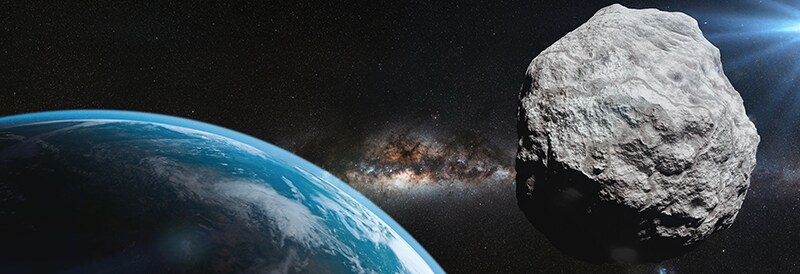
Most planets in our solar system with satellites have several, but the Earth only has one Moon. However, it turns out our lone moon sometimes isn’t so alone. Every now and again, other space objects join the moon in orbit near or around the Earth. The way those objects orbit determines whether they are mini-moons or quasi-moons.
Last year, the mini-moon 2024 PT5 left Earth’s orbit after two months. This tiny asteroid was about 33 feet long. Astronomers suggest it came from the Arjuna asteroid belt, which orbits the Sun on a path similar to the Earth’s. This year, we can enjoy the company of 2025 PN7, a quasi-moon that potentially will be with us for the next 60 years.
Where Do They Come From?
A mini-moon is an object that comes close enough to Earth to be affected by its gravitational pull and may end up temporarily orbiting Earth. Scientists theorize that some recent mini-moons are artifacts that have broken off from the Moon, while others originate in the Arjuna asteroid belt. Asteroids from the belt usually make a horseshoe-shaped orbit near the Earth.
A quasi-moon is a space object, usually a small asteroid, that orbits the sun in a similar path to the Earth and its Moon. The Earth’s gravity does not capture these objects, and they are likely to wander off into their own orbital path eventually.
These objects are usually too small to see with the naked eye or with small telescopes. They are discovered by astronomers using larger telescopes and processing data about what they can view in the night sky in real-time. Professional and amateur astronomers often scan the night sky for asteroids, comets, and other celestial objects that approach the Earth. For example, 2024 PT5 was discovered by the Asteroid Terrestrial-impact Last Alert System (ATLAS), an ongoing NASA-funded project aimed at detecting asteroids that may pose a threat to Earth.
Where Do They Go?
Even though a mini-moon may complete an orbit around the Earth, it will probably be pulled away by the Sun’s gravitational field, which is stronger. Since quasi-moons are not part of Earth’s gravitational field, they disappear from view as the Earth moves through space.
Astronomers estimate the Earth has had seven quasi-moons and five mini-moons since they’ve been able to track these small, faint celestial bodies, as reported in Sky&Telescope, “Meet 2025 PN7, Earth’s New Quasi-Moon.” So when you notice the man in the moon, rest assured that he may not be as lonely as he looks.
Discussion Questions
- How do scientists find mini- and quasi-moons?
- Why do you think it’s important for astronomers to look for these celestial objects?