
Alkyl Halides



Medchemexpress LLC Perfluoropentanoic acid | 2706-90-3 | 98.0% | 264.05 | 25 G

Perfluoropentanoic acid (PFPeA) is a short-chain perfluorinated compound that serves as an important indicator of perfluorinated compound pollution in ecosystems. It has been observed to affect planktonic microbial communities and show certain toxicity in mice studies.
- Indicator of perfluorinated compound pollution
- Impacts planktonic microbial communities
- Can threaten water quality via microbial metabolism
- In vivo studies suggest potential for liver damage and skin inflammation


Cambridge Isotope Laboratories 2H 2H 3H 3H-Perfluorodecanoic acid (7 3 FTCA) (unlabeled) (mix of isomers) 100 ug/mL in methanol 1 2 mL
2H 2H 3H 3H-Perfluorodecanoic acid (7 3 FTCA) (unlabeled) (mix of isomers) 100 ug/mL in methanol 1 2 mL


Medchemexpress LLC Perfluoropentanoic acid | 2706-90-3 | 98.0% | 264.05 | 1 G
Perfluoropentanoic acid (PFPeA) is a short-chain perfluorinated compound used as an important indicator of perfluorinated compound pollution in ecosystems. It exhibits certain toxicity to mice and is intended for research use only.
- Short-chain perfluorinated compound.
- Indicator of perfluorinated compound pollution.
- Exhibits toxicity to mice, affecting liver, skin, and immune cells.
- Can impact planktonic microbial communities and water quality.
- Increases serum and urine concentrations after topical application.
- Alters gene expression related to lipid metabolism and inflammation.

Medchemexpress LLC Perfluoropentanoic acid | 2706-90-3 | 98.0% | 264.05 | 10 G
Perfluoropentanoic acid (PFPeA) is a short-chain perfluorinated compound used as an indicator of perfluorinated compound pollution in ecosystems. It has shown certain toxicity in mice and can impact planktonic microbial communities. This product is for research use only.
- Serves as an indicator of perfluorinated compound pollution
- Exhibits toxicity to mice
- Affects planktonic microbial communities
- Available with downloadable data sheet, COA, and SDS

Matrix Scientific N-PERFLUOROPENTANOIC ACID-5G
n-Perfluoropentanoic acid, 97%-5g,C5HF9O2, MFCD00040211, mw 264.05,
SPEX CERTIPREP LLC 3P n-Perfluorododecanoic acid; 50 µg/mL in MeOH with 4 mole eq. NaOH; 1 mL
n-Perfluorododecanoic acid; 50 µg/mL in MeOH with 4 mole eq. NaOH; 1 mL
SPEX CERTIPREP LLC 3P 2H,2H,3H,3H-Perfluorohexanoic acid; 50 µg/mL in MeOH with 4 mole eq. NaOH; 1 mL
2H,2H,3H,3H-Perfluorohexanoic acid; 50 µg/mL in MeOH with 4 mole eq. NaOH; 1 mL
SPEX CERTIPREP LLC 3P 2H,2H,3H,3H-Perfluorodecanoic acid; 50 µg/mL in MeOH with 4 mole eq. NaOH; 1 mL
2H,2H,3H,3H-Perfluorodecanoic acid; 50 µg/mL in MeOH with 4 mole eq. NaOH; 1 mL
SPEX CERTIPREP LLC 3P 2H,2H,3H,3H-Perfluorooctanoic acid; 50 µg/mL in MeOH with 4 mole eq. NaOH; 1 mL
2H,2H,3H,3H-Perfluorooctanoic acid; 50 µg/mL in MeOH with 4 mole eq. NaOH; 1 mL
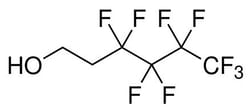
Strem, An Ascensus Company CAS# 2043-47-2. 10g. 1H,1H,2H,2H-Perfluorohexan-1-ol, 99%. MFCD00039543
CAS# 2043-47-2. 10g. 1H,1H,2H,2H-Perfluorohexan-1-ol, 99%. MFCD00039543. Molecular Weight: 264.09. Molecular Formula: F(CF2)4CH2CH2OH. Color/form: colorless liq. Strem# 09-6085. http://www.strem.com/catalog/v/09-6085/

Matrix Scientific 1H,1H,2H,2H-PERFLUORO-1-DE-25G
1H,1H,2H,2H-Perfluoro-1-decanol, 97%; 25g,C10H5F17O, MFCD00039544, mw 464.12, [678-39-7]
Cayman Chemical 2H 2H 3H 3H-Perfluorooctanoic
A polyfluoroalkyl substance; has been found as a contaminant in wastewater
![Medchemexpress LLC 4H-indol-4-one, 1-[2-[4-(3-chlorophenyl)-1-piperazinyl]ethyl]-1,5,6,7-tetrahydro- | 496921-73-4 | 99.2% | 357.88 g/mol | C20H24ClN3O | 1 ML](https://assets.fishersci.com/TFS-Assets/CCG/product-images/5000248305.png-250.jpg)
Medchemexpress LLC 4H-indol-4-one, 1-[2-[4-(3-chlorophenyl)-1-piperazinyl]ethyl]-1,5,6,7-tetrahydro- | 496921-73-4 | 99.2% | 357.88 g/mol | C20H24ClN3O | 1 ML
NEO 376 is a research-grade small molecule reported as a selective modulator of 5-HT1, GABA, and dopamine receptors with documented antipsychotic activity. It is offered as a solid and as a ready-to-use 10 mM solution in DMSO for in vitro research; handle and store according to supplied safety and handling documents.
- Selective modulator of 5-HT1, GABA, and dopamine receptors.
- Provided as 10 mM solution in DMSO and as solid formats (typical milligram packs).
- High purity (~99.2%).
- Molecular weight 357.88 g/mol; formula C20H24ClN3O.
- Storage: powder -20°C (long term); in solvent -80°C for extended storage.
- Intended for research use only; not for human or clinical use.

Medchemexpress LLC Perfluoropentanoic acid | 2706-90-3 | 98.0% | 264.05 | 5 G
Perfluoropentanoic acid (PFPeA), a short-chain perfluorinated compound, serves as an important indicator of perfluorinated compound pollution in ecosystems. It exhibits certain toxicity to mice and can significantly affect the structure and spatial distribution of planktonic microbial communities, potentially threatening water quality through microbial metabolism.
- Target: Biochemical assay reagents; PPAR; interleukin related; S100 protein
- Pathway: Others; cell cycle/DNA damage; metabolic enzyme/protease; vitamin D related/nuclear receptor; immunology/inflammation