
Vanillic Acid

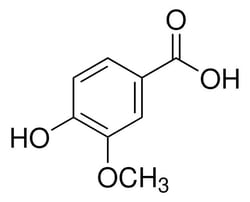
Sigma Aldrich Vanillic acid
MilliporeSigma Sigma Organics products encompass a wide range of quality reagents, solvents, catalysts, and building blocks for organic synthesis. From benchtop discovery to process development and scale-up, Sigma Organics solutions are built to meet the needs of synthetic chemists.


Sigma Aldrich Vanillic acid
MilliporeSigma Sigma Organics products encompass a wide range of quality reagents, solvents, catalysts, and building blocks for organic synthesis. From benchtop discovery to process development and scale-up, Sigma Organics solutions are built to meet the needs of synthetic chemists.

Medchemexpress LLC Homovanillic acid | 306-08-1 | 182.17 | 1 G

Homovanillic acid (Vanilacetic acid) is a dopamine metabolite found to be associated with aromatic L-amino acid decarboxylase deficiency, celiac disease, growth hormone deficiency, and sepiapterin reductase deficiency. This compound offers valuable insights for various research applications.
- Increases presynaptic membrane protein SYN1 in HT22 and rat hippocampal neurons.
- Protects synaptic structure.
- Inhibits the degradation of autophagy marker proteins LC3 and SQSTM1/p62.
- Reduces the formation of autophagosomes.
- Exhibits antidepressant activities in mouse Corticosterone-induced depression models.
- Exhibits neuroprotective activities in mouse Corticosterone-induced depression models.

Medchemexpress LLC Homovanillic acid | 306-08-1 | 182.17 | 25 MG
Homovanillic acid (Vanilacetic acid) is a dopamine metabolite that has been associated with aromatic L-amino acid decarboxylase deficiency, celiac disease, growth hormone deficiency, and sepiapterin reductase deficiency. This product is classified under Monophenols, Ketones, Aldehydes, Acids, and Phenols, acting as both an endogenous metabolite and a drug metabolite.
- Relevant to disease markers and various research fields including metabolic disease, nervous system disorder, immune system disorder, and endocrine diseases.
- Increases presynaptic membrane protein SYN1 in HT22 and rat hippocampal neurons, protecting synaptic structure.
- Inhibits the degradation of autophagy marker proteins LC3 and SQSTM1/p62, reducing autophagosome formation.
Medchemexpress LLC Homovanillic acid (vanilacetic acid) | 306-08-1 | MFCD00004350 | 182.17 | 1 ML
Homovanillic acid (Vanilacetic acid) is a dopamine metabolite that has been linked to aromatic L-amino acid decarboxylase deficiency, celiac disease, growth hormone deficiency, and sepiapterin reductase deficiency. It is intended for research use only.
- Increases presynaptic membrane protein SYN1 in HT22 and rat hippocampal neurons, protecting synaptic structure at concentrations of 1-40 μM.
- Inhibits the degradation of autophagy marker proteins LC3 and SQSTM1/p62, and reduces the formation of autophagosomes at concentrations of 1-40 μM.
- Exhibits antidepressant and neuroprotective activities in mouse Corticosterone-induced depression models at doses of 100-300 mg/kg (po, twice a week for 5 weeks).

Medchemexpress LLC Homovanillic acid | 306-08-1 | 182.17 | 250 MG
Homovanillic acid (Vanilacetic acid) is a dopamine metabolite that has been associated with several conditions, including aromatic L-amino acid decarboxylase deficiency, celiac disease, growth hormone deficiency, and sepiapterin reductase deficiency. It is intended for research use only and exhibits both antidepressant and neuroprotective activities.
- Increases presynaptic membrane protein SYN1 in HT22 and rat hippocampal neurons, protecting synaptic structure.
- Inhibits the degradation of autophagy marker proteins LC3 and SQSTM1/p62.
- Reduces the formation of autophagosomes.
- Exhibits antidepressant activities in mouse Corticosterone-induced depression models.
- Exhibits neuroprotective activities in mouse Corticosterone-induced depression models.
- Functions as an endogenous metabolite.
- Serves as a disease marker for endocrine diseases, nervous system disorders, and immune system disorders.