
Universal Pipette Tips
Disposable pipette tips designed to fit single and multichannel pipettes from most manufacturers; offer acceptable performance compared to pipette specific tips and can be used with a variety of pipette models.
Single-use universal pipette tips are designed for compatibility with most mechanical and electronic single and multichannel pipettors.
Universal pipette tips are available in a range of types, sizes, colors, styles, and packaging configurations and may be designed for specific purposes or tasks.
- Capacity or volume based on the pipettor size
- Filters to reduce contamination and cross-contamination
- Color
- Sterility or autoclavability
- Tip style: beveled, tapered, wide bore, round, flat, or gel-loading
- Length: short or extended
- Purity: metal-free or DNase-, RNase-, ATP-, Bioburden-, PCR inhibitor-, endotoxin-, or pyrogen-free for genomic and biologic applications
- Surface treatments to reduce retention
- Packaging options to help facilitate re-stocking or eliminate waste


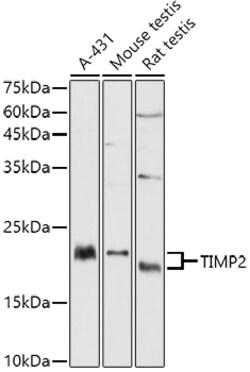
ABclonal Technology TIMP2 Rabbit pAb

This gene is a member of the TIMP gene family. The proteins encoded by this gene family are natural inhibitors of the matrix metalloproteinases, a group of peptidases involved in degradation of the extracellular matrix. In addition to an inhibitory role against metalloproteinases, the encoded protein has a unique role among TIMP family members in its ability to directly suppress the proliferation of endothelial cells. As a result, the encoded protein may be critical to the maintenance of tissue homeostasis by suppressing the proliferation of quiescent tissues in response to angiogenic factors, and by inhibiting protease activity in tissues undergoing remodelling of the extracellular matrix.

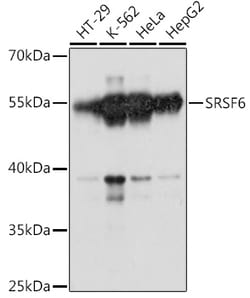
ABclonal Technology SRSF6 Rabbit pAb
The protein encoded by this gene is involved in mRNA splicing and may play a role in the determination of alternative splicing. The encoded nuclear protein belongs to the splicing factor SR family and has been shown to bind with and modulate another member of the family, SFRS12. Alternative splicing results in multiple transcript variants. In addition, two pseudogenes, one on chromosome 17 and the other on the X chromosome, have been found for this gene.
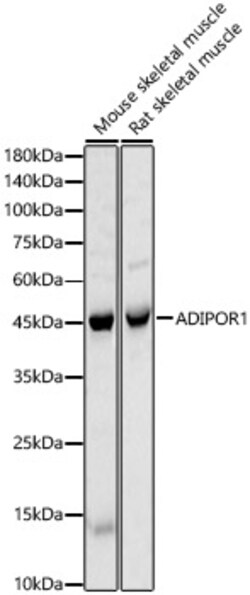
ABclonal Technology ADIPOR1 Rabbit pAb
This gene encodes a protein which acts as a receptor for adiponectin, a hormone secreted by adipocytes which regulates fatty acid catabolism and glucose levels. Binding of adiponectin to the encoded protein results in activation of an AMP-activated kinase signaling pathway which affects levels of fatty acid oxidation and insulin sensitivity. A pseudogene of this gene is located on chromosome 14. Multiple alternatively spliced transcript variants have been found for this gene.
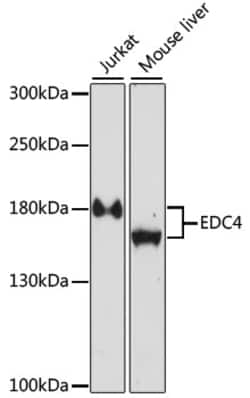
ABclonal Technology EDC4 Rabbit pAb
Predicted to be involved in deadenylation-independent decapping of nuclear-transcribed mRNA. Located in P-body and nucleoplasm.
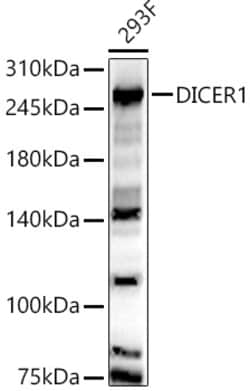
ABclonal Technology DICER1 Rabbit pAb
This gene encodes a protein possessing an RNA helicase motif containing a DEXH box in its amino terminus and an RNA motif in the carboxy terminus. The encoded protein functions as a ribonuclease and is required by the RNA interference and small temporal RNA (stRNA) pathways to produce the active small RNA component that represses gene expression. This protein also acts as a strong antiviral agent with activity against RNA viruses, including the Zika and SARS-CoV-2 viruses. Alternative splicing results in multiple transcript variants.
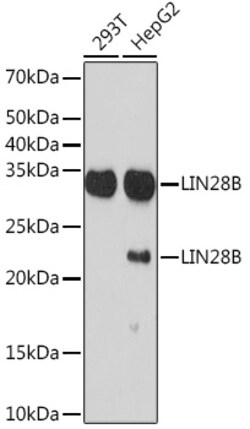
ABclonal Technology LIN28B Rabbit mAb
The protein encoded by this gene belongs to the lin-28 family, which is characterized by the presence of a cold-shock domain and a pair of CCHC zinc finger domains. This gene is highly expressed in testis, fetal liver, placenta, and in primary human tumors and cancer cell lines. It is negatively regulated by microRNAs that target sites in the 3 UTR, and overexpression of this gene in primary tumors is linked to the repression of let-7 family of microRNAs and derepression of let-7 targets, which facilitates cellular transformation.
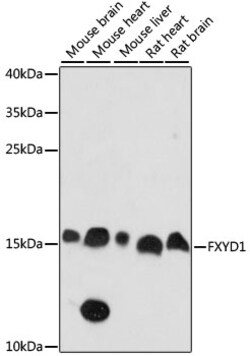
ABclonal Technology FXYD1 Rabbit pAb
This gene encodes a member of the small membrane protein family characterized by a 35-amino acid signature sequence (PFXYD) and regulates ion transport. FXYD proteins, such as FXYD1 (phospholemman), FXYD2 (gamma subunit of Na,K-ATPase), FXYD3 (MAT-8), FXYD4 (CHIF), and FXYD5 (RIC), can induce channel activity. FXYD2 regulates Na,K-ATPase, and transmembrane topology has been established for FXYD1 and FXYD2. This gene product is a plasma membrane substrate for several kinases (PKA, PKC, NIMA, and myotonic dystrophy kinase) and is involved in ion channel formation or regulation. Different 5 UTR transcript variants have been described.
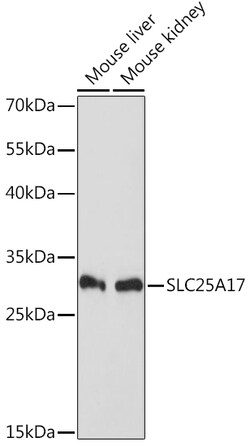
ABclonal Technology SLC25A17 Rabbit pAb
This gene encodes a peroxisomal membrane protein that belongs to the family of mitochondrial solute carriers. It is expressed in the liver, and is likely involved in transport. Alternative splicing results in multiple transcript variants.
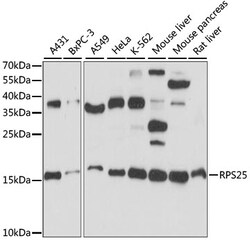
ABclonal Technology RPS25 Rabbit pAb
Ribosomes, the organelles that catalyze protein synthesis, consist of a small 40S subunit and a large 60S subunit. Together these subunits are composed of 4 RNA species and approximately 80 structurally distinct proteins. This gene encodes a ribosomal protein that is a component of the 40S subunit. The protein belongs to the S25E family of ribosomal proteins. It is located in the cytoplasm. As is typical for genes encoding ribosomal proteins, there are multiple processed pseudogenes of this gene dispersed through the genome.
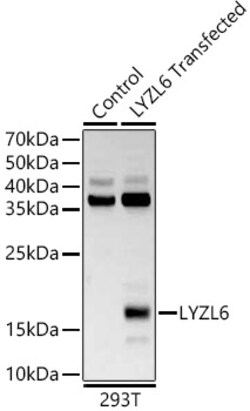
ABclonal Technology LYZL6 Rabbit pAb
This gene encodes a member of the C-type lysozyme/alpha-lactalbumin family. C-type lysozymes are bacteriolytic factors that play a role in host defense, whereas alpha-lactalbumins mediate lactose biosynthesis. The encoded protein contains catalytic residues characteristic of C-type lysozymes and may play a role in male reproduction. Alternatively spliced transcript variants have been observed for this gene.
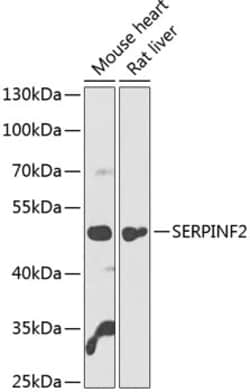
ABclonal Technology SERPINF2 Rabbit pAb
This gene encodes a member of the serpin family of serine protease inhibitors. The protein is a major inhibitor of plasmin, which degrades fibrin and various other proteins. Consequently, the proper function of this gene has a major role in regulating the blood clotting pathway. Mutations in this gene result in alpha-2-plasmin inhibitor deficiency, which is characterized by severe hemorrhagic diathesis. Multiple transcript variants encoding different isoforms have been found for this gene.
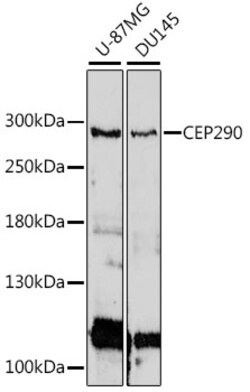
ABclonal Technology CEP290 Rabbit pAb
This gene encodes a protein with 13 putative coiled-coil domains, a region with homology to SMC chromosome segregation ATPases, six KID motifs, three tropomyosin homology domains and an ATP/GTP binding site motif A. The protein is localized to the centrosome and cilia and has sites for N-glycosylation, tyrosine sulfation, phosphorylation, N-myristoylation, and amidation. Mutations in this gene have been associated with Joubert syndrome and nephronophthisis and the presence of antibodies against this protein is associated with several forms of cancer.
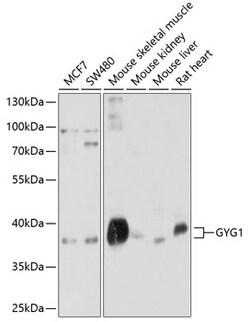
ABclonal Technology GYG1 Rabbit pAb
This gene encodes a member of the glycogenin family. Glycogenin is a glycosyltransferase that catalyzes the formation of a short glucose polymer from uridine diphosphate glucose in an autoglucosylation reaction. This reaction is followed by elongation and branching of the polymer, catalyzed by glycogen synthase and branching enzyme, to form glycogen. This gene is expressed in muscle and other tissues. Mutations in this gene result in glycogen storage disease XV. This gene has pseudogenes on chromosomes 1, 8 and 13 respectively. Alternatively spliced transcript variants encoding different isoforms have been identified.
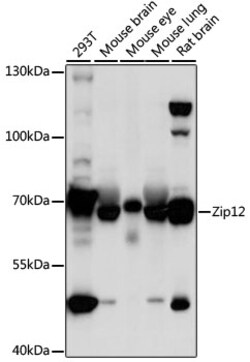
ABclonal Technology Zip12 Rabbit pAb
Zinc is an essential cofactor for hundreds of enzymes. It is involved in protein, nucleic acid, carbohydrate, and lipid metabolism, as well as in the control of gene transcription, growth, development, and differentiation. SLC39A12 belongs to a subfamily of proteins that show structural characteristics of zinc transporters (Taylor and Nicholson, 2003 [PubMed 12659941]).