
Protein Molecular Weight Markers

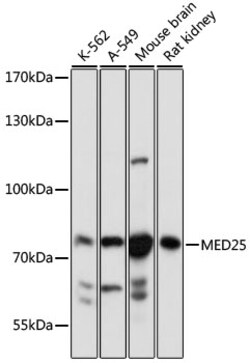
ABclonal Technology MED25 Rabbit pAb

This gene encodes a component of the transcriptional coactivator complex termed the Mediator complex. This complex is required for transcription of most RNA polymerase II-dependent genes. The encoded protein plays a role in chromatin modification and in preinitiation complex assembly. Mutations in this gene are associated with Charcot-Marie-Tooth disease type 2B2.


Sigma Aldrich Fine Chemicals Biosciences Gel Filtration Markers Kit for Protein Molecular Weights 29,000-700,000 Da | 1KT
Gel Filtration Markers Kit for Protein Molecular Weights 29,000-700,000 Da | 1KT

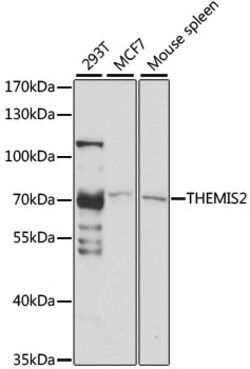
ABclonal Technology THEMIS2 Rabbit pAb
Predicted to be involved in T cell receptor signaling pathway and regulation of B cell activation. Predicted to be active in cytoplasm and nucleus.
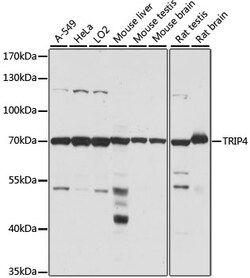
ABclonal Technology TRIP4 Rabbit pAb
This gene encodes a subunit of the tetrameric nuclear activating signal cointegrator 1 (ASC-1) complex, which associates with transcriptional coactivators, nuclear receptors and basal transcription factors to facilitate nuclear receptors-mediated transcription. This protein is localized in the nucleus and contains an E1A-type zinc finger domain, which mediates interaction with transcriptional coactivators and ligand-bound nuclear receptors, such as thyroid hormone receptor and retinoid X receptor alpha, but not glucocorticoid receptor. Mutations in this gene are associated with spinal muscular atrophy with congenital bone fractures-1 (SMABF1).
Gold Biotechnology Inc BLUEstain™ Protein ladder, 11-245 kDa 2x500 µL
The BLUEstainTM Protein ladder is a three-color protein standard with 12 prestained proteins covering a wide range molecular weights from ~11 to 245 kDa. Proteins are covalently coupled with a bluechromophore except for two reference bands (one green and one red band at 25 kDa and 75 kDa respectively) when separated on SDS-PAGE (Tris-glycine buffer). The BLUEstainTM Protein ladder, is designed for monitoring protein separation during SDS-polyacrylamide gel electrophoresis, verification of Western transfer efficiency on membranes (PVDF, nylon, or nitrocellulose) and for approximating the size of proteins. The ladder is supplied in gel loading buffer and is ready to use.
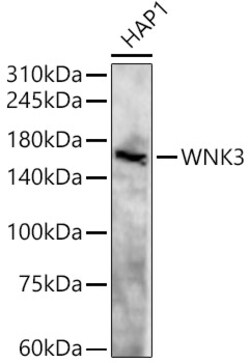
ABclonal Technology WNK3 Rabbit pAb
This gene encodes a protein belonging to the with no lysine family of serine-threonine protein kinases. These family members lack the catalytic lysine in subdomain II, and instead have a conserved lysine in subdomain I. This family member functions as a positive regulator of the transcellular Ca2+ transport pathway, and it plays a role in the increase of cell survival in a caspase-3-dependent pathway. Alternative splicing results in multiple transcript variants.
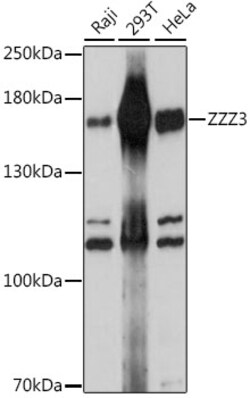
ABclonal Technology ZZZ3 Rabbit pAb
Predicted to enable DNA binding activity and zinc ion binding activity. Predicted to be involved in histone H4 acetylation. Located in nucleolus and nucleoplasm.
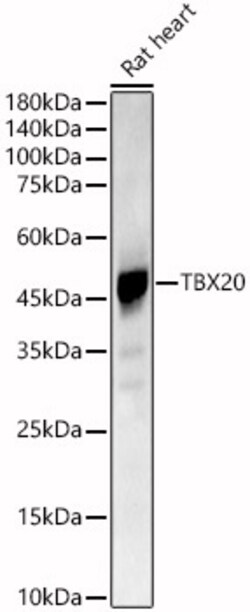
ABclonal Technology TBX20 Rabbit pAb
This gene encodes a T-box family member. The T-box family members share a common DNA binding domain, termed the T-box, and they are transcription factors involved in the regulation of developmental processes. This gene is essential for heart development. Mutations in this gene are associated with diverse cardiac pathologies, including defects in septation, valvulogenesis and cardiomyopathy. Alternatively spliced transcript variants encoding different isoforms have been found for this gene.
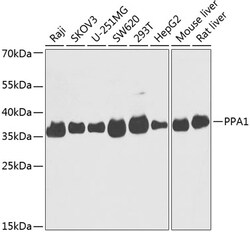
ABclonal Technology PPA1 Rabbit pAb
The protein encoded by this gene is a member of the inorganic pyrophosphatase (PPase) family. PPases catalyze the hydrolysis of pyrophosphate to inorganic phosphate, which is important for the phosphate metabolism of cells. Studies of a similar protein in bovine suggested a cytoplasmic localization of this enzyme.
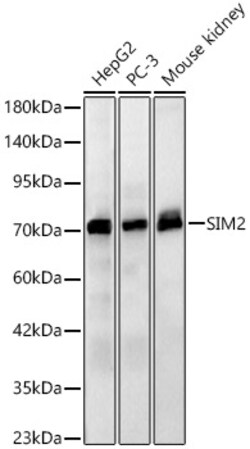
ABclonal Technology SIM2 Rabbit pAb
This gene represents a homolog of the Drosophila single-minded (sim) gene, which encodes a transcription factor that is a master regulator of neurogenesis. The encoded protein is ubiquitinated by RING-IBR-RING-type E3 ubiquitin ligases, including the parkin RBR E3 ubiquitin protein ligase. This gene maps within the so-called Down syndrome chromosomal region, and is thus thought to contribute to some specific Down syndrome phenotypes. Alternative splicing of this gene results in multiple transcript variants.
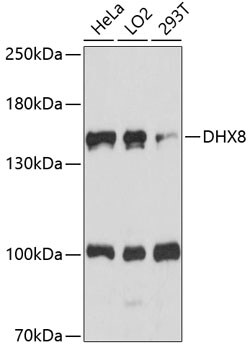
ABclonal Technology DHX8 Rabbit pAb
This gene is a member of the DEAH box polypeptide family. The encoded protein contains the DEAH (Asp-Glu-Ala-His) motif which is characteristic of all DEAH box proteins, and is thought to function as an ATP-dependent RNA helicase that regulates the release of spliced mRNAs from spliceosomes prior to their export from the nucleus. This protein may be required for the replication of human immunodeficiency virus type 1 (HIV-1). Alternative splicing results in multiple transcript variants.
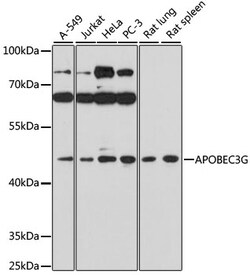
ABclonal Technology APOBEC3G Rabbit pAb
This gene is a member of the cytidine deaminase gene family. It is one of seven related genes or pseudogenes found in a cluster, thought to result from gene duplication, on chromosome 22. Members of the cluster encode proteins that are structurally and functionally related to the C to U RNA-editing cytidine deaminase APOBEC1. The protein encoded by this gene catalyzes site-specific deamination of both RNA and single-stranded DNA. The encoded protein has been found to be a specific inhibitor of human immunodeficiency virus-1 (HIV-1) infectivity.
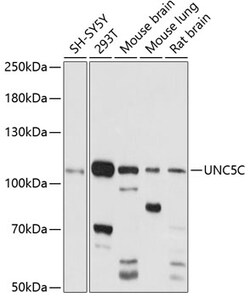
ABclonal Technology UNC5C Rabbit pAb
This gene product belongs to the UNC-5 family of netrin receptors. Netrins are secreted proteins that direct axon extension and cell migration during neural development. They are bifunctional proteins that act as attractants for some cell types and as repellents for others, and these opposite actions are thought to be mediated by two classes of receptors. The UNC-5 family of receptors mediate the repellent response to netrin, they are transmembrane proteins containing 2 immunoglobulin (Ig)-like domains and 2 type I thrombospondin motifs in the extracellular region.
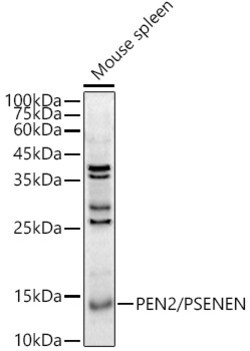
ABclonal Technology PEN2/PSENEN Rabbit pAb
Presenilins, which are components of the gamma-secretase protein complex, are required for intramembranous processing of some type I transmembrane proteins, such as the Notch proteins and the beta-amyloid precursor protein. Signaling by Notch receptors mediates a wide range of developmental cell fates. Processing of the beta-amyloid precursor protein generates neurotoxic amyloid beta peptides, the major component of senile plaques associated with Alzheimers disease. This gene encodes a protein that is required for Notch pathway signaling, and for the activity and accumulation of gamma-secretase. Mutations resulting in haploinsufficiency for this gene cause familial acne inversa-2 (ACNINV2). Alternative splicing results in multiple transcript variants.
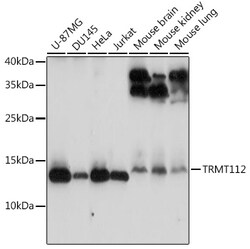
ABclonal Technology TRMT112 Rabbit pAb
Enables protein heterodimerization activity and protein methyltransferase activity. Involved in macromolecule methylation and positive regulation of rRNA processing. Located in nucleoplasm and perinuclear region of cytoplasm. Part of protein-containing complex.