
Protein Molecular Weight Markers

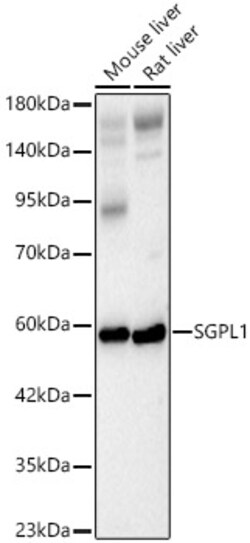
ABclonal Technology SGPL1 Rabbit pAb

Enables sphinganine-1-phosphate aldolase activity. Involved in apoptotic signaling pathway, fatty acid metabolic process, and sphingolipid metabolic process. Located in endoplasmic reticulum. Implicated in nephrotic syndrome type 14.

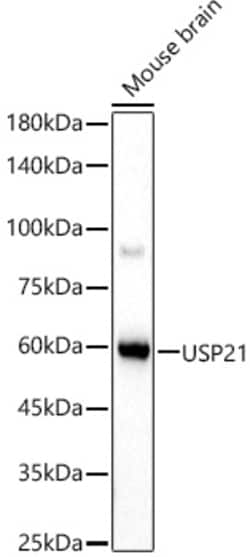
ABclonal Technology USP21 Rabbit pAb
This gene encodes a member of the C19 peptidase family, also known as family 2 of ubiquitin carboxy-terminal hydrolases. The encoded protein cleaves ubiquitin from ubiquitinated proteins for recycling in intracellular protein degradation. The encoded protein is also able to release NEDD8, a ubiquitin-like protein, from NEDD8-conjugated proteins. This gene has been referred to as USP16 and USP23 but is now known as USP21. Alternatively spliced transcript variants encoding different isoforms have been found for this gene.
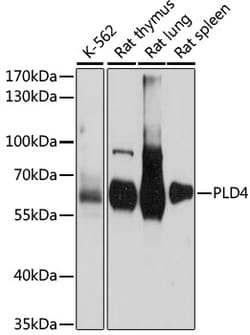
ABclonal Technology PLD4 Rabbit pAb
Predicted to enable single-stranded DNA 5-3 exodeoxyribonuclease activity. Predicted to be involved in hematopoietic progenitor cell differentiation, phagocytosis, and regulation of cytokine production involved in inflammatory response. Predicted to be located in early endosome and endoplasmic reticulum membrane. Predicted to be active in several cellular components, including endoplasmic reticulum, phagocytic vesicle, and trans-Golgi network membrane.
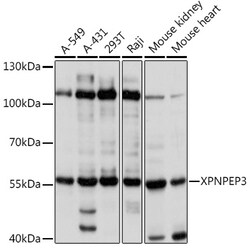
ABclonal Technology XPNPEP3 Rabbit pAb
The protein encoded by this gene belongs to the family of X-pro-aminopeptidases that utilize a metal cofactor, and remove the N-terminal amino acid from peptides with a proline residue in the penultimate position. This protein has been shown to localize to the mitochondria of renal cells, and have a role in ciliary function. Mutations in this gene are associated with nephronophthisis-like nephropathy-1. Alternatively spliced transcript variants encoding different isoforms have been noted for this gene, however, expression of some of these isoforms in vivo is not known.
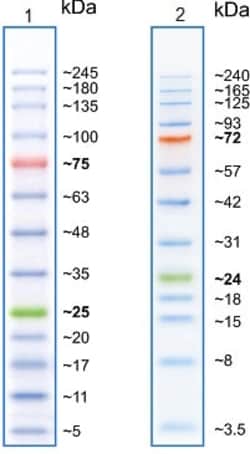
Abcam Prestained Protein Ladder - E x tra broad molecular weight (5 - 245 kDa), 500UL
5-245 kDa prestained protein ladder is a three-color protein standard with 13 prestained proteins. - Suitable for western blot (WB), SDS-PAGE - Designed for monitoring protein separation - Supplied in gel loading buffer and is ready to use
The product is subject to the following: Abcam Restricted Use Statement
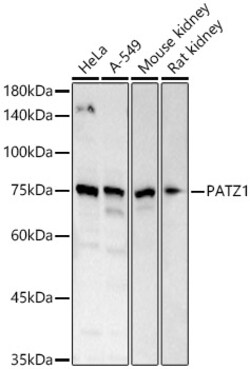
ABclonal Technology PATZ1 Rabbit pAb
This gene encodes a protein with an A-T hook DNA-binding motif, a POZ domain for protein interactions and transcriptional repression, and zinc fingers for DNA binding, suggesting a role as a transcriptional repressor. In small round cell sarcoma, a chromosome 22 inversion fuses this gene with EWS, forming a t(1;22)(p36.1;q12) translocation. This rearrangement joins the EWS transactivation domain with this protein’s zinc finger domain, creating a chimeric transcription factor. This fusion is an example of intra-chromosomal rearrangement. Four alternatively spliced transcript variants have been identified.
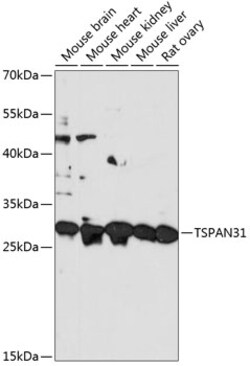
ABclonal Technology TSPAN31 Rabbit pAb
The protein encoded by this gene is a member of the transmembrane 4 superfamily, also known as the tetraspanin family. Most of these members are cell-surface proteins that are characterized by the presence of four hydrophobic domains. The proteins mediate signal transduction events that play a role in the regulation of cell development, activation, growth and motility. This encoded protein is thought to be involved in growth-related cellular processes. This gene is associated with tumorigenesis and osteosarcoma.
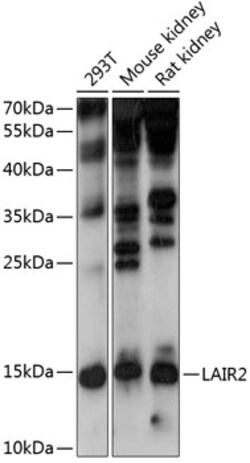
ABclonal Technology LAIR2 Rabbit pAb
The protein encoded by this gene is a member of the immunoglobulin superfamily. It was identified by its similarity to leukocyte-associated immunoglobulin-like receptor 1, a membrane-bound receptor that modulates innate immune response. The protein encoded by this locus is a soluble receptor that may play roles in both inhibition of collagen-induced platelet aggregation and vessel formation during placental implantation. This gene maps to a region of 19q13.4, termed the leukocyte receptor cluster, which contains 29 genes in the immunoglobulin superfamily. Alternatively spliced transcript variants have been described for this gene.
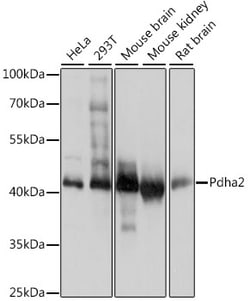
ABclonal Technology PDHA2 Rabbit pAb
Predicted to enable pyruvate dehydrogenase (acetyl-transferring) activity. Predicted to contribute to pyruvate dehydrogenase (NAD+) activity. Predicted to be involved in acetyl-CoA biosynthetic process from pyruvate. Predicted to act upstream of or within mitochondrial acetyl-CoA biosynthetic process from pyruvate. Located in mitochondrion. Is expressed in nervous system and testis. Orthologous to human PDHA2 (pyruvate dehydrogenase E1 subunit alpha 2).
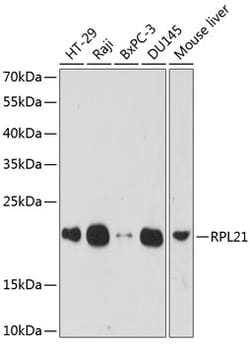
ABclonal Technology RPL21 Rabbit pAb
Ribosomes, the organelles that catalyze protein synthesis, consist of a small 40S subunit and a large 60S subunit. Together these subunits are composed of 4 RNA species and approximately 80 structurally distinct proteins. This gene encodes a ribosomal protein that is a component of the 60S subunit. The protein belongs to the L21E family of ribosomal proteins. It is located in the cytoplasm. As is typical for genes encoding ribosomal proteins, there are multiple processed pseudogenes of this gene dispersed through the genome.
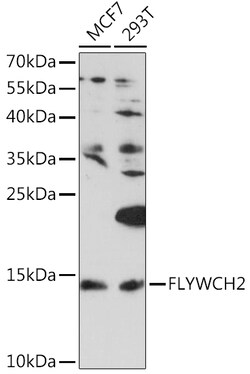
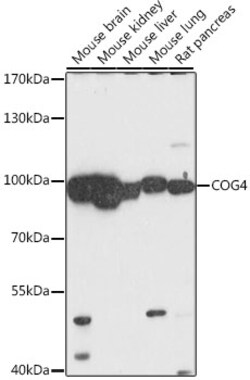
ABclonal Technology COG4 Rabbit pAb
The protein encoded by this gene is a component of an oligomeric protein complex involved in the structure and function of the Golgi apparatus. Defects in this gene may be a cause of congenital disorder of glycosylation type IIj. Two transcript variants encoding different isoforms have been found for this gene.
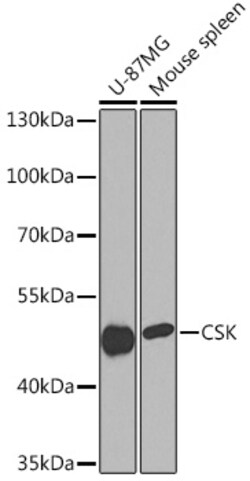
ABclonal Technology CSK Rabbit pAb
The protein encoded by this gene is involved in multiple pathways, including the regulation of Src family kinases. It plays an important role in T-cell activation through its association with the protein encoded by the protein tyrosine phosphatase, non-receptor type 22 (PTPN22) gene. This protein also phosphorylates C-terminal tyrosine residues on multiple substrates, including the protein encoded by the SRC proto-oncogene, non-receptor tyrosine kinase gene. Phosphorylation suppresses the kinase activity of the Src family tyrosine kinases. An intronic polymorphism (rs34933034) in this gene has been found to affect B-cell activation and is associated with systemic lupus erythematosus (SLE). Alternative splicing results in multiple transcript variants.
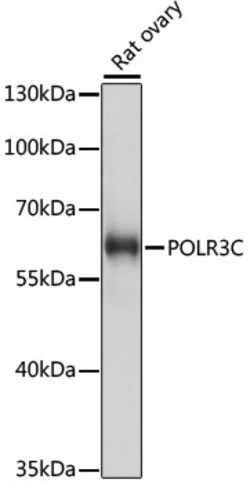
ABclonal Technology POLR3C Rabbit pAb
Enables single-stranded DNA binding activity. Involved in positive regulation of innate immune response and positive regulation of interferon-beta production. Located in nucleoplasm. Part of RNA polymerase III complex.
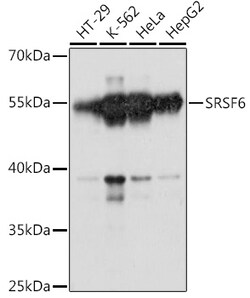
ABclonal Technology SRSF6 Rabbit pAb
The protein encoded by this gene is involved in mRNA splicing and may play a role in the determination of alternative splicing. The encoded nuclear protein belongs to the splicing factor SR family and has been shown to bind with and modulate another member of the family, SFRS12. Alternative splicing results in multiple transcript variants. In addition, two pseudogenes, one on chromosome 17 and the other on the X chromosome, have been found for this gene.