Protein Molecular Weight Markers
- (1)
- (1)
- (1)
- (1)
- (1)
- (39)
- (1)
- (19)
- (1)
- (2)
- (1)
- (2)
- (2)
- (1)
- (1)
- (2)
- (2)
- (1)
- (2)
- (2)
- (1)
- (4)
- (1)
- (1)
- (1)
- (1)
- (1)
- (1)
- (3)
- (2)
- (1)
- (1)
- (2)
- (2)
- (1)
- (1)
- (2)
- (4)
- (2)
- (1)
- (1)
- (1)
- (4)
- (1)
- (2)
- (2)
- (1)
- (1)
- (2)
- (3)
- (13)
- (1)
- (2)
- (2)
- (5)
- (3)
- (2)
- (9)
- (3)
- (5)
- (2)
- (1)
- (1)
- (2)
- (2)
- (9)
- (8)
- (1)
- (7)
- (2)
- (1)
- (2)
- (2)
- (3)
- (1)
- (23)
Filtered Search Results
ABclonal Technology PKN1 Rabbit pAb
Small and Specialty Supplier Partner
Small and/or specialty supplier based on Federal laws and SBA requirements.
Learn More
Small and/or specialty supplier based on Federal laws and SBA requirements.
Learn More
The protein encoded by this gene belongs to the protein kinase C superfamily. This kinase is activated by Rho family of small G proteins and may mediate the Rho-dependent signaling pathway. This kinase can be activated by phospholipids and by limited proteolysis. The 3-phosphoinositide dependent protein kinase-1 (PDPK1/PDK1) is reported to phosphorylate this kinase, which may mediate insulin signals to the actin cytoskeleton. The proteolytic activation of this kinase by caspase-3 or related proteases during apoptosis suggests its role in signal transduction related to apoptosis. Alternatively spliced transcript variants encoding distinct isoforms have been observed.
Non-distribution item offered as a customer accommodation; additional freight charges may apply.
Learn More
ABclonal Technology SLC1A7 Rabbit pAb
Small and Specialty Supplier Partner
Small and/or specialty supplier based on Federal laws and SBA requirements.
Learn More
Small and/or specialty supplier based on Federal laws and SBA requirements.
Learn More
Predicted to enable anion transmembrane transporter activity. Involved in neurotransmitter reuptake. Predicted to be located in plasma membrane. Predicted to be active in glutamatergic synapse. Predicted to be integral component of postsynaptic membrane and integral component of presynaptic membrane.
Non-distribution item offered as a customer accommodation; additional freight charges may apply.
Learn More
ABclonal Technology TCTA Rabbit pAb
Small and Specialty Supplier Partner
Small and/or specialty supplier based on Federal laws and SBA requirements.
Learn More
Small and/or specialty supplier based on Federal laws and SBA requirements.
Learn More
Involved in negative regulation of osteoclast differentiation and osteoclast fusion. Predicted to be integral component of membrane.
Non-distribution item offered as a customer accommodation; additional freight charges may apply.
Learn More
ABclonal Technology ATP6V1G3 Rabbit pAb
Small and Specialty Supplier Partner
Small and/or specialty supplier based on Federal laws and SBA requirements.
Learn More
Small and/or specialty supplier based on Federal laws and SBA requirements.
Learn More
This gene encodes a component of vacuolar ATPase (V-ATPase), a multisubunit enzyme that mediates acidification of eukaryotic intracellular organelles. V-ATPase dependent organelle acidification is necessary for such intracellular processes as protein sorting, zymogen activation, receptor-mediated endocytosis, and synaptic vesicle proton gradient generation. V-ATPase is composed of a cytosolic V1 domain and a transmembrane V0 domain. The V1 domain consists of three A and three B subunits, two G subunits plus the C, D, E, F, and H subunits. The V1 domain contains the ATP catalytic site. The V0 domain consists of five different subunits a, c, c, c and d. Additional isoforms of many of the V1 and V0 subunit proteins are encoded by multiple genes or alternatively spliced transcript variants. This gene encodes one of three G subunit proteins. Transcript variants encoding different isoforms have been found for this gene.
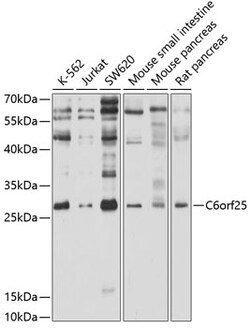
Non-distribution item offered as a customer accommodation; additional freight charges may apply.
Learn More
ABclonal Technology TPD52 Rabbit pAb
Small and Specialty Supplier Partner
Small and/or specialty supplier based on Federal laws and SBA requirements.
Learn More
Small and/or specialty supplier based on Federal laws and SBA requirements.
Learn More
Enables calcium ion binding activity and protein homodimerization activity. Involved in B cell differentiation. Located in endoplasmic reticulum and perinuclear region of cytoplasm.
Non-distribution item offered as a customer accommodation; additional freight charges may apply.
Learn More
ABclonal Technology SOX13 Rabbit pAb
Small and Specialty Supplier Partner
Small and/or specialty supplier based on Federal laws and SBA requirements.
Learn More
Small and/or specialty supplier based on Federal laws and SBA requirements.
Learn More
This gene encodes a member of the SOX (SRY-related HMG-box) family of transcription factors involved in the regulation of embryonic development and in the determination of cell fate. The encoded protein may act as a transcriptional regulator after forming a protein complex with other proteins. It has also been determined to be a type-1 diabetes autoantigen, also known as islet cell antibody 12.
Non-distribution item offered as a customer accommodation; additional freight charges may apply.
Learn More
Biotium Histiocytoma Marker(D11), CF740 conjugate, 0.1mg/mL
In Western blotting, this antibody detects an antigen of 125 kDa in human liver and 135 kDa in tumors of histiocytic origin. Comparative study of this MAb and a standard CD68 MAb showed that their antigens are different. Its antigen in all macrophage types studied is located on the plasma membrane and within cytoplasmic structures including lysosomes. This MAb shows a restricted reactivity to cells of the monocyte/macrophage system. It specifically reacts with blood monocytes and stains resident macrophages in a wide variety of human tissues. This MAb does not stain antigen-presenting cells, e.g., Langerhans cells. Reportedly, its reactivity is restricted to histiocytes and macrophages.Primary antibodies are available purified, or with a selection of fluorescent CF Dyes and other labels. CF Dyes offer exceptional brightness and photostability. Note: Conjugates of blue fluorescent dyes like CF405S and CF405M are not recommended for detecting low abundance targets, because
Non-distribution item offered as a customer accommodation; additional freight charges may apply.
Learn More
ABclonal Technology PLS1 Rabbit pAb
Small and Specialty Supplier Partner
Small and/or specialty supplier based on Federal laws and SBA requirements.
Learn More
Small and/or specialty supplier based on Federal laws and SBA requirements.
Learn More
Plastins are a family of actin-binding proteins that are conserved throughout eukaryote evolution and expressed in most tissues of higher eukaryotes. In humans, two ubiquitous plastin isoforms (L and T) have been identified. The protein encoded by this gene is a third distinct plastin isoform, which is specifically expressed at high levels in the small intestine. Alternatively spliced transcript variants varying in the 5 UTR, but encoding the same protein, have been found for this gene. A pseudogene of this gene is found on chromosome 11.
Non-distribution item offered as a customer accommodation; additional freight charges may apply.
Learn More
ABclonal Technology FBXO21 Rabbit pAb
Small and Specialty Supplier Partner
Small and/or specialty supplier based on Federal laws and SBA requirements.
Learn More
Small and/or specialty supplier based on Federal laws and SBA requirements.
Learn More
This gene encodes a member of the F-box protein family which is characterized by an approximately 40 amino acid motif, the F-box. The F-box proteins constitute one of the four subunits of ubiquitin protein ligase complex called SCFs (SKP1-cullin-F-box), which function in phosphorylation-dependent ubiquitination. The F-box proteins are divided into 3 classes Fbws containing WD-40 domains, Fbls containing leucine-rich repeats, and Fbxs containing either different protein-protein interaction modules or no recognizable motifs. The protein encoded by this gene belongs to the Fbxs class. Alternative splicing of this gene generates 2 transcript variants.
Non-distribution item offered as a customer accommodation; additional freight charges may apply.
Learn More
ABclonal Technology NSF Rabbit pAb
Small and Specialty Supplier Partner
Small and/or specialty supplier based on Federal laws and SBA requirements.
Learn More
Small and/or specialty supplier based on Federal laws and SBA requirements.
Learn More
Enables PDZ domain binding activity and ionotropic glutamate receptor binding activity. Involved in intracellular protein transport, positive regulation of protein catabolic process, and positive regulation of receptor recycling. Located in Golgi apparatus, cytosol, and plasma membrane. Implicated in developmental and epileptic encephalopathy.
Non-distribution item offered as a customer accommodation; additional freight charges may apply.
Learn More
ABclonal Technology MRE11 Rabbit pAb
Small and Specialty Supplier Partner
Small and/or specialty supplier based on Federal laws and SBA requirements.
Learn More
Small and/or specialty supplier based on Federal laws and SBA requirements.
Learn More
This gene encodes a nuclear protein involved in homologous recombination, telomere length maintenance, and DNA double-strand break repair. By itself, the protein has 3 to 5 exonuclease activity and endonuclease activity. The protein forms a complex with the RAD50 homolog, this complex is required for nonhomologous joining of DNA ends and possesses increased single-stranded DNA endonuclease and 3 to 5 exonuclease activities. In conjunction with a DNA ligase, this protein promotes the joining of noncomplementary ends in vitro using short homologies near the ends of the DNA fragments. This gene has a pseudogene on chromosome 3. Alternative splicing of this gene results in two transcript variants encoding different isoforms.
Non-distribution item offered as a customer accommodation; additional freight charges may apply.
Learn More
ABclonal Technology Zip12 Rabbit pAb
Small and Specialty Supplier Partner
Small and/or specialty supplier based on Federal laws and SBA requirements.
Learn More
Small and/or specialty supplier based on Federal laws and SBA requirements.
Learn More
Zinc is an essential cofactor for hundreds of enzymes. It is involved in protein, nucleic acid, carbohydrate, and lipid metabolism, as well as in the control of gene transcription, growth, development, and differentiation. SLC39A12 belongs to a subfamily of proteins that show structural characteristics of zinc transporters (Taylor and Nicholson, 2003 [PubMed 12659941]).
Non-distribution item offered as a customer accommodation; additional freight charges may apply.
Learn More
ABclonal Technology TRPV6 Rabbit pAb
Small and Specialty Supplier Partner
Small and/or specialty supplier based on Federal laws and SBA requirements.
Learn More
Small and/or specialty supplier based on Federal laws and SBA requirements.
Learn More
This gene encodes a member of a family of multipass membrane proteins that functions as calcium channels. The encoded protein contains N-terminal ankyrin repeats, which are required for channel assembly and regulation. Translation initiation for this protein occurs at a non-AUG start codon that is decoded as methionine. This gene is situated next to a closely related gene for transient receptor potential cation channel subfamily V member 5 (TRPV5). This locus has experienced positive selection in non-African populations, resulting in several non-synonymous codon differences among individuals of different genetic backgrounds.
Non-distribution item offered as a customer accommodation; additional freight charges may apply.
Learn More
ABclonal Technology UPK3A Rabbit pAb
Small and Specialty Supplier Partner
Small and/or specialty supplier based on Federal laws and SBA requirements.
Learn More
Small and/or specialty supplier based on Federal laws and SBA requirements.
Learn More
This gene encodes a member of the uroplakin family, a group of transmembrane proteins that form complexes on the apical surface of the bladder epithelium. Mutations in this gene may be associated with renal adysplasia. Alternatively spliced transcript variants have been described.
Non-distribution item offered as a customer accommodation; additional freight charges may apply.
Learn More
ABclonal Technology VPS37A Rabbit pAb
Small and Specialty Supplier Partner
Small and/or specialty supplier based on Federal laws and SBA requirements.
Learn More
Small and/or specialty supplier based on Federal laws and SBA requirements.
Learn More
This gene belongs to the VPS37 family, and encodes a component of the ESCRT-I (endosomal sorting complex required for transport I) protein complex, required for the sorting of ubiquitinated transmembrane proteins into internal vesicles of multivesicular bodies. Expression of this gene is downregulated in hepatocellular carcinoma, and mutations in this gene are associated with autosomal recessive spastic paraplegia-53. A related pseudogene has been identified on chromosome 5. Alternatively spliced transcript variants have been found for this gene.
Non-distribution item offered as a customer accommodation; additional freight charges may apply.
Learn More