
Protein Molecular Weight Markers


Sigma Aldrich Fine Chemicals Biosciences fluorescent IEf-Marker pI
filtered through a 0.45 mum membrane filter

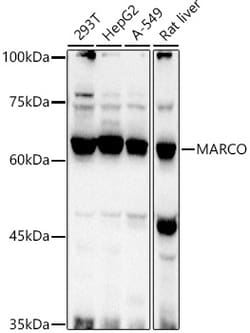
ABclonal Technology MARCO Rabbit pAb

The protein encoded by this gene is a member of the class A scavenger receptor family and is part of the innate antimicrobial immune system. The protein may bind both Gram-negative and Gram-positive bacteria via an extracellular, C-terminal, scavenger receptor cysteine-rich (SRCR) domain. In addition to short cytoplasmic and transmembrane domains, there is an extracellular spacer domain and a long, extracellular collagenous domain. The protein may form a trimeric molecule by the association of the collagenous domains of three identical polypeptide chains.

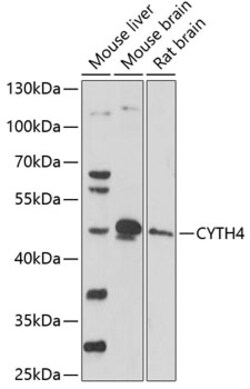
ABclonal Technology CYTH4 Rabbit pAb
This gene encodes a member of the PSCD family of proteins, which have an N-terminal coiled-coil motif, a central Sec7 domain, and a C-terminal pleckstrin homology (PH) domain. The coiled-coil motif is involved in homodimerization, the Sec7 domain contains guanine-nucleotide exchange protein (GEP) activity, and the PH domain interacts with phospholipids and is responsible for association of PSCDs with membranes. Members of this family function as GEPs for ADP-ribosylation factors (ARFs), which are guanine nucleotide-binding proteins involved in vesicular trafficking pathways. This protein exhibits GEP activity in vitro with ARF1 and ARF5, but is inactive with ARF6. Alternatively spliced transcript variants have been found for this gene.
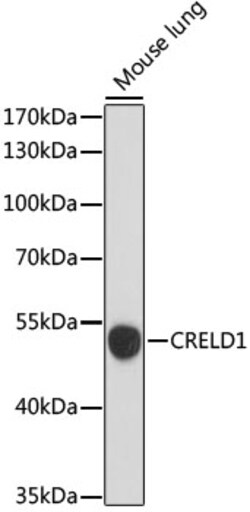
ABclonal Technology CRELD1 Rabbit pAb
This gene encodes a member of a subfamily of epidermal growth factor-related proteins. The encoded protein is characterized by a cysteine-rich with epidermal growth factor-like domain. This protein may function as a cell adhesion molecule. Mutations in this gene are the cause of atrioventricular septal defect. Alternate splicing results in multiple transcript variants.
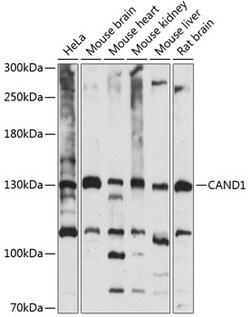
ABclonal Technology CAND1 Rabbit pAb
This gene encodes an essential regulator of Cullin-RING ubiquitin ligases, which are in involved in ubiquitinylation of proteins degraded by the Ub proteasome system. The encoded protein binds to unneddylated cullin-RING box protein complexes and acts as an inhibitor of cullin neddylation and of Skp1, cullin, and F box ubiquitin ligase complex assembly and activity. In mammalian cell culture, this protein predominantly localizes to the cytoplasm. Knockdown of this gene in preadipocytes results in blocked adipogenesis. Alternative splicing results in multiple transcript variants.
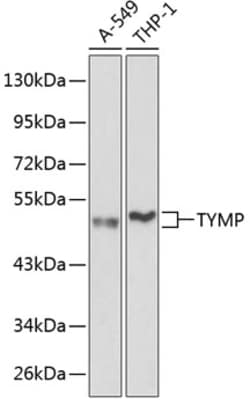
ABclonal Technology TYMP Rabbit pAb
This gene encodes an angiogenic factor which promotes angiogenesis in vivo and stimulates the in vitro growth of a variety of endothelial cells. It has a highly restricted target cell specificity acting only on endothelial cells. Mutations in this gene have been associated with mitochondrial neurogastrointestinal encephalomyopathy. Multiple alternatively spliced transcript variants have been identified.
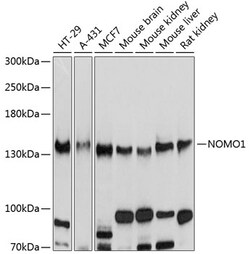
ABclonal Technology NOMO1 Rabbit pAb
This gene encodes a protein originally thought to be related to the collagenase gene family. This gene is one of three highly similar genes in a region of duplication located on the p arm of chromosome 16. These three genes encode closely related proteins that may have the same function. The protein encoded by one of these genes has been identified as part of a protein complex that participates in the Nodal signaling pathway during vertebrate development. Mutations in ABCC6, which is located nearby, rather than mutations in this gene are associated with pseudoxanthoma elasticum (PXE).
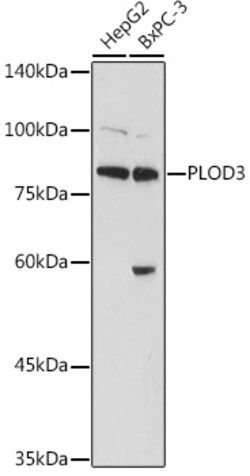
ABclonal Technology PLOD3 Rabbit pAb
The protein encoded by this gene is a membrane-bound homodimeric enzyme that is localized to the cisternae of the rough endoplasmic reticulum. The enzyme (cofactors iron and ascorbate) catalyzes the hydroxylation of lysyl residues in collagen-like peptides. The resultant hydroxylysyl groups are attachment sites for carbohydrates in collagen and thus are critical for the stability of intermolecular crosslinks. Some patients with Ehlers-Danlos syndrome type VIB have deficiencies in lysyl hydroxylase activity.
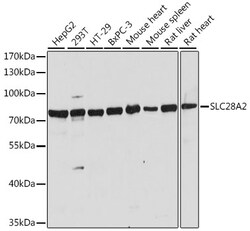
ABclonal Technology SLC28A2 Rabbit pAb
Enables neurotransmitter transmembrane transporter activity and nucleoside transmembrane transporter activity. Involved in several processes, including nucleoside transport, purine nucleobase transmembrane transport, and pyrimidine-containing compound transmembrane transport. Predicted to be located in membrane. Predicted to be part of brush border membrane, coated vesicle, and vesicle membrane. Predicted to be integral component of plasma membrane.
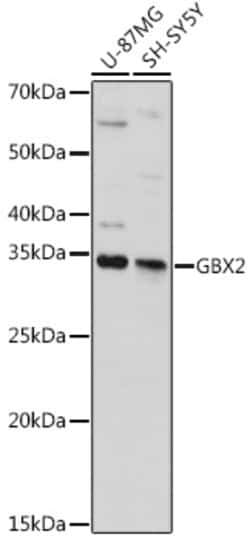
ABclonal Technology GBX2 Rabbit pAb
Enables sequence-specific double-stranded DNA binding activity. Predicted to be involved in regulation of nervous system development and regulation of transcription by RNA polymerase II. Predicted to act upstream of or within several processes, including branching involved in blood vessel morphogenesis, nervous system development, and neural crest cell migration. Predicted to be part of chromatin. Predicted to be active in nucleus.
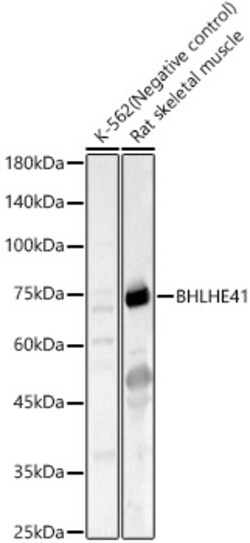
ABclonal Technology BHLHE41 Rabbit pAb
This gene encodes a basic helix-loop-helix protein expressed in various tissues. The encoded protein can interact with ARNTL or compete for E-box binding sites in the promoter of PER1 and repress CLOCK/ARNTLs transactivation of PER1. This gene is believed to be involved in the control of circadian rhythm and cell differentiation. Defects in this gene are associated with the short sleep phenotype.
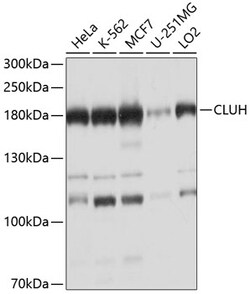
ABclonal Technology CLUH Rabbit pAb
Enables mRNA binding activity. Involved in intracellular distribution of mitochondria. Located in cytoplasm.
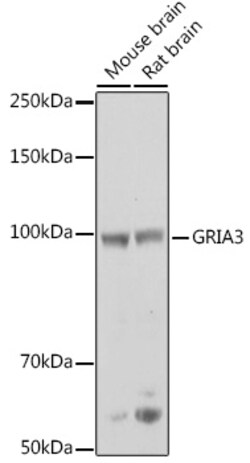
ABclonal Technology GRIA3 Rabbit pAb
Glutamate receptors are the predominant excitatory neurotransmitter receptors in the mammalian brain and are activated in a variety of normal neurophysiologic processes. These receptors are heteromeric protein complexes composed of multiple subunits, arranged to form ligand-gated ion channels. The classification of glutamate receptors is based on their activation by different pharmacologic agonists. The subunit encoded by this gene belongs to a family of AMPA (alpha-amino-3-hydroxy-5-methyl-4-isoxazole propionate)-sensitive glutamate receptors, and is subject to RNA editing (AGA->,GGA, R->,G). Alternative splicing at this locus results in different isoforms, which may vary in their signal transduction properties.
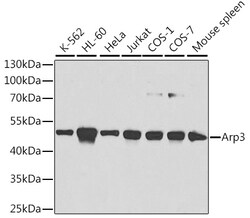
ABclonal Technology Arp3 Rabbit pAb
The specific function of this gene has not yet been determined, however, the protein it encodes is known to be a major constituent of the ARP2/3 complex. This complex is located at the cell surface and is essential to cell shape and motility through lamellipodial actin assembly and protrusion. Three transcript variants encoding two different isoforms have been found for this gene.
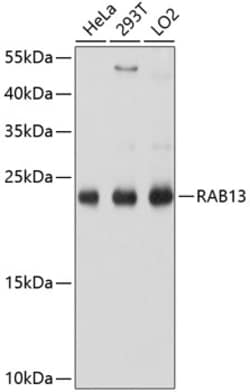
ABclonal Technology RAB13 Rabbit pAb
This gene is a member of the Rab family of small G proteins and plays a role in regulating membrane trafficking between trans-Golgi network (TGN) and recycling endosomes (RE). The encoded protein is involved in the assembly of tight junctions, which are components of the apical junctional complex (AJC) of epithelial cells. The AJC plays a role in forming a barrier between luminal contents and the underlying tissue. Additional functions associated with the protein include endocytic recycling of occludin, regulation of epithelial cell scattering, neuronal regeneration and regulation of neurite outgrowth. Alternately spliced transcript variants have been observed for this gene. A pseudogene associated with this gene is located on chromosome 12.