
Primary Antibody Matched Pairs

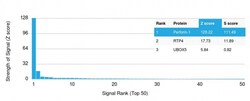
Biotium Perforin-1 (Pore Forming Protein) (Apoptosis Marker)(PRF1/2467), CF740 conjugate, 0.1mg/mL
Perforin is a pore-forming protein that leads to osmotic lysis of the target cells and subsequently enables granzymes to enter the target cells and activate apoptosis. Perforin has structural and functional similarities to complement component 9 (C9). Like C9, this protein creates transmembrane tubules and is capable of lysing non-specifically a variety of target cells. It is one of the main cytolytic proteins of cytolytic granules, and is known to be a key effector molecule for T-cell- and natural killer-cell-mediated cytolysis. Defects in this gene cause familial hemophagocytic lymphohistiocytosis type 2 (HPLH2), a rare and lethal autosomal recessive disorder of early childhood. The expression of perforin is reportedly upregulated in activated CD8 T-cells, natural killer cells and some CD4 T-cells. Primary antibodies are available purified, or with a selection of fluorescent CF Dyes and other labels. CF Dyes offer exceptional brightness and photostability. Note: Conjug


Biotium RAD51 (Prognostic and Response to Chemotherapy Marker)(RAD51/2765), CF740 conjugate, 0.1mg/mL
RAD51 is one of the key factors of DNA repair by homologous recombination and has been shown to have anti-apoptotic activity in tumor cells. RAD51 protein interacts with a variety of tumor suppressor proteins including p53, BRCA1 and BRCA2. Elevated expression of RAD51 enhances radio-resistance of human tumor cells. Overexpression of RAD51 protein in tumor cells renders them resistant against cytotoxic drugs like Cisplatin. RAD51 interacts with BRCA1 and BRCA2 to influence subcellular localization and cellular response to DNA damage. BRCA2 inactivation may be a key event leading to genomic instability and tumorigenesis from deregulation of RAD51. High-level expression of RAD51 has been observed in a variety of human malignancies. RAD51 overexpression correlates with histological grading of the tumor in invasive ductal mammary carcinoma. Primary antibodies are available purified, or with a selection of fluorescent CF Dyes and other labels. CF Dyes offer exceptional brightnes
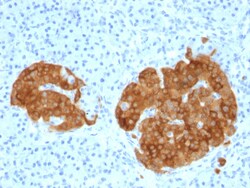
Biotium GAD2 / GAD65 (GABAergic Neuronal Marker) (GAD2/1960), CF568 conjugate, 0.1mg/mL
This MAb recognizes a protein of 65 kDa, which is identified as glutamic acid decarboxylase 2 (GDA2). It is responsible for catalyzing the production of gamma-aminobutyric acid from L-glutamic acid. There are two forms of glutamic acid decarboxylases (GAD s) that are found in the brain: GAD2 (also known as GAD65) and GAD1 (also known as GAD67). GAD1 and GAD2 are members of the group II decarboxylase family of proteins and are responsible for catalyzing the rate-limiting step in the production of GABA (ÃŽ³-aminobutyric acid) from L-glutamic acid. Although both GAD s are found in the brain, GAD2 localizes to synaptic vesicle membranes in nerve terminals, while GAD1 is distributed throughout the cell. A pathogenic role for GAD2 is identified in the human pancreas since it has been identified as an autoantibody and an auto-reactive T cell target in insulin-dependent diabetes.Primary antibodies are available purified, or with a selection of fluorescent CF Dyes and other label
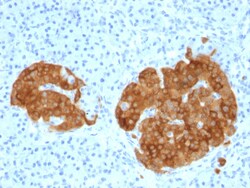
Biotium GAD2 / GAD65 (GABAergic Neuronal Marker)(GAD2/1960), 1mg/mL
This MAb recognizes a protein of 65 kDa, which is identified as glutamic acid decarboxylase 2 (GDA2). It is responsible for catalyzing the production of gamma-aminobutyric acid from L-glutamic acid. There are two forms of glutamic acid decarboxylases (GAD s) that are found in the brain: GAD2 (also known as GAD65) and GAD1 (also known as GAD67). GAD1 and GAD2 are members of the group II decarboxylase family of proteins and are responsible for catalyzing the rate-limiting step in the production of GABA (ÃŽ³-aminobutyric acid) from L-glutamic acid. Although both GAD s are found in the brain, GAD2 localizes to synaptic vesicle membranes in nerve terminals, while GAD1 is distributed throughout the cell. A pathogenic role for GAD2 is identified in the human pancreas since it has been identified as an autoantibody and an auto-reactive T cell target in insulin-dependent diabetes.Primary antibodies are available purified, or with a selection of fluorescent CF Dyes and other label
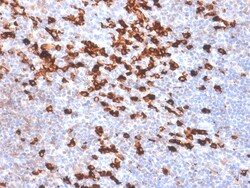
Biotium Human Kappa Light Chain (B-Cell Marker) (IGKC/1999R), CF488A conjugate, 0.1mg/mL
This MAb is specific to kappa light chain of immunoglobulin and shows no cross-reaction with lambda light chain or any of the five heavy chains. In mammals, the two light chains in an antibody are always identical, with only one type of light chain, kappa or lambda. The ratio of Kappa to Lambda is 70:30. However, with the occurrence of multiple myeloma or other B-cell malignancies this ratio is disturbed. Antibody to the kappa light chain is reportedly useful in the identification of leukemias, plasmacytomas, and certain non-Hodgkin's lymphomas. Demonstration of clonality in lymphoid infiltrates indicates that the infiltrate is malignant.Primary antibodies are available purified, or with a selection of fluorescent CF Dyes and other labels. CF Dyes offer exceptional brightness and photostability. Note: Conjugates of blue fluorescent dyes like CF405S and CF405M are not recommended for detecting low abundance targets, because blue dyes have lower fluorescence and can give h
American Research Products Inc PrEST Antigen HRG
PrEST Antigen HRG antigen APrEST85391 for histidine-rich glycoprotein Recombinant protein fragment of Human HRG


Ferret TNF ELISA Pair Set 15PP (Sino Biological)
Each vial contains 200 ng of recombinant Ferret TNF-alpha / TNFA ELISA Pair Set. Reconstitute with 1 mL Dilution Buffer. After reconstitution, store at -20℃ to -80℃ in a manual defrost freezer. A seven-point standard curve using 2-fold serial dilutions in Dilution Buffer, and a high standard of 5000 pg/mL is recommended.
American Research Products Inc PrEST Antigen KIF26A
PrEST Antigen KIF26A antigen APrEST84065 for kinesin family member 26A Recombinant protein fragment of Human KIF26A
American Research Products Inc PrEST Antigen UBE2S
PrEST Antigen UBE2S antigen APrEST87796 for ubiquitin-conjugating enzyme E2S Recombinant protein fragment of Human UBE2S
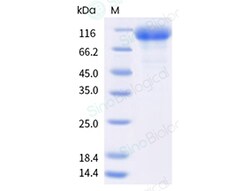
Sino Biological Recombinant Human IL-12 R beta 1/IL12RB1 Protein (ECD, hFc Tag)
A DNA sequence encoding the Human IL12RB1 (NP_005526.1) (Met1-Glu540) was expressed with the Fc region of human IgG1 at the C-terminus.
American Research Products Inc PrEST Antigen LRG1
PrEST Antigen LRG1 antigen APrEST84394 for leucine-rich alpha-2-glycoprotein 1 Recombinant protein fragment of Human LRG1
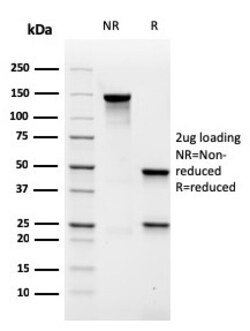
Biotium MALT1 (MALT-Lymphoma Marker)(rMT1/410), CF488A conjugate, 0.1mg/mL
Mucosa associated lymphoid tissue lymphoma translocation gene 1 (MALT1) is found in extranodal low-grade B cell lymphomas. MALT1 encodes two Ig-like C2-type domains and fuses with an API2 gene, which is highly expressed in adult lymphoid tissue. The translocation of this MALT1 gene, which maps to human chromosome 18q21, and the apoptosis-inhibiting API2 gene results in an increased development of MALT lymphomas and apoptosis inhibition. Sites at which this API2-MALT1 (11;18)(q21;q21) translocation commonly occurs are within human lung and kidney tissue. MALT lymphoma expresses nuclear Bcl10, which mediates the oligomerization and activation of a MALT1 caspase-like domain. MALT1 mRNA is found in pre-B cells, mature B cells and plasma cells. Primary antibodies are available purified, or with a selection of fluorescent CF Dyes and other labels. CF Dyes offer exceptional brightness and photostability. Note: Conjugates of blue fluorescent dyes like CF405S and CF405M are not r
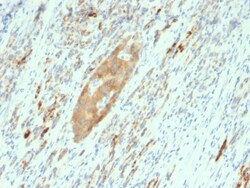
Biotium GAD2 / GAD65 (GABAergic Neuronal Marker)(GAD2/2362), CF594 conjugate, 0.1mg/mL
This MAb recognizes a protein of 65 kDa, which is identified as glutamic acid decarboxylase 2 (GDA2). It is responsible for catalyzing the production of gamma-aminobutyric acid from L-glutamic acid. There are two forms of glutamic acid decarboxylases (GAD's) that are found in the brain: GAD2 (also known as GAD65) and GAD1 (also known as GAD67). GAD1 and GAD2 are members of the group II decarboxylase family of proteins and are responsible for catalyzing the rate-limiting step in the production of GABA (-aminobutyric acid) from L-glutamic acid. Although both GAD's are found in the brain, GAD2 localizes to synaptic vesicle membranes in nerve terminals, while GAD1 is distributed throughout the cell. A pathogenic role for GAD2 is identified in the human pancreas since it has been identified as an autoantibody and an auto-reactive T cell target in insulin-dependent diabetes. Primary antibodies are available purified, or with a selection of fluorescent CF Dyes and other labels. CF Dyes
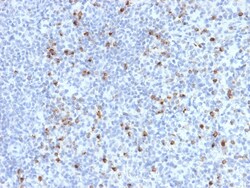
Biotium Perforin-1 (Pore Forming Protein) (Apoptosis Marker)(PRF1/2470), CF568 conjugate, 0.1mg/mL
Perforin is a pore-forming protein that leads to osmotic lysis of the target cells and subsequently enables granzymes to enter the target cells and activate apoptosis. Perforin has structural and functional similarities to complement component 9 (C9). Like C9, this protein creates transmembrane tubules and is capable of lysing non-specifically a variety of target cells. It is one of the main cytolytic proteins of cytolytic granules, and is known to be a key effector molecule for T-cell- and natural killer-cell-mediated cytolysis. Defects in this gene cause familial hemophagocytic lymphohistiocytosis type 2 (HPLH2), a rare and lethal autosomal recessive disorder of early childhood. The expression of perforin is reportedly upregulated in activated CD8 T-cells, natural killer cells and some CD4 T-cells. Primary antibodies are available purified, or with a selection of fluorescent CF Dyes and other labels. CF Dyes offer exceptional brightness and photostability. Note: Conjug

Medchemexpress LLC MME Human HEK293 50ug

MME proteins exhibit thermolysin-like specificity and primarily degrade polypeptides of up to 30 amino acids Crucially it plays a key role in cleaving the Gly-Phe bond to degrade opioid peptides including Met-enkephalin and Leu-enkephalin MME Protein Human (HEK293) is the recombinant human-derived MME protein expressed by HEK293 with tag free