
Protein Labeling Reagents


AMERICAN RESEARCH PRODUCTS INC WATER SOLUBLE BIOTIN LABELING
5000265802 WATER SOLUBLE BIOTIN LABELING

AMERICAN RESEARCH PRODUCTS INC WATER SOLUBLE LONG ARM BIOTIN
5000265819 WATER SOLUBLE LONG ARM BIOTIN

MEDCHEMEXPRESS LLC (±)-ANAP hydrochloride | 2308035-47-2 | 98.5% | 308.76 | C15H17ClN2O3 | 10 MG

(±)-ANAP hydrochloride is a fluorescent, unnatural amino-acid analog of prodan used as an environment-sensitive probe in biochemical and biophysical studies. It displays polarity-dependent changes in fluorescence intensity and emission wavelength, allowing monitoring of local microenvironments when incorporated site-specifically into peptides or proteins. The compound is supplied as a solid hydrochloride salt with storage recommendations to minimize exposure to moisture and light.
- Sensitive to polarity with changes in intensity and emission wavelength.
- Suitable for site-specific incorporation into peptides and proteins.
- Enables monitoring of local microenvironmental changes.
- High purity appropriate for research applications.
- Stable as a solid; store sealed away from moisture and light at 4°C.
- Available in small package sizes for screening and synthesis.

Broadpharm IR 750 NHS Ester, 100 mg, near-infrared fluorescent dye, water-soluble, NHS ester reactive group, pH-insensitive, stable signals, suitable for flow cytometry and microscopy
IR 750 NHS Ester, 100 mg, near-infrared fluorescent dye, water-soluble, NHS ester reactive group, pH-insensitive, stable signals, suitable for flow cytometry and microscopy

ACRO BIOSYSTEMS HRSV Pre-Fusion Glycoprotein F0 Specific ELISA Kit, 96 Tests
The HRSV Pre-Fusion Glycoprotein F0 Specific ELISA Kit is a sandwich ELISA designed for quantitative detection of HRSV pre-fusion F0 glycoprotein in vaccine samples. It is intended to support manufacturing and quality-control workflows by specifically identifying pre-fusion F0 from HRSV A and B while distinguishing it from post-fusion forms.
- Kit provides 96 tests.
- Sandwich ELISA method for quantitative detection.
- Specifically detects HRSV (A) and HRSV (B) pre-fusion glycoprotein F0.
- Does not detect post-fusion glycoprotein F0.
- Intended for vaccine sample testing in manufacturing and quality control.
- Optimized for quantitative determination in vaccine samples.
MEDCHEMEXPRESS LLC M-PEG12-NHS ester | 2207596-93-6 | >=98.0% | C30H55NO16 | 100 MG
m-PEG12-NHS ester is a PEG-based PROTAC linker that plays a crucial role in the synthesis of PROTACs. These molecules are designed with two distinct ligands, one targeting an E3 ubiquitin ligase and the other a target protein. This innovative mechanism enables PROTACs to leverage the intracellular ubiquitin-proteasome system for the selective degradation of specific target proteins, offering a novel approach in drug discovery.
- Utilized in the synthesis of PROTACs
- Features a PEG-based linker
- Facilitates targeted protein degradation
- Leverages the ubiquitin-proteasome system
- Designed for research use
MEDCHEMEXPRESS LLC Dde Biotin-PEG4-azide | 1802907-93-2 | 99.44% | C32H53N7O8S | 25 MG
Dde Biotin-PEG4-azide is a PEG-based PROTAC linker utilized in the synthesis of PROTACs. It functions as a click chemistry reagent, containing an Azide group, enabling it to participate in copper-catalyzed azide-alkyne cycloaddition (CuAAc) reactions with Alkyne groups and strain-promoted alkyne-azide cycloaddition (SPAAC) reactions with DBCO or BCN groups.
- PEG-based PROTAC linker
- Click chemistry reagent with Azide group
- Undergoes CuAAc reactions with Alkyne groups
- Participates in SPAAC reactions with DBCO or BCN groups
MEDCHEMEXPRESS LLC Desthiobiotin-PEG4-acid | >98% | 461.55 | 25 MG
Desthiobiotin-PEG4-acid is a PEG-based PROTAC linker that can be used in the synthesis of PROTACs. PROTACs contain two different ligands connected by a linker; one is a ligand for an E3 ubiquitin ligase and the other is for the target protein. PROTACs exploit the intracellular ubiquitin-proteasome system to selectively degrade target proteins.
- Used as a PEG-based PROTAC linker
- Useful in the synthesis of PROTACs
- Enables selective degradation of target proteins
MEDCHEMEXPRESS LLC Sulfo-Cy3 Azide | 1801695-56-6 | C35H46N6O10S3 | 5 MG
Sulfo-Cy3 Azide is a water-soluble fluorogenic dye that contains an azide group, facilitating Click Chemistry. This dye is suitable for labeling sensitive molecules, such as proteins.
- Can participate in copper-catalyzed azide-alkyne cycloaddition (CuAAc) with alkyne-containing molecules.
- Can undergo ring strain-promoted alkyne-azide cycloaddition (SPAAC) with molecules containing DBCO or BCN groups.
MEDCHEMEXPRESS LLC Sulfo-Cy5.5 Azide | 1955527-41-9 | C44H50N6O13S4 | 5 MG
Sulfo-Cy5.5 Azide is a click chemistry reagent that contains an azide group. It is a water-soluble dye with excitation at 673 nm and emission at 707 nm. It is designed to label sensitive molecules like peptides, proteins, and oligonucleotides. The azide group allows it to undergo copper-catalyzed azide-alkyne cycloaddition (CuAAc) with molecules containing alkyne groups, and ring strain-promoted alkyne-azide cycloaddition (SPAAC) with molecules containing DBCO or BCN groups.
- Click chemistry reagent
- Contains an azide group
- Water-soluble dye (Ex=673 nm, Em=707 nm)
- Designed to label sensitive molecules such as peptides, proteins, and oligonucleotides
- Can undergo copper-catalyzed azide-alkyne cycloaddition (CuAAc) with alkyne-containing molecules
- Can undergo ring strain-promoted alkyne-azide cycloaddition (SPAAC) with DBCO or BCN-containing molecules
MEDCHEMEXPRESS LLC Desthiobiotin-Iodoacetamide | 2924824-04-2 | C14H25IN4O3 | 50 MG
Desthiobiotin-Iodoacetamide serves as an ADC linker, a crucial component in antibody-drug conjugates. This compound can function as a probe to label cell lysis treated with Oridonin. It is supplied as a white to off-white solid with a high purity of 99.51%.
- Functions as an ADC linker
- Can be used as a probe for Oridonin-treated cell lysis
- Relevant for research in cancer, targeted therapy, and immunotherapy
- Solid appearance, white to off-white
- Purity of 99.51%
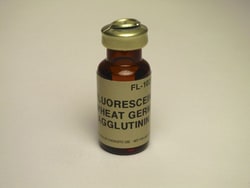
Vector Laboratories Wheat Germ Agglutinin (WGA) Fluorescein-labeled 5 mg
Wheat germ agglutinin (WGA) contains a group of closely related isolectins that bind N-acetylglucosamine (preferentially the dimers and trimers of this sugar) and oligosaccharides containing terminal N-acetylglucosamine or chitobiose, structures common to many serum and membrane glycoproteins. Bacterial cell wall peptidoglycans, chitin, cartilage glycosaminoglycans, and glycolipids can also bind WGA. Native WGA also interacts with some glycoproteins via sialic acid residues (see succinylated WGA). This fluorescein-labeled WGA features a ratio of fluorophores to lectin protein that provides optimal staining (excitation 495 nm, emission 515 nm). Supplied as a solution essentially free of unconjugated fluorophores, it is preserved with sodium azide. The recommended inhibiting/eluting sugar is chitin hydrolysate or 500 mM N-acetylglucosamine with salt and/or acid elution.