
Immunohistochemistry Kits and Reagents


Cell Signaling Technology Phospho-FAK (Tyr397) (D20B1) Rabbit Monoclonal Antibody (BSA and Azide Free) 100uug

This product is the carrier free version of product #8556. All data were generated using the same antibody clone in the standard formulation which contains BSA and glycerol.This formulation is ideal for use with technologies requiring specialized or custom antibody labeling, including fluorophores, metals, lanthanides, and oligonucleotides. It is not recommended for ChIP, ChIP-seq, CUT&RUN or CUT&Tag assays. If you require a carrier free formulation for chromatin profiling, please contact us. Optimal dilutions/concentrations should be determined by the end user.BSA and Azide Free antibodies are quality control tested by size exclusion chromatography (SEC) to determine antibody integrity.

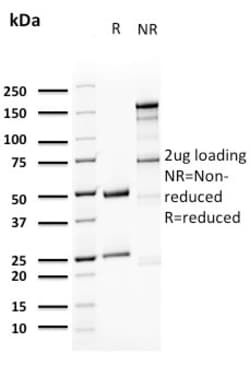
Biotium Uroplakin 1A (Urothelial Differentiation Marker)(UPK1A/2923), Biotin conjugate, 0.1mg/mL
The protein encoded by this gene is a member of the transmembrane 4 superfamily, also known as the tetraspanin family. Most of these members are cell-surface proteins that are characterized by the presence of four hydrophobic domains. The proteins mediate signal transduction events that play a role in the regulation of cell development, activation, growth and motility. This encoded protein is found in the asymmetrical unit membrane (AUM) where it can complex with other transmembrane 4 superfamily proteins. It may play a role in normal bladder epithelial physiology, possibly in regulating membrane permeability of superficial umbrella cells or in stabilizing the apical membrane through AUM/cytoskeletal interactions. The protein may also play a role in tumor suppression. Primary antibodies are available purified, or with a selection of fluorescent CF Dyes and other labels. CF Dyes offer exceptional brightness and photostability. Note: Conjugates of blue fluorescent dyes like

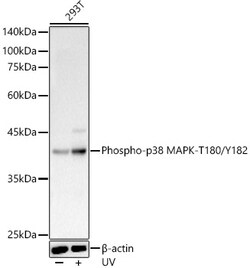
ABclonal Technology Phospho-p38 MAPK-T180/Y182 Rabbit pAb
The protein encoded by this gene is a member of the MAP kinase family. MAP kinases act as an integration point for multiple biochemical signals, and are involved in a wide variety of cellular processes such as proliferation, differentiation, transcription regulation and development. This kinase is activated by various environmental stresses and proinflammatory cytokines. The activation requires its phosphorylation by MAP kinase kinases (MKKs), or its autophosphorylation triggered by the interaction of MAP3K7IP1/TAB1 protein with this kinase. The substrates of this kinase include transcription regulator ATF2, MEF2C, and MAX, cell cycle regulator CDC25B, and tumor suppressor p53, which suggest the roles of this kinase in stress related transcription and cell cycle regulation, as well as in genotoxic stress response. Four alternatively spliced transcript variants of this gene encoding distinct isoforms have been reported.
Genscript Corporation Nectin-4 IgV DomainBiotin H
Nectin-4 seems to be involved in cell adhesion through trans-homophilic and -heterophilic interactions the latter including specifically interactions with NECTIN1 Does not act as receptor for alpha-herpesvirus entry into cells (Microbial infection) Acts as a receptor for measles virus
![Biolegend Purified anti-MAP2 [1D7-B9-C8-F6]; Isotype: Mouse IgG2b, κ; Reactivity: Mouse, Human; Apps: IHC-P, WB; Size: 100 μg](https://assets.fishersci.com/TFS-Assets/CCG/product-images/502567060.png-250.jpg)
Biolegend Purified anti-MAP2 [1D7-B9-C8-F6]; Isotype: Mouse IgG2b, κ; Reactivity: Mouse, Human; Apps: IHC-P, WB; Size: 100 μg
Purified anti-MAP2 [1D7-B9-C8-F6]; Isotype: Mouse IgG2b, κ; Reactivity: Mouse, Human; Apps: IHC-P, WB; Size: 100 μg
ABclonal Technology TFF1/pS2 Rabbit mAb
Members of the trefoil family are characterized by having at least one copy of the trefoil motif a 40-amino acid domain that contains three conserved disulfides They are stable secretory proteins expressed in gastrointestinal mucosa Their functions are not defined but they may protect the mucosa from insults stabilize the mucus layer and affect healing of the epithelium This gene which is expressed in the gastric mucosa has also been studied because of its expression in human tumors This gene and two other related trefoil family member genes are found in a cluster on chromosome 21
ABclonal Technology 488 Conjugated AIF1/IBA1
Enables actin filament binding activity and calcium ion binding activity Involved in several processes including Rac protein signal transduction actin filament organization and ruffle assembly Acts upstream of or within actin filament bundle assembly Located in several cellular components including actin filament phagocytic cup and ruffle membrane Is expressed in adrenal cortex central nervous system embryo mesenchyme and retina Human ortholog(s) of this gene implicated in type 1 diabetes mellitus Orthologous to human AIF1 (allograft inflammatory factor 1)
Biotium Napsin-A(NAPSA/1238), Biotin conjugate, 0.1mg/mL
Napsin is a pepsin-like aspartic proteinase connected with maturation of surfactant protein B. There are two closely related napsins, napsin A and napsin B. Napsin A is expressed as a single chain protein. Immunohistochemical studies revealed high expression levels of napsin A in human lung and kidney but low expression in spleen. Napsin A is expressed in type II pneumocytes and in adenocarcinomas of lung. The high specificity expression of napsin A in adenocarcinomas of lung is useful to distinguish primary lung adenocarcinomas from adenocarcinomas of other organs.Primary antibodies are available purified, or with a selection of fluorescent CF Dyes and other labels. CF Dyes offer exceptional brightness and photostability. Note: Conjugates of blue fluorescent dyes like CF405S and CF405M are not recommended for detecting low abundance targets, because blue dyes have lower fluorescence and can give higher non-specific background than other dye colors.
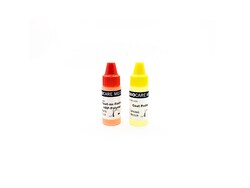
Biocare Medical, LLC Goat-on-Rodent HRP-Polymer, 6 ml
Goat-on-Rodent HRP-Polymer is for goat primary antibodies on mouse, rat or human tissues and labeled with horseradish peroxidase. Goat antibodies are advantageous as the detection has minimum cross reactivity to mouse, rat or human IgG.
Biotium pS2 / pNR-2 / TFF1 (Estrogen-Regulated Protein) (TFF1/2969R), CF740 conjugate, 0.1mg/mL
This antibody recognizes a polypeptide of 6.5 kDa, identified as pS2 estrogen-regulated protein. Its epitope is localized between aa57-84 of human pS2 protein. pS2 is a trefoil peptide. Trefoil peptides are protease resistant molecules secreted throughout the gut that play a role in mucosal healing. These peptides contain three intra-chain disulfide bonds, forming the trefoil motif, or P-domain. pS2 is known to form dimers and this dimerization is thought to play a role in its protective and healing properties. About 60% of breast carcinomas are positive for pS2. Staining is cytoplasmic, often with localization to the Golgi apparatus. pS2 is shown to be localized in normal stomach mucosa, gastric fluid, goblet cells in the colon and small intestine, and in ulcerations of the gastrointestinal tract. Several studies have shown that pS2 is primarily expressed in estrogen receptor-positive breast tumors and it may define a subset of estrogen-dependent tumors that displays an increased
Biotium pS2 / pNR-2 / TFF1 (Estrogen-Regulated Protein) (TFF1/2969R), Biotin conjugate, 0.1mg/mL
This antibody recognizes a polypeptide of 6.5 kDa, identified as pS2 estrogen-regulated protein. Its epitope is localized between aa57-84 of human pS2 protein. pS2 is a trefoil peptide. Trefoil peptides are protease resistant molecules secreted throughout the gut that play a role in mucosal healing. These peptides contain three intra-chain disulfide bonds, forming the trefoil motif, or P-domain. pS2 is known to form dimers and this dimerization is thought to play a role in its protective and healing properties. About 60% of breast carcinomas are positive for pS2. Staining is cytoplasmic, often with localization to the Golgi apparatus. pS2 is shown to be localized in normal stomach mucosa, gastric fluid, goblet cells in the colon and small intestine, and in ulcerations of the gastrointestinal tract. Several studies have shown that pS2 is primarily expressed in estrogen receptor-positive breast tumors and it may define a subset of estrogen-dependent tumors that displays an increased
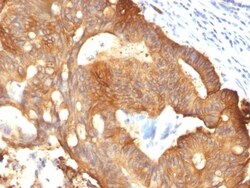
Biotium Cytokeratin 8(B22.1), Biotin conjugate, 0.1mg/mL
Cytokeratin 8 (CK8) belongs to the type II (or B or basic) subfamily of high molecular weight cytokeratins and exists in combination with cytokeratin 18 (CK18). CK8 is primarily found in the non-squamous epithelia and is present in majority of adenocarcinomas and ductal carcinomas. It is absent in squamous cell carcinomas. Hepatocellular carcinomas are defined by the use of antibodies that recognize only cytokeratin 8 and 18. CK8 exists on several types of normal and neoplastic epithelia, including many ductal and glandular epithelia such as colon, stomach, small intestine, trachea, and esophagus as well as in transitional epithelium. Anti-CK8 does not react with skeletal muscle or nerve cells. Epithelioid sarcoma, chordoma, and adamantinoma show strong positivity corresponding to that of simple epithelia (with antibodies against CK8, CK18 and CK19). Reportedly, anti-CK8 is useful for the differentiation of lobular (ring-like, perinuclear) from ductal (peripheral-predominant)
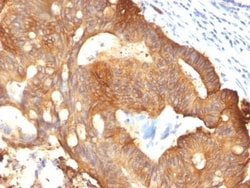
Biotium Cytokeratin 8(B22.1), CF740 conjugate, 0.1mg/mL
Cytokeratin 8 (CK8) belongs to the type II (or B or basic) subfamily of high molecular weight cytokeratins and exists in combination with cytokeratin 18 (CK18). CK8 is primarily found in the non-squamous epithelia and is present in majority of adenocarcinomas and ductal carcinomas. It is absent in squamous cell carcinomas. Hepatocellular carcinomas are defined by the use of antibodies that recognize only cytokeratin 8 and 18. CK8 exists on several types of normal and neoplastic epithelia, including many ductal and glandular epithelia such as colon, stomach, small intestine, trachea, and esophagus as well as in transitional epithelium. Anti-CK8 does not react with skeletal muscle or nerve cells. Epithelioid sarcoma, chordoma, and adamantinoma show strong positivity corresponding to that of simple epithelia (with antibodies against CK8, CK18 and CK19). Reportedly, anti-CK8 is useful for the differentiation of lobular (ring-like, perinuclear) from ductal (peripheral-predominant)
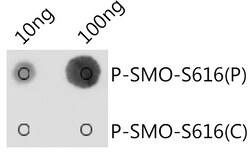
ABclonal Technology Phospho-SMO-S616 Rabbit pAb
The protein encoded by this gene is a G protein-coupled receptor that interacts with the patched protein, a receptor for hedgehog proteins. The encoded protein tranduces signals to other proteins after activation by a hedgehog protein/patched protein complex.
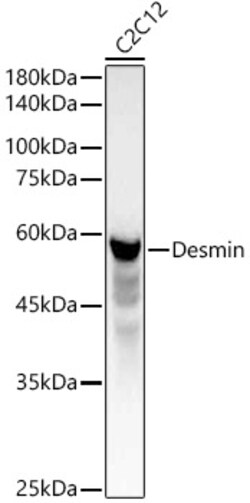
ABclonal Technology Desmin Rabbit pAb
This gene encodes a muscle-specific class III intermediate filament. Homopolymers of this protein form a stable intracytoplasmic filamentous network connecting myofibrils to each other and to the plasma membrane. Mutations in this gene are associated with desmin-related myopathy, a familial cardiac and skeletal myopathy (CSM), and with distal myopathies.