
Substrates


Ubpbio A fluorogenic substrate of proteasomes, preferentially cleaved by immunoproteasomes.

Ac-ANW-AMC is a fluorogenic substrate of the chymotrypsin-like activity of proteasomes. This substrate is preferentially cleaved by immunoproteasomes compared to constitutive proteasomes. The AMC fluorescence can be detected by a fluorimeter or a plate reader using excitation/emission wavelengths at 360 nm/460 nm, respectively. This substrate can be used to determine the chymotrypsin-like activity of immunoproteasomes. Working concentration is 50 - 200 µM.

Ubpbio K48-linked tri-Ubiquitin (human), enzymatically synthesized
Ub chains are formed by conjugating the C-terminal glycine residue of Ub onto any of seven internal lysine residues or the amino group of the previous Ub. Ub chains are classified by the lysine residue used to link Ubs; different Ub chain topologies can result in different signals. For instance, Ub chains linked through lysine 6, 11, 27, 29, 33 and 48 are capable of targeting proteins for proteasomal degradation; in contrast, Ub chains linked through lysine 63 or the N-terminal amino group (linear Ub chains) often play important nonproteolytic functions including regulation of kinase activation and protein translation. All Ub chain products are produced by using of human wild type Ub reacting with specific E2s.
Ubpbio K63-linked polyubiquitin chain mix containing 2-12 human ubiquitin, enzymatically synthesized
Ub chains are formed by conjugating the C-terminal glycine residue of Ub onto any of seven internal lysine residues or the amino group of the previous Ub. Ub chains are classified by the lysine residue used to link Ubs; different Ub chain topologies can result in different signals. For instance, Ub chains linked through lysine 6, 11, 27, 29, 33 and 48 are capable of targeting proteins for proteasomal degradation; in contrast, Ub chains linked through lysine 63 or the N-terminal amino group (linear Ub chains) often play important nonproteolytic functions including regulation of kinase activation and protein translation. All Ub chain products are produced by using of human wild type Ub reacting with specific E2s.
Ubpbio K48-linked polyubiquitin chain mix containing 2-8 human ubiquitin, enzymatically synthesized
Ub chains are formed by conjugating the C-terminal glycine residue of Ub onto any of seven internal lysine residues or the amino group of the previous Ub. Ub chains are classified by the lysine residue used to link Ubs; different Ub chain topologies can result in different signals. For instance, Ub chains linked through lysine 6, 11, 27, 29, 33 and 48 are capable of targeting proteins for proteasomal degradation; in contrast, Ub chains linked through lysine 63 or the N-terminal amino group (linear Ub chains) often play important nonproteolytic functions including regulation of kinase activation and protein translation. All Ub chain products are produced by using of human wild type Ub reacting with specific E2s.
Ubpbio A fluorogenic substrate of the caspase-like activity of proteasomes.
Z-LLE-AMC is a fluorogenic substrate for the peptidylglutamyl peptide hydrolyzing (PGPH) activity or the caspase-like activity of the 20S and 26S proteasomes. Working concentrations of this substrate is 50-200 µM. The released AMC can be detected by a fluorimeter or plate reader at excitation/emission wavelengths of 380 nm/460 nm, respectively. When used to determine proteasome activity in cell lysates, cell lysates that are pre-treated with a proteasome inhibitor such as MG132, PS341 or epoxomicin can be used to determine the fluorescence contributed by other cellular proteases that cleave this substrate. Readings from proteasome inhibitor-treated lysates should be subtracted.
Ubpbio A fluorogenic substrate of the trypsin-like activity of proteasomes
Ac-KQL-AMC is a fluorogenic substrate of the trypsin-like activity of both constitutive and immuno proteasomes. The AMC fluorescence can be detected by a fluorimeter or a plate reader using excitation/emission wavelengths at 360 nm/460 nm, respectively. This substrate can be used to determine the trypsin-like activity of proteasomes. Working concentration is 50 - 200 µM.
Ubpbio K63-linked di-Ubiquitin (human), enzymatically synthesized
Ub chains are formed by conjugating the C-terminal glycine residue of Ub onto any of seven internal lysine residues or the amino group of the previous Ub. Ub chains are classified by the lysine residue used to link Ubs; different Ub chain topologies can result in different signals. For instance, Ub chains linked through lysine 6, 11, 27, 29, 33 and 48 are capable of targeting proteins for proteasomal degradation; in contrast, Ub chains linked through lysine 63 or the N-terminal amino group (linear Ub chains) often play important nonproteolytic functions including regulation of kinase activation and protein translation. All Ub chain products are produced by using of human wild type Ub reacting with specific E2s.
Ubpbio A FRET-based fluorogenic substrate of Papain-like protease (PLPro) from SARS viruses, including SARS-CoV-2. PLPro also has deubiquitinase activity. 5MG
Dabcyl–FRLKGGAPIKGV–Edans is an internally quenched fluorogenic substrate for the SARS-CoV or MERS-CoV family Papain-like protease (PLPro or PLP) that recognizes a LXGG consensus cleavage sites. Upon PLP-mediated cleavage between glycine and alanine, the resulting APIKGV-Edans fluorescence can be monitored at the excitation/emission wavelengths of 355/538 nm, respectively. In addition, PLP has deubiquitinating and deISG15ylation activities.
Ubpbio K63-linked hexa-Ubiquitin (human), enzymatically synthesized
Ub chains are formed by conjugating the C-terminal glycine residue of Ub onto any of seven internal lysine residues or the amino group of the previous Ub. Ub chains are classified by the lysine residue used to link Ubs; different Ub chain topologies can result in different signals. For instance, Ub chains linked through lysine 6, 11, 27, 29, 33 and 48 are capable of targeting proteins for proteasomal degradation; in contrast, Ub chains linked through lysine 63 or the N-terminal amino group (linear Ub chains) often play important nonproteolytic functions including regulation of kinase activation and protein translation. All Ub chain products are produced by using of human wild type Ub reacting with specific E2s.
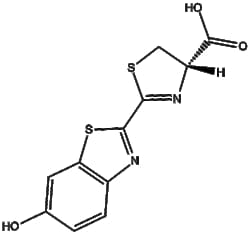
Apexbio Technology LLC D-Luciferin(Synonyms: Firefly Luciferin, Luciferin, Beetle Luciferin, (S)-2-(6'-Hydroxybenzothiazolyl)-Δ2-thiazoline-4-carboxylic acid), 50mg, CAS: 2591-17-5.
D-Luciferin (CAS 2591-17-5) is a membrane-permeable bioluminescent substrate for firefly luciferase characterized by a Km of approximately 2 M In the presence of ATP luciferin undergoes oxidation and decarboxylation catalyzed by luciferase emitting measurable photons This bioluminescence enables quantification of intracellular ATP levels both in vitro and in vivo In biomedical research D-Luciferin is commonly applied for monitoring promoter-driven luciferase gene expression and as a non-invasive imaging probe in bioluminescence imaging (BLI) studies to assess tumor burden pharmacodynamics and cellular ATP content
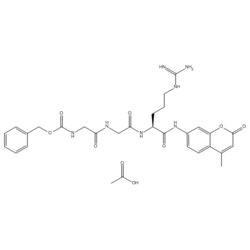
Medchemexpress LLC Z-Gly-Gly-Arg-AMC acetate | 2070009-61-7 | 99.8% | 639.66 | 10 MG
Z-Gly-Gly-Arg-AMC acetate is a thrombin-specific fluorogenic substrate. It is used for testing thrombin generation in platelet-rich plasma (PRP) and platelet-poor plasma (PPP), with excitation/emission wavelengths of 390/480 nm. This product is intended for research use only.
- Thrombin-specific fluorogenic substrate
- Used for testing thrombin generation in platelet-rich plasma and platelet-poor plasma
- Excitation wavelength 390 nm, emission wavelength 480 nm
- Solid appearance, white to off-white color
- Soluble in DMSO at 100 mg/mL and in water at 20 mg/mL
- Store powder at -80°C for 2 years or -20°C for 1 year
- Store in solvent at -80°C for 6 months or -20°C for 1 month in sealed storage, away from moisture and light
TARGETMOL CHEMICALS INC D-Luciferin potassium 100MG
Also available in 1 g, 10 mg, 50 mg, 500 mg and bulk. Please contact Fisher for quotes. D-Luciferin potassium (D-Luciferin K Salt) is a popular bioluminescent substrate of luciferase in the presence of ATP. Purity 99.13%
Cayman Chemical PAD Substrate 1ea
An internal standard for the quantification of propoxur by GC- or LC-MS
Revvity Health Sciences Inc HTRF Biotin-APP-Eu cryptate (BACE1 substrate), 20,000 Assay Points
HTRF Biotin-APP-Eu cryptate (BACE1 substrate), 20,000 Assay Points

Cayman Chemical MPO PeroxIdatIon Substrate 1ea
A FAS-I inhibitor (IC50 79 nM) selective for FAS-I over 30 other enzymes receptors and ion channels at 10 UM inhibits the incorporation of 14C-acetate in mouse N-42 hypothalamus cells (IC50 570 nM) reduces the proliferation of GaMG human glioma cells at 10 UM