Promotional price valid on web orders only. Your contract pricing may differ. Interested in signing up for a dedicated account number?
Learn More
Learn More
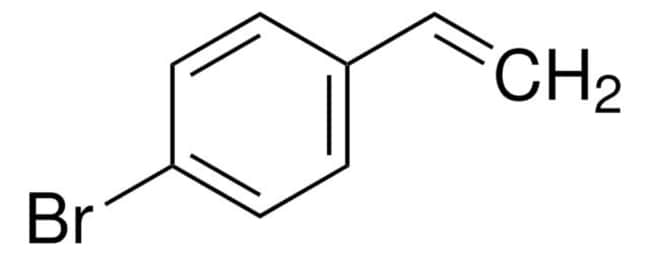

Description
- 4-Bromostyrene is a para-halogenated styrene derivative. The proton spectra of 4-bromostyrene exhibits dipolar couplings consistent with planar ground state structures, only if the torsional motion of lowest frequency occurs at about 80cm-1. It undergoes Heck reaction with 2-bromo-6-methoxynaphthalene in the presence of sodium acetate and Hermann's catalyst in N, N-dimethylacetamide to afford diarylethene. 4-Bromostyrene was used in the following studies:
- Structure-activity relationships (SAR) study of the chemical and biochemical properties of the vinyl group of styrene.
- Synthesis of silsesquioxanes (SQ) having 4-bromostyrenyl substituents.
- To investigate the photochemical growth of Br-terminated self-assembled monolayers (SAMs) on Si(111).
- Synthesis of poly(1,4-phenylenevinylene) via Heck reaction.
- Synthesis of nitroolefins via alkene cross-metathesis.
Specifications
Specifications
| CAS | 2039-82-9 |
| Density | 1.4 g/mL (at 25°C) |
| Boiling Point | 89°C (6 mmHg) |
| Molecular Formula | C8H7Br |
| Refractive Index | n20/D 1.594 (literature) |
| Linear Formula | H2C=CHC6H4Br |
| Quantity | 25 g |
| MDL Number | MFCD00000110 |
| Synonym | 1-(4-Bromophenyl)ethylene; 1-Bromo-4-ethenylbenzene; 1-Bromo-4-vinylbenzene; 4-Vinyl-1-bromobenzene; p -Bromostyrene |
| Molecular Weight (g/mol) | 183.05 |
| Show More |
Product Title
By clicking Submit, you acknowledge that you may be contacted by Fisher Scientific in regards to the feedback you have provided in this form. We will not share your information for any other purposes. All contact information provided shall also be maintained in accordance with our Privacy Policy.
Spot an opportunity for improvement?