Promotional price valid on web orders only. Your contract pricing may differ. Interested in signing up for a dedicated account number?
Learn More
Learn More
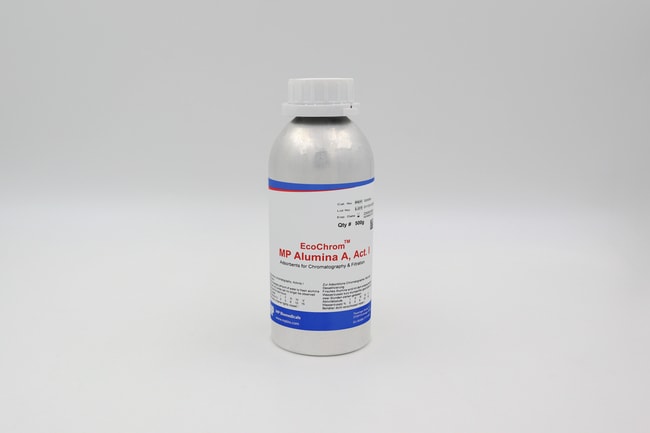


Description
- Alumina A is widely used to remove water from gas streams.
- Also used for its hardness and strength.
- It is widely used as an abrasive, including as a much less expensive substitute for industrial diamond.
- Many types of sandpaper use aluminium oxide crystals.
- In chemistry laboratories, alumina is a medium for chromatography, available in basic (pH 9.5), acidic (pH 4.5 when in water) and neutral formulations, as well as for alcohols, hydrocarbons, steroids, alkaloids and natural pigments.
- Neutral alumina, (less active than the basic form) is useful for separation of aldehydes, ketones, quinones, esters, lactones, and glucosides.
- Acidic alumina, is the weakest and least often used type.
- Alumina is useful for separation of acid pigments and strong acids.
- It can cause polymerization, condensation and dehydration reactions.
- Neither acetone nor ethyl acetate should be used as eluants, the latter being subject to saponification.
- It is used as a dosimeter for radiation protection and therapy applications for its optically stimulated luminescence properties.

Specifications
Specifications
| Color | Pink to White |
| Physical Form | Free-flowing Powder |
| Quantity | 500 g |
| Formula Weight | 101.96 |
| Density | 3.94 g/cm3 (at 20°C) |
| Chemical Name or Material | Alumina A, Activity: I, Activity acc. To Brockmann: 23 l/mm |
Safety and Handling
| Recommended Storage | Store at room temperature. |
Unless specified otherwise, MP Biomedical's products are for research or further manufacturing use only, not for direct human use. For more information, please contact our customer service department.
Product Title
By clicking Submit, you acknowledge that you may be contacted by Fisher Scientific in regards to the feedback you have provided in this form. We will not share your information for any other purposes. All contact information provided shall also be maintained in accordance with our Privacy Policy.
Spot an opportunity for improvement?