Learn More
Description
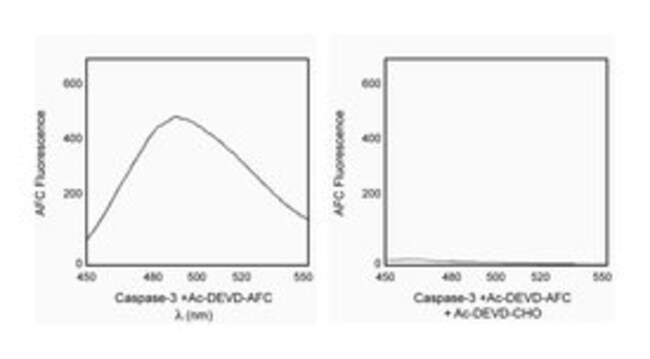
The caspase family of cysteine proteases was discovered following a search of human cDNA libraries for sequences homologous to ced-3, a cell death gene described in the nematode worm C. elegans. The first mammalian homologue of ced-3 to be identified was ICE (interleukin-1α converting enzyme). Subsequently, numerous mammalian ced-3 homologues have been discovered and have each been given a variety of names. To achieve consistency, the term “caspase” was adopted as a root name for all family members. The name reflects the catalytic properties of these enzymes, the “c” denotes their cysteine protease mechanism and “aspase” refers to their ability to cleave after aspartic acid residues. These proteases are expressed as inactive proenzymes, which are proteolytically cleaved into large and small subunits, which form the active enzyme. Active caspase-3 consists of 17 and 12 kDa subunits which are derived from a 32 kDa proenzyme (pro-caspase-3). Activecaspase-3 has been shown to cleave PARP [poly (ADP ribose) polymerase], an enzyme that is involved in DNA repair and genomic maintenance. Proteolysis of the 116 kDa intact form of PARP into 85 and 25 kDa subunits results in loss of normal PARP function. The cleavage site in PARP is C-terminal to Asp-216. The upstream sequence of the PARP cleavage site, DEVD (Asp-Glu-Val-Asp), is utilized as a basis for the highly specific caspase-3 substrate Ac(N-acetyle)-DEVD-AFC (7-amino-4-trifluoromethylcoumarin). Caspase-3 cleaves the tetrapeptide between D and AFC, thus releasing the fluorogenic AFC which can be quantified by U.V. spectrofluorometry. When coupled to an aldehyde group (CHO), the DEVD peptide functions as a potent inhibitor of caspase-3 activity and can be used to block caspase-3 mediated cleavage of Ac-DEVD-AFC. These tetrapeptide substrates can be used to identify and quantitate caspase-3 activity in apoptotic cell lysates.
- Format: Purified
- Molecular weight: 729 Dalton
- Storage buffer: Lyophilized powder
- Purity: ≥98%
Functional assay

Specifications
Specifications
| Form | Lyophilized |
| For Use With (Application) | For Caspase-3, fluorescence quantitation, used in protease assays |
| Quantity | 1 mg |
| Substrate Type | Caspase Substrate |
| Molecular Weight (g/mol) | 729 |
| Storage Requirements | -20°C |
| Substrate Quantity | 1mg |
Research use only.
By clicking Submit, you acknowledge that you may be contacted by Fisher Scientific in regards to the feedback you have provided in this form. We will not share your information for any other purposes. All contact information provided shall also be maintained in accordance with our Privacy Policy.