Promotional price valid on web orders only. Your contract pricing may differ. Interested in signing up for a dedicated account number?
Learn More

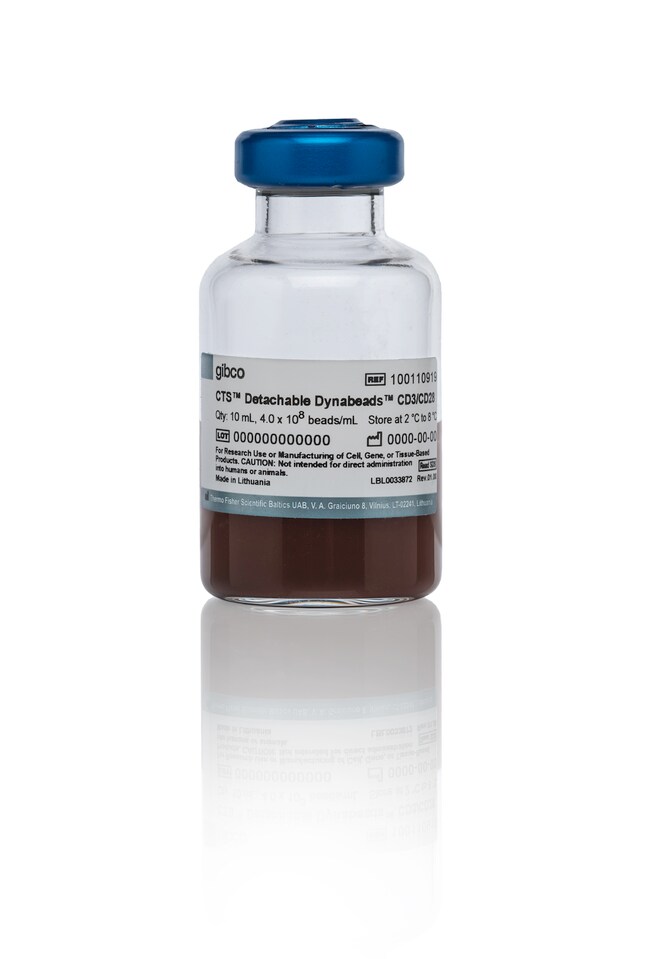
Gibco™ CTS™ Detachable Dynabeads™ CD3/CD28

Catalog No. A56996
Change view
Click to view available options
Quantity:
10 mL
1 product options available for selection
Product selection table with 1 available options. Use arrow keys to navigate and Enter or Space to select.
Catalog No. Quantity
A56996 10 mL
Use arrow keys to navigate between rows. Press Enter or Space to select a product option. 1 options available.
1 options
Catalog No. A56996 Supplier Gibco™ Supplier No. A56996
Only null left
Add to Cart
Edge
Add to Cart
Request a Quote

Gibco CTS Detachable Dynabeads CD3/CD28 magnetic beads are intended for ex vivo isolation and activation of T cells in a simultaneous one-step mechanism.

Gibco CTS Detachable Dynabeads CD3/CD28 magnetic beads are intended for ex vivo isolation and activation of T cells in a simultaneous one-step mechanism. When used in combination with the CTS Detachable Dynabeads Release Buffer (Cat. No. A55883), this offering is the first-of-its-kind cGMP cell selection technology to have an active release mechanism for process development, clinical trial, and commercial manufacturing use.

Features of the CTS Detachable Dynabeads CD3/CD28 include:

  • Empower users with process flexibility by allowing active release of beads from target cells at any time
  • Optimize target cell purity, yield, activation profile, and desired phenotype thanks to the active release mechanism that gives users more control
  • Provide an automation-friendly solution by working directly with the CTS DynaCellect Magnetic Separation System
  • Enable consistent performance in light of biological variability within processes
  • Are suitable for both autologous and allogeneic cell therapy manufacturing processes

Coated with camelid-derived single-domain VHH antibodies that target CD3 and CD28 cell surface markers, these Dynabeads magnetic beads provide both the primary and co-stimulatory signals that are required for activation and expansion of T cells. These Detachable Dynabeads are meant for direct use with the CTS Detachable Dynabeads Release Buffer that has an active ingredient, biotin, that competitively displaces a biotin derivative on the surface of the beads. This proprietary mechanism allows users to achieve active release of the beads from target cells at any time within their process.

Based on a recommended 3-to-1 bead-to-target-cell ratio (not total nucleated cell number), one 10-mL vial can theoretically isolate and activate up to 1.33 x 10⁹ T cells.

CTS Detachable Dynabeads CD3/CD28 also include Drug Master Files (DMFs) to support cross-referencing in regulatory submissions prior to clinical trial and commercial manufacturing use.

Specifications

Concentration 4 x 10⁸ beads/mL
Content And Storage CTS™ Detachable Dynabeads™ CD3/CD28, 10 mL

Store at 2°C to 8°C with vial upright to keep beads in suspension.
Color Brown
Material Polystyrene
Product Type Cell Isolation and Activation Reagent
For Use With (Equipment) CTS™ DynaCellect™ Magnetic Separation System
Product Line CTS Detachable Dynabeads
Purity or Quality Grade GMP-grade
Quantity 10 mL
Shipping Condition Ships at 2°C to 8°C with wet (not frozen) gel packs, keep vial upright to keep beads in suspension
Diameter (Metric) 4.5 μm
Show More Show Less
What is the definition of superparamagnetic, and what does this mean for my cell isolation application with Dynabeads magnetic beads?

Superparamagnetic means that the Dynabeads magnetic beads exhibit magnetic properties when placed within a magnetic field, but have no residual magnetism when removed from the magnetic field.

This means that your targeted cells, proteins, or nucleic acids are only subjected to magnetic forces during the time the beads are on the magnet. The beads do not aggregate, but remain evenly dispersed in suspension.

What are the shipping and storage and conditions for CTS Detachable Dynabeads CD3/CD28 (Cat. No. A56996)?

CTS Detachable DynabeadsCD3/CD28 (Cat. No. A56996) is shipped at 2-8 degrees C. We recommend storing it at 2-8 degrees C, protected from light.

As CTS Detachable Dynabeads CD3/CD28 (Cat. No. A56996) and CTS Dynabeads CD3/CD28 (Cat. No. 40203D) bind to both CD3 and CD28 markers, does that mean that CD3 positive CD28 negative cell subsets are excluded from the positive fraction?

Yes, CTS Detachable Dynabeads CD3/CD28 (Cat. No. A56996) and CTS Dynabeads CD3/CD28 (Cat. No. 40203D) preferentially isolate CD3+ CD28+ double-positive T cells, which are demonstrated to contain the clinically relevant subset of T cells (i.e., CD27 positive, PD-1 negative, CD8 positive CAR T cells).

Also note that CTS Dynabeads is the only isolation technology on the market that excludes exhausted T cells from the manufacturing of the T cell drugs. Please see this reference from University of Pennsylvania & Novartis that used CTS Dynabeads CD3/CD28 in a clinical study of patients with Chronic Lymphocytic Leukemia (CLL): https://pubmed.ncbi.nlm.nih.gov/29713085/

Are there potential risks to patient safety when using CTS Dynabeads or CTS Detachable Dynabeads?

Unlike magnetic beads from our competitors, CTS Dynabeads are not phagocytosed by T cells or incorporated into patients. CTS Dynabeads are inert to T cell phagocytosis and can therefore be removed (using the CTS DynaCellect Magnetic Separation System, Cat. No. A55867) before the final drug is injected into the patient.

There is also no evidence that CTS Dynabeads activate T cells non-specifically. Adding Dynabeads without antibodies, for example, to cell suspensions does not upregulate activation markers nor induces expansion.

What are the antibodies on the surface of CTS Detachable Dynabeads CD3/CD28 (Cat. No. A56996)?

CTS Detachable Dynabeads CD3/CD28 (Cat. No. A56996) are coated with camelid-derived, single-domain (VHH) antibody fragments that identify and bind CD3 and CD28 markers, separately. These antibodies are produced in an Animal origin Free (AOF) yeast-based system, helping to reduce any risk of viral contamination.

What is the shelf-life for CTS Detachable Dynabeads CD3/CD28 (Cat. No. A56996)?

At the time of launch to market for CTS Detachable Dynabeads CD3/CD28 (Cat. No. A56996) in 2023, the shelf-life was 6 months, but our plan is to extend the shelf-life to 9, 12, 18, 24, 36, 48, and 60 months on a rolling basis. Therefore, our expectation is that the shelf-life will be 5 years by the year 2028.

When using CTS Detachable Dynabeads CD3/CD28 (Cat. No. A56996), what is the recommended ratio of CTS Detachable Dynabeads CD3/CD28 to target T cells?

When using CTS Detachable Dynabeads CD3/CD28 (Cat. No. A56996) for simultaneous isolation and activation in one step, we recommend a 3:1 ratio of Dynabeads to target T cells. Please do not calculate it based on the number of total nucleated cells in your starting material.

When using CTS Detachable Dynabeads CD3/CD28 for activation only, downstream of a separate isolation step with a separate isolation reagent, the recommended ratio of Dynabeads to target T cells is 1:1.

Are CTS Dynabeads and CTS Detachable Dynabeads for clinical trial and commercial manufacturing use?

Yes, CTS Dynabeads and CTS Detachable Dynabeads are GMP-grade and CTS-branded, which means that they are eligible for use in process development, clinical trials, and commercial manufacturing.

Thermo Fisher Scientific’s Cell Therapy Systems (CTS) translates to cGMP manufacturing, testing, and traceability documentation (such as Drug Master Files and Regulatory Support Files) for customer filing needs, and a proven track record of use in many clinical trials and commercialized drugs on the market.

The CTS Dynabeads portfolio, specifically, has been actively used in over 200 clinical trials in 2023 as well as in a number of FDA-approved drugs for commercial use.

How does the active release mechanism work for CTS Detachable Dynabeads?

CTS Detachable Dynabeads are meant to be used with the CTS Detachable Dynabeads Release Buffer that comes in a bioprocess container compatible with our CTS DynaCellect Magnetic Separation System for automated workflows.

After the isolation step, the Dynabeads-bound T cells are incubated with the CTS Detachable Dynabeads Release Buffer to actively detach the cells from the Dynabeads. The CTS Detachable Dynabeads Release Buffer contains d-biotin that outcompetes a biotin derivative on the surface of CTS Detachable Dynabeads. It is not an enzymatic reaction.

Users may then rely on the CTS DynaCellect Magnetic Separation System to magnetically separate CTS Detachable Dynabeads from target T cells so they are left with a highly pure target T cell population in the positive fraction.

Do I need to purchase any other product along with CTS Detachable Dynabeads CD3/CD28 (Cat. No. A56996) to perform the active release of the CTS Detachable Dynabeads CD3/CD28?

Yes, you would need to also purchase the CTS Detachable Dynabeads Release Buffer in order to take advantage of the active release mechanism for CTS Detachable Dynabeads CD3/CD28. The CTS Detachable Dynabeads Release Buffer contains d-biotin that outcompetes a biotin derivative on the surface of CTS Detachable Dynabeads CD3/CD28. It is not an enzymatic reaction.

After the active release of CTS Detachable Dynabeads CD3/CD28, you may use the CTS DynaCellect Magnetic Separation System to magnetically separate the CTS Detachable Dynabeads CD3/CD28 from target T cells so that you are left with a highly pure target T cell population in the positive fraction.

Are CTS Detachable Dynabeads compatible with any cell culture media?

Due to the presence of biotin in the CTS Detachable Dynabeads Release Buffer, we do not recommend using CTS Detachable Dynabeads with media that already contain high amounts of biotin, such as RPMI media. Instead, we recommend pairing with media such as our CTS OpTmizer SFM and CTS OpTmizer Pro SFM.

Note: Internal studies have shown that the biotin in the CTS Detachable Dynabeads Release Buffer does not have any impact on cell phenotype or viability.

Are Dynabeads compatible with centrifugation?

Dynabeads are not designed or intended to be used with centrifugation. Pressure from centrifugal forces should not theoretically be a problem for the Dynabeads themselves due to their rigid nature and composition. However, the force exerted by the Dynabeads on surrounding cells within the pellet may be detrimental to cell viability.

What is the concentration of Dynabeads in CTS Detachable Dynabeads?

Each vial contains 4x10E8 Dynabeads per mL.

What is the benefit of CTS Detachable Dynabeads CD3/CD28 (Cat. No. A56996) having VHH antibody fragments for both CD3 and CD28?

Thermo Fisher Scientific is the only supplier that has GMP-grade reagents with a technology that can both isolate and activate T cells in a one-step mechanism. This is enabled by CTS Detachable Dynabeads CD3/CD28 (Cat. No. A56996) where both CD3 and CD28 VHH antibody fragments are present on the surface of the CTS Detachable Dynabeads.

The advantage is that users do not need another reagent to perform activation steps downstream from target T cell isolation. Instead, they can save process time, steps, and additional costs that would normally be required had they used separate reagents for isolation and cell activation.

What makes Dynabeads magnetic?

Dynabeads magnetic beads are uniform, non-porous, superparamagnetic, monodispersed and highly crosslinked polystyrene microspheres consisting of an even dispersion of magnetic material throughout the bead. The magnetic material within the Dynabeads magnetic beads consists of a mixture of maghemite (gamma-Fe2O3) and magnetite (Fe3O4). The iron content (Fe) of the beads is 20% by weight in our M-450 Dynabeads.

Dynabeads magnetic beads are also coated with a thin polystyrene shell which encases the magnetic material and prevents any leakage from the beads or trapping of ligands in the bead interior. The shell also protects the target from exposure to iron while providing a defined surface area for the adsorption or coupling of various molecules.

The uniformity of Dynabeads' size and shape provides consistent physical and chemical properties. These uniform physical characteristics lead to high-quality, reproducible results.

When using CTS Detachable Dynabeads, what is the level of residual Dynabeads left after the bead removal step?

This depends on the total number of cells that you are processing in a single run and the total number of Dynabeads used. However, our large-scale studies with 10-liter volumes on the CTS DynaCellect Magnetic Separation System yielded less than 25 residual Dynabeads per 3 million cells. And with 1-liter volumes, performance was even better as we observed less than 5 residual Dynabeads per 3 million cells (again in internal studies).

As a reference point, most regulatory agencies have an unofficial minimum threshold of 100 residual beads per 3 million cells.

Can I try out CTS Detachable Dynabeads but do so manually with columns, and not with the CTS DynaCellect Magnetic Separation System?

All of our CTS Detachable Dynabeads products are intended to be used with the CTS DynaCellect Magnetic Separation System. While small DynaMag magnets can be used to assess the functionality of the product in a laboratory scale, it does not allow you to see the full benefits or accurate performance should you decide to scale up to clinical or commercial manufacturing.

Using our CTS Detachable Dynabeads without the CTS DynaCellect Magnetic Separation System is not representative of the yield and purity obtained in the automated closed system.

What is the level of support offered when using CTS Dynabeads and CTS Detachable Dynabeads in clinical trials and commercial manufacturing?

Our CTS Dynabeads and CTS Detachable Dynabeads are supported with Drug Master Files (DMFs), Regulatory Support Files (RSFs), and other traceability documentation.

We have dedicated resources from our Quality and Regulatory teams to support customers who enter into a Commercial Supply Agreement with us.

Is there any research evidence demonstrating that CD3+CD28+ T cells are better than CD3+ only T cells in immunotherapy? Some researchers hypothesize that if CD3+CD28- T cells are excluded, important subsets may be missed and cell recovery would be lower.

CD28- T cells in the starting material prior to manufacturing are associated with exhausted T cells and not relevant for the clinical efficacy nor persistence of the T cell drug in vivo in the patient.

Naive T cells require three essential signals for activation: T cell receptor (or CD3) engagement, co-stimulatory receptors (such as CD28) activation, and cytokine stimulation (IL-2 for expansion). Activated T cells downregulate the co-stimulatory molecule CD28 and loosen its expression altogether upon chronic antigen exposure. Downregulation of CD28 is a hallmark of senescent T cells. CD3+CD28- cells are therefore activated T cells and are susceptible to activation-induced cell death (AICD) if re-stimulated in the absence of the co-stimulatory receptor CD28. If isolated, these cells will die during the first hours of the expansion process.

Please see the following references:
https://www.ncbi.nlm.nih.gov/pmc/articles/PMC6600236/
https://onlinelibrary.wiley.com/doi/abs/10.1111/j.0105-2896.2005.00256.x
https://pubmed.ncbi.nlm.nih.gov/10882412/

As CTS Detachable Dynabeads CD3/CD28 (Cat. Nos. A56996) and CTS Dynabeads CD3/CD28 (Cat. No. 40203D) bind to both CD3 and CD28 markers, does it mean that CD3 positive CD28 negative cell subsets are excluded from the positive fraction?

Yes, CTS Detachable Dynabeads CD3/CD28 (Cat. No. A56996) and CTS Dynabeads CD3/CD28 (Cat. No. 40203D) preferentially isolate CD3+ CD28+ double-positive T cells, which are demonstrated to contain the clinically relevant subset of T cells (i.e., CD27 positive, PD-1 negative, CD8 positive CAR T cells).

Also note that CTS Dynabeads is the only isolation technology on the market that excludes exhausted T cells from the manufacturing of T cell drugs. Please see this reference from University of Pennsylvania & Novartis that used CTS Dynabeads CD3/CD28 in a clinical study of patients with Chronic Lymphocytic Leukemia (CLL): https://pubmed.ncbi.nlm.nih.gov/29713085/

What is the difference between CTS Detachable Dynabeads CD3/CD28 (Cat. No. A56996) and CTS Dynabeads CD3/CD28 (Cat. No. 40203D)?

When used with the CTS Detachable Dynabeads Release Buffer, CTS Detachable Dynabeads CD3/CD28 (Cat. No. A56999) can be actively detached from target T cells at any desired time.

On the other hand, CTS Dynabeads CD3/CD28 (Cat. No. 40203D) that launched to market in 2006 may not be actively detached from target T cells. They passively dissociate from the target T cells post-isolation, over time, based on the binding kinetics of antibodies conjugated to the surface.

Please note that both products contain the same M-450 Dynabeads microspheres at their core but all other raw materials used, such as the antibodies, are different between the two products.


For Research Use or Manufacturing of Cell, Gene, or Tissue-Based Products. CAUTION: Not intended for direct administration into humans or animals.

Product Title
Select an issue

By clicking Submit, you acknowledge that you may be contacted by Fisher Scientific in regards to the feedback you have provided in this form. We will not share your information for any other purposes. All contact information provided shall also be maintained in accordance with our Privacy Policy.