Learn More
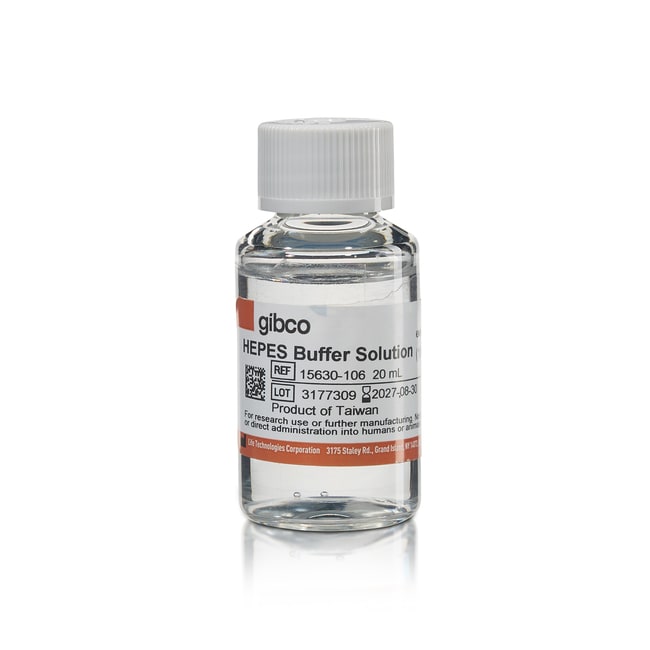
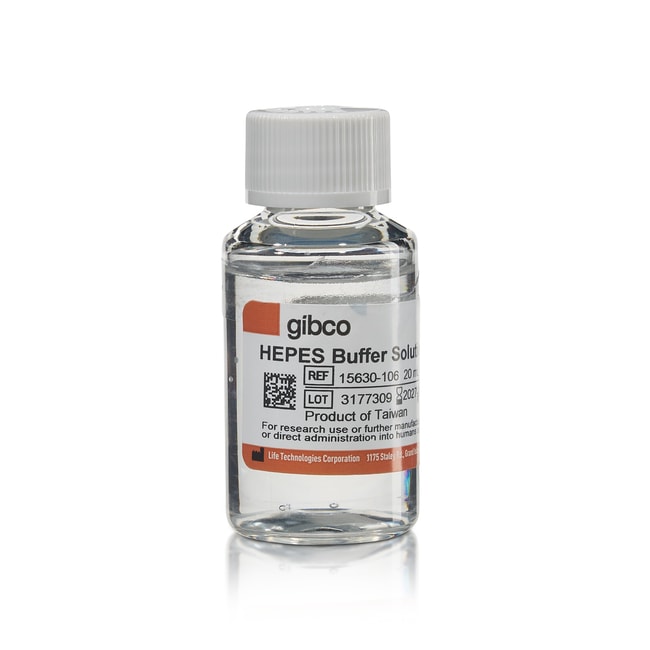

Gibco™ HEPES (1 M)


Description
Gibco HEPES (4-(2-hydroxyethyl)-1-piperazineethanesulfonic acid) is a zwitterionic organic chemical buffering agent commonly used in cell culture media. The addition of 10–25 mM HEPES provides extra buffering capacity when cell culture requires extended periods of manipulation outside of a CO2 incubator.
Gibco HEPES (N-2-hydroxyethylpiperazine-N-2-ethane sulfonic acid) is a good buffering choice for many cell culture systems because it:
- Is membrane impermeable
- Has limited effect on biochemical reactions
- Is chemically and enzymatically stable
- Has a very low visible and UV light absorbance
cGMP manufacturing and quality system
For supply chain continuity, we manufacture this product at two separate facilities located in Grand Island, NY, and Scotland, UK. Both sites are compliant with cGMP manufacturing requirements and are certified to the ISO 13485 standard.
Order Info
Shipping Condition: Room Temperature

Specifications
Specifications
| Chemical Name or Material | Zwitterionic Organic Chemical Buffer |
| CAS | 7365-45-9 |
| Concentration | 1 M |
| For Use With (Application) | Chromatin Biology |
| pH | 7 to 7.5 |
| Physical Form | Liquid |
| Quantity | 20 mL |
| Solution Type | Buffer |
| Formulation | N-2-Hydroxyethylpiperazine-N-2-Ethane Sulfonic Acid |
| Sterility | Sterile |
| Show More |
Frequently Asked Questions (FAQs)
If the media formulation contains:
NaHCO3 (g/L) < 1.5, it needs CO2 at 4%;
NaHCO3 (g/L) 1.5 – 2.2, it needs CO2 at 5%;
NaHCO3 (g/L) 2.2 - 3.4, it needs CO2 at 7%;
NaHCO3 (g/L) > 3.5, it needs CO2 at 10% .
*There are some exceptions. Gibco DMEM has always been made according to Dulbecco’s original published formulation, with 3.7 g/L sodium bicarbonate. Customers have been using this medium in CO2 incubators ranging from 5-10% CO2 for decades, usually with no trouble maintaining physiological pH. This also depends on the cell type. Once cells are growing, the pH will drop (due to metabolic accumulation of lactic acid).
Sodium bicarbonate is necessary to control the pH of the solution. To maintain physiological pH, the concentration of the sodium bicarbonate in the medium must be matched with the right level of CO2 in the atmosphere above the medium in the incubator*.
If the sodium bicarbonate is high and the CO2 concentration is low, the pH will become alkaline. This is something that you will see in a bottle of media when it is exposed to air for long periods or when there is a lot of head space in the bottle. The media color will be pinkish or purplish. When this media is put back into a CO2 incubator, the color/pH will change back to the normal orangeish/reddish color or physiological pH.
If the sodium bicarbonate is low and the CO2 is high, the pH will become acidic. This is something you will see when you put medium into a 5% or 10% CO2 incubator.
*There are some exceptions. For instance, Gibco DMEM has always been made according to Dulbecco’s original published formulation, with 3.7g/L sodium bicarbonate. Customers have been using this medium in CO2 incubators ranging from 5-10% CO2 for decades, usually with no trouble maintaining physiological pH. this also depends on the cell type, Once cells are growing, the pH will drop (due to metabolic accumulation of lactic acid).
This product should be stored at 2-8 degrees C and should not be frozen. The biggest issue with accidentally freezing this product is its solubility. If this product was accidentally frozen, we recommend placing it in a 2-8 degree environment and allowing it to slowly thaw overnight. If the product is fully thawed and shows no signs of precipitation, then it should still be usable, but we cannot guarantee effectiveness.
1M HEPES is in water with a pH range of 7.2 - 7.5.
Sorry, we do not test endotoxin levels for this product.
For Research Use or Further Manufacturing. Not for diagnostic use or direct administration into humans or animals.
By clicking Submit, you acknowledge that you may be contacted by Fisher Scientific in regards to the feedback you have provided in this form. We will not share your information for any other purposes. All contact information provided shall also be maintained in accordance with our Privacy Policy.