Promotional price valid on web orders only. Your contract pricing may differ. Interested in signing up for a dedicated account number?
Learn More

Gibco™ Human Mesothelin Recombinant Protein, PeproTech®

Catalog No. 10063100UG
Encompass_Preferred
Change view
Click to view available options
Quantity:
1 mg
10 μg
100 μg
250 μg
50 μg
500 μg
6 product options available for selection
Product selection table with 6 available options. Use arrow keys to navigate and Enter or Space to select.
Catalog No. Quantity
10063100UG 100 μg
100-63-10UG 10 μg
100-63-1MG 1 mg
10063250UG 250 μg
10063500UG 500 μg
100-63-50UG 50 μg
Use arrow keys to navigate between rows. Press Enter or Space to select a product option. 6 options available.
6 options
This item is not returnable. View return policy
Catalog No. 10063100UG Supplier Gibco™ Supplier No. 10063100UG
Only null left
Add to Cart
Edge
Add to Cart
This item is not returnable. View return policy

Recombinant Protein

PeproTech's CHO cell-derived Recombinant Human Mesothelin is a glycoprotein containing 327 amino acid residues, and has a calculated molecular weight of approximately 36.4 kDa. As a result of glycosylation, Recombinant Human Mesothelin migrates with an apparent molecular mass of approximately 40-45 kDa by SDS-PAGE gel, under reducing and non-reducing conditions. This product is shipped at ambient temperature. For storage, handling and reconstitution information, please see the lot-specific Certificate of Analysis

Originally identified as a differentiation antigen of mesotheliomas, ovarian cystadenocarcinomas, and pancreatic adenocarcinomas, Mesothelin is a glycosylphosphatidylinositol (GPI)-anchored, cell-surface glycoprotein predominantly secreted by cells of the mesothelium. Although Mesothelin is expressed at restricted levels by normal mesothelial cells of the pleural,pericardial, and peritoneal membranes, aberrant expression has been documented in the aforementioned cancers, as well as in endometriod uterine adenocarcinomas and squamous cell carcinomas of the esophagus, stomach, lung, and cervix. Proteolytic cleavage of Mesothelin yields a soluble, polypeptide fragment designated megakaryocyte potentiating factor (MPF) based on its ability to stimulate megakaryocyte colony-forming activity of murine interleukin-3 in murine bone marrow cell cultures. Originally isolated from the HPC-Y5 pancreatic cell line, MPF has been suggested to play a role in the proliferation and differentiation of megakaryoctyes, and the regulation of resultant platelet production. While the biological functions of both Mesothelin and MPF remain speculative, high-levels of expression in cancerous tissues compared to limited distribution in normal tissues strongly suggests their involvement in tumorigenesis. Both have been demonstrated to promote tumor cell proliferation, migration,anchorage-independent growth, and tumor progression; demonstrating their involvement in heterotypic cell adhesion and the metastatic spread of cancer.
TRUSTED_SUSTAINABILITY

Specifications

Accession Number Q13421
For Use With (Application) Control, ELISA Standard, Binding Assay, Bioactivity
Formulation Protein with no preservative
Gene ID (Entrez) 10232
Molecular Weight (g/mol) 36.4 kDa
Name Human Mesothelin
Purification Method Purified
Quantity 100 μg
Source CHO cells
Storage Requirements -20°C
Regulatory Status RUO
Endotoxin Concentration <1 EU/μg
Gene Alias CAK1; CAK1 antigen; megakaryocyte potentiating factor; Megakaryocyte-potentiating factor; Mes; Mesothelin; Mesothelin, cleaved form; MPF; MSLN; Pre-pro-megakaryocyte-potentiating factor; SMR; SMRP; soluble MPF mesothelin related protein
Common Name Mesothelin
Gene Symbol MSLN
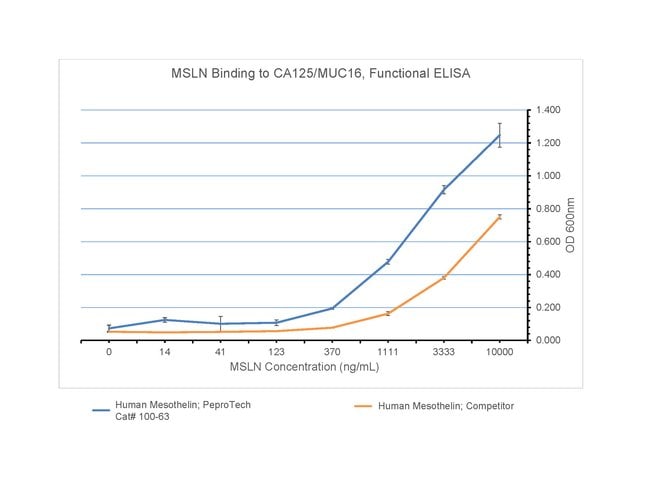
Biological Activity Determined by its ability to bind immobilized recombinant CA125/MUC16 in a functional ELISA.
Product Type Protein
Conjugate Unconjugated
Recombinant Recombinant
Sequence EVEKTACPSG KKAREIDESL IFYKKWELEA CVDAALLATQ MDRVNAIPFT YEQLDVLKHK LDELYPQGYP ESVIQHLGYL FLKMSPEDIR KWNVTSLETL KALLEVNKGH EMSPQVATLI DRFVKGRGQL DKDTLDTLTA FYPGYLCSLS PEELSSVPPS SIWAVRPQDL DTCDPRQLDV LYPKARLAFQ NMNGSEYFVK IQSFLGGAPT EDLKALSQQN VSMDLATFMK LRTDAVLPLT VAEVQKLLGP HVEGLKAEER HRPVRDWILR QRQDDLDTLG LGLQGGIPNG YLVLDLSMQE ALSGTPCLLG PGPVLTVLAL LLASTLA
Content And Storage -20°C
Activity Determined by its ability to bind immobilized recombinant CA125/MUC16 in a functional ELISA.
Expression System CHO cells
Form Lyophilized
Purity or Quality Grade ≥ 95% by SDS-PAGE gel and HPLC analyses.
Show More Show Less
Product Title
Select an issue

By clicking Submit, you acknowledge that you may be contacted by Fisher Scientific in regards to the feedback you have provided in this form. We will not share your information for any other purposes. All contact information provided shall also be maintained in accordance with our Privacy Policy.