Promotional price valid on web orders only. Your contract pricing may differ. Interested in signing up for a dedicated account number?
Learn More

Gibco™ Human TLR-3 Recombinant Protein, PeproTech®

Catalog No. 1600125UG
Encompass_Preferred
Change view
Click to view available options
Quantity:
25 μg
1 product options available for selection
Product selection table with 1 available options. Use arrow keys to navigate and Enter or Space to select.
Catalog No. Quantity
160-01-25UG 25 μg
Use arrow keys to navigate between rows. Press Enter or Space to select a product option. 1 options available.
1 options
This item is not returnable. View return policy
Catalog No. 160-01-25UG Supplier Gibco™ Supplier No. 1600125UG
Add to Cart
Edge
Add to Cart
This item is not returnable. View return policy

Recombinant Protein

160-01-1MG will be provided as 5 x 200 μg (160-01-200UG). 160-01-500UG will be provided as multiple 100 μg (160-01-100UG) and 200 μg (160-01-200UG) vials. Recombinant Human TLR-3 is 77.4 kDa glycoprotein containing 681 residues which comprise the TLR-3 extracellular domain. This product is shipped at ambient temperature. For storage, handling and reconstitution information, please see the lot-specific Certificate of Analysis.

TLR3 (Toll-like receptor 3, CD283) is a member of the Toll-like receptor (TLR) family which plays a fundamental role in pathogen recognition and activation of innate immunity. TLRs are highly conserved from drosophila to humans and share structural and functional similarities. TLRs recognize pathogen-associated molecular patterns (PAMPs) that are expressed on infectious agents, and mediate the production of cytokines necessary for the development of effective immunity. The various TLRs exhibit different patterns of expression. TLR3 is most abundantly expressed in placenta and pancreas, and is restricted to the dendritic subpopulation of the leukocytes. TLR3 recognizes dsRNA associated with viral infection, and induces the activation of NF-kappaB and the production of type I interferons. Further, TLR3 may play a role in host defense against viruses, and the use of alternative polyadenylation sites to generate different length transcripts has been noted for the TLR3 gene. Like its counterparts in Drosophila, TLRs signal through adaptor molecules and could constitute an important and unrecognized component of innate immunity in humans. The TLR family is a phylogenetically conserved mediator of innate immunity that is essential for microbial recognition. TLRs characterized so far activate the MyD88/interleukin-1 receptor-associated kinase (IRAK) signaling pathway. TLR3 is the only human TLR which does not utilize MyD88 as an adaptor molecule instead utilizing TRIF in a signaling path which results in downstream activation of IRF-3 and NF-kB. TLR3 activation leads not only to Type I interferon induction but also to other inflammatory cytokines which result in DC maturation. TLR3 is known to recognize viral double-stranded (ds) RNA, a molecular pattern associated with viral infection. Recently it has been shown to recognize viruses such as Influenza A and West Nile Virus and can mediate entry of at least West Nile Virus.
TRUSTED_SUSTAINABILITY

Specifications

Accession Number O15455
For Use With (Application) Control, Bioactivity
Formulation Protein with no preservative
Gene ID (Entrez) 7098
Molecular Weight (g/mol) 77.4 kDa
Name Human TLR-3
Purification Method Purified
Quantity 25 μg
Source HEK293 cells
Storage Requirements -20°C
Regulatory Status RUO
Endotoxin Concentration <1 EU/μg
Gene Alias AI957183; CD283; IIAE2; TLR 3; TLR3; TLR-3; toll like receptor 3; toll-like receptor 3; toll-like receptor 3 variant 1
Common Name TLR3 (CD283)
Gene Symbol TLR3
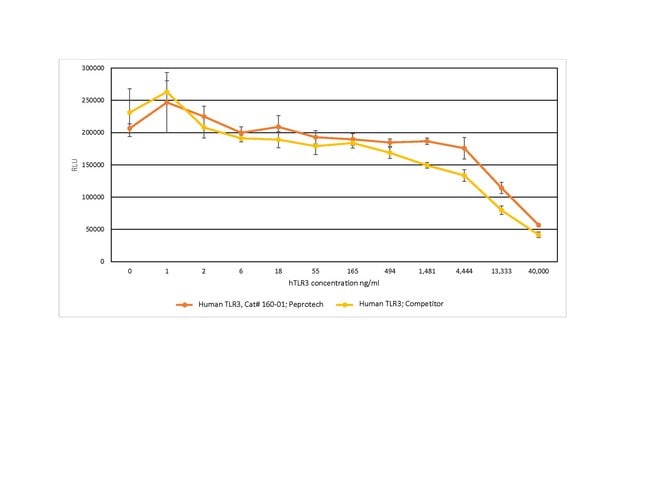
Biological Activity Determined by its ability to neutralize Poly I:C induced NF-kappaB signaling in HT-29 cells stably transfected with NF-kappaB-luc. The ED50 for this effect is 5-10 ug/ml
Product Type Protein
Conjugate Unconjugated
Recombinant Recombinant
Sequence STTKCTVSHE VADCSHLKLT QVPDDLPTNI TVLNLTHNQL RRLPAANFTR YSQLTSLDVG FNTISKLEPE LCQKLPMLKV LNLQHNELSQ LSDKTFAFCT NLTELHLMSN SIQKIKNNPF VKQKNLITLD LSHNGLSSTK LGTQVQLENL QELLLSNNKI QALKSEELDI FANSSLKKLE LSSNQIKEFS PGCFHAIGRL FGLFLNNVQL GPSLTEKLCL ELANTSIRNL SLSNSQLSTT SNTTFLGLKW TNLTMLDLSY NNLNVVGNDS FAWLPQLEYF FLEYNNIQHL FSHSLHGLFN VRYLNLKRSF TKQSISLASL PKIDDFSFQW LKCLEHLNME DNDIPGIKSN MFTGLINLKY LSLSNSFTSL RTLTNETFVS LAHSPLHILN LTKNKISKIE SDAFSWLGHL EVLDLGLNEI GQELTGQEWR GLENIFEIYL SYNKYLQLTR NSFALVPSLQ RLMLRRVALK NVDSSPSPFQ PLRNLTILDL SNNNIANIND DMLEGLEKLE ILDLQHNNLA RLWKHANPGG PIYFLKGLSH LHILNLESNG FDEIPVEVFK DLFELKIIDL GLNNLNTLPA SVFNNQVSLK SLNLQKNLIT SVEKKVFGPA FRNLTELDMR FNPFDCTCES IAWFVNWINE THTNIPELSS HYLCNTPPHY HGFPVRLFDT SSCKDSAPFE L
Content And Storage -20°C
Activity Determined by its ability to neutralize Poly I:C induced NF-kappaB signaling in HT-29 cells stably transfected with NF-kappaB-luc. The ED50 for this effect is 5-10 ug/ml.
Expression System HEK293 cells
Form Lyophilized
Purity or Quality Grade ≥ 95% by SDS-PAGE gel and HPLC analyses.
Show More Show Less
Product Title
Select an issue

By clicking Submit, you acknowledge that you may be contacted by Fisher Scientific in regards to the feedback you have provided in this form. We will not share your information for any other purposes. All contact information provided shall also be maintained in accordance with our Privacy Policy.