Promotional price valid on web orders only. Your contract pricing may differ. Interested in signing up for a dedicated account number?
Learn More

Invitrogen™ Human VEGF-165 Recombinant Protein

Catalog No. ENRVEGFI
Change view
Click to view available options
Quantity:
20 μg
1 product options available for selection
Product selection table with 1 available options. Use arrow keys to navigate and Enter or Space to select.
Catalog No. Quantity
ENRVEGFI 20 μg
Use arrow keys to navigate between rows. Press Enter or Space to select a product option. 1 options available.
1 options
Catalog No. ENRVEGFI Supplier Invitrogen™ Supplier No. RVEGFI
Add to Cart
Edge
Add to Cart

Recombinant Protein

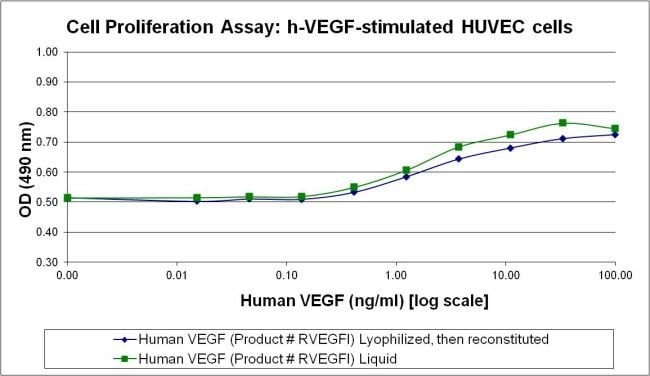
Mature human VEGF165 was expressed in Pichia pastoris, KM71. GenBank Accession # 003376, amino acids 27 - 191. For protein verification, the expressed protein was N-terminal sequenced and begins with the following 10 amino acids: EGGGQNHHEV. Purity is >95% by SDS-PAGE analyses. Activity: The biological activity of recombinant human VEGF165 was determined by measuring the proliferation of human umbilical vein endothelial cells (HUVEC). Use: For in vitro applications. A dose-response assay should be performed to determine the optimal concentration for specific experiments. Reconstitution and Dilution: Store lyophilized material at 4°C. Reconstitute in 1 mL of distilled or deionized water. Dilute in a buffer-containing carrier protein, aliquot, and store at or below -70°C, avoiding multiple freeze-thaw cycles. PBS with 1% BSA or a neutral media containing <10% FCS are suitable buffers.

The vascular endothelial growth factor (VEGF) family currently includes VEGF-A, VEGF-B, VEGF-C, VEGF-D, VEGF-E, and PIGF. VEGF and its receptor system have been shown to be the fundamental regulators in the cell signaling of angiogenesis. Most tumors have the absolute requirement of angiogenesis and VEGF has been described as the most potent angiogenic cytokine linked to this process. To date 5 different isoforms of VEGF have been described. These isoforms are generated as the result of alternative splicing from a single VEGF gene. These various isoforms have been shown to bind to two tyrosine-kinase receptors flt-1 (VEGFR-1) and flk-1/KDR (VEGFR-2), which have been found to be expressed almost exclusively on endothelial cells.
TRUSTED_SUSTAINABILITY

Specifications

Accession Number P15692
For Use With (Application) Bioactivity
Formulation PBS with no preservative
Gene ID (Entrez) 7422
Molecular Weight (g/mol) 19.2 kDa
Name Human VEGF-165
Purification Method Purified
Quantity 20 μg
Source Yeast
Storage Requirements 4°C
Regulatory Status RUO
Gene Alias H-VEGF-165; MVCD1; M-VEGF-165; vascular endothelial growth factor 165b; vascular endothelial growth factor A; vascular endothelial growth factor A121; vascular endothelial growth factor A165; vascular permeability factor; VEGF; VEGF164; VEGF165; Vegfa; VEGF-A; VPF
Common Name VEGF-165
Gene Symbol Vegfa
Biological Activity Determined by the proliferation effect on human umbilical vein endothelial cells (HUVECs).
Product Type Protein
Conjugate Unconjugated
Species Yeast
Recombinant Recombinant
Sequence Human VEGF-165, amino acids 27-191 (Accession # 003376)
Content And Storage 4°C
Activity Determined by the proliferation effect on human umbilical vein endothelial cells (HUVECs).
Expression System P. pastoris
Form Lyophilized
Protein Subtype Recombinant
Purity or Quality Grade >95% by SDS-PAGE
Show More Show Less
What is the relationship between specific activity units and International Units of activity?

There is no direct correlation or calculation between specific activity unit and International Unit (IU) values. International Units (IU) express a quantification of activity for the base amount of a substance in relation to an analogous reference standard with an internationally accepted unit of biological potency (i.e., IU/ng) that has been assigned based on an International Collaborative Study conducted by the World Health Organization (WHO). WHO Reference Standards are made available by the National Institute for Biological Standards and Control (NIBSC). Intended to simplify the comparison of activity of a substance obtained from different sources, IU measurements can vary as comparison methods are rarely the same between sources. A true direct comparison requires standardized methods of analysis in order to guarantee comparability of the substance’s activity in relation to its mass across sources.

Why can't I see the protein pellet in the vial for my lyophilized recombinant protein? Is this normal?

Gibco recombinant proteins are frequently formulated without carrier proteins or additives (e.g., BSA, HSA, sucrose, etc.) and Gibco PeproTech recombinant proteins don't contain a carrier protein. As a result, during lyophilization, the protein product may be deposited on the vial as a thin, and sometimes invisible film instead of a pellet. The size of the pellet, if any, is not directly related to the quantity of the recombinant protein in the vial. Our quality control procedures assure that each vial contains the correct amount of product.

To ensure complete recovery of protein product, before opening a vial of lyophilized recombinant protein, we recommend centrifuging it in a microcentrifuge for 20-30 seconds to drive any protein that may be lodged in the cap or on the side or the bottom of the vial. After reconstitution, you can confirm the presence of product protein by running a small amount on SDS-PAGE. In general, a protein band with expected size should be visible with as little as 10 ng of protein loaded on an acrylamide gel.

Does a particular recombinant protein contain the wild-type or mutated amino acid sequence?

Protein sequence information is available on the individual product page, except for proprietary engineered proteins.

What kind of tubes should I use for storing aliquots of reconstituted recombinant proteins?

In general, we recommend using polypropylene tubes for storing aliquots of reconstituted recombinant proteins. Specific information for appropriate storage and handling of many recombinant proteins can be found on the product pages.

Does each lot of recombinant protein have the same specific activity?

No, each lot can vary slightly with regards to its specific activity. The information on the data sheet for each product is provided as a guide. For lot-specific information, please please check the Certificate of Analysis or contact Technical Support.

What is the specific activity of my recombinant protein?

The ED50 for each functionally active recombinant protein can be found on its product page under Activity as well as in the data sheet. The specific activity (units/mg) for each recombinant protein can be determined from the ED50 using information available in our Tech Tip here: https://assets.thermofisher.com/TFS-Assets/BID/Technical-Notes/converting-ed50-ng-ml-specific-activity-units-mg-tech-note.pdf

What is the shelf life of your recombinant proteins?

The majority of our recombinant proteins have a guaranteed shelf life of one year unless otherwise indicated in our technical data sheets. This guarantee applies only if the recombinant protein is stored under the conditions stated in the data sheet. If you are not completely satisfied with the performance of the product, please contact Technical Support at techsupport@thermofisher.com for assistance.

Why is my recombinant protein not soluble?

The solubility issue might be due to improper handling, or use of a solvent other than the one we recommended. We recommend that you warm the lyophilized powder to room temperature before you open the vial, and that you solubilize the protein in the buffer solution recommended in the manual (some proteins are more soluble in low pH buffer). Do not reconstitute at a protein concentration greater than 1 mg/mL. Do not vortex or mix protein solutions vigorously. Allowing the reconstituted protein to incubate overnight at 4 degrees C may help resolve any solubility issues.

Are Thermo Fisher Scientific recombinant proteins calibrated with the WHO Reference Standard?

Where possible, Thermo Fisher Scientific obtains International Unit (IU) values through multiple side-by-side comparisons of our product(s) against the analogous WHO Reference Standard within our biological activity assay. Performing multiple comparison tests allows us to account for any outliers due to possible variations with the assay (e.g., product handling, assay protocol, etc.). Using the results of these comparisons, we can provide a reliable quantification of our product’s activity in relation to the activity of the WHO Reference Standard.

Information pertaining to whether a specific product has been tested against the WHO Reference Standard can typically be located on the product page or COA.

What are the major differences between the recombinant proteins produced in different expression systems?

The recombinant proteins provided by Thermo Fisher Scientific are usually produced in different expression systems such as E. coli, insect cells, or mammalian cells. The major differences in recombinant proteins produced in different expression systems are in the post-translational modifications present, such as glycosylation. Recombinant proteins produced in E. coli are not glycosylated. Recombinant proteins produced in insect cells are partially glycosylated without galactose and sialic acid and not branched. Recombinant proteins produced in mammalian cells are fully glycosylated.

Note: Mimic Sf9 Insect Cells (a derivative of the Sf9 insect cell line that has been modified to stably express a variety of mammalian glycosyltransferases) can be used for production of complex N-glycans with terminal sialic acid and galactose.

Why do I have to freeze recombinant protein solutions in working aliquots?

Repeated freeze/thaws will affect the stability of the recombinant protein. For example, freezing will significantly affect the pH of the protein solution and might cause denaturation of the protein (Arch Biochem Biophys 384:398 (2000)).


WARNING: Reproductive Harm - www.P65Warnings.ca.gov
Product Title
Select an issue

By clicking Submit, you acknowledge that you may be contacted by Fisher Scientific in regards to the feedback you have provided in this form. We will not share your information for any other purposes. All contact information provided shall also be maintained in accordance with our Privacy Policy.