Promotional price valid on web orders only. Your contract pricing may differ. Interested in signing up for a dedicated account number?
Learn More
Learn More
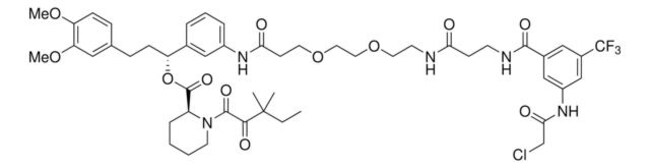
Sigma Aldrich Kb03-Slf Electrophilic Protein Degrader
Shop All MilliporeSigma Sigma Organic Chemistry Products

Description
KB03-SLF is an electrophilic PROTAC developed in the Cravatt lab and is useful for the discovery of ligandable E3 ligases, an area of interest for the targeted protein degradation (TPD) field seeking to map out and utilize a larger repertoire of the available human E3 ligases. This bifunctional tool compound comprises a synthetic ligand for FKBP12 (SLF) on one end and scout fragment 914975 on the other end. Scout fragments are electrophiles that covalently modify targetable cysteine residues on proteins, an approach that has been scaled to globally quantitate Cys reactivity across human proteomes and cells. When SLF and the electrophilic fragment are fused together, monitoring the levels of FKBP12 in cells may indicate scout-mediated FKBP12 degradation, for which follow-up studies would validate the mechanism of FKPB12 depletion and any targets to which the scout fragment is covalently bound. Scout-bound proteins leading to FKBP12 (or other targets) depletion discovered by this strategy will further expand the communal TPD toolbox. Due to the reactive nature of the scout fragment, other proteins will also be modified, so careful controls and validation should be considered.This proteomic approach to E3 discovery was demonstrated by Zhang et al in the discovery that DCAF16 mediated nuclear FKBP12 degradation via KB02-SLF.Additional electrophilic PROTACs were developed incorporating scout fragments with broad cysteine reactivity:KB02-SLF (914738) containing chloroacetamide scout fragment 912131KB05-SLF (913715) containing acrylamide scout fragment 911798Related tools:Additional bifunctional tools for FKPB12 variants: dTAG-13 (SML2601 for FKBP12F36V) and Biotin-SLF (914223 for FKBP12)Inhibitors useful in validation of proteasomal-mediated degradation: MG123 (SML1135) and MLN4924 (5.05477 for Cullin-RING ubiquitin ligases that regulate neddylation of Cullin proteins)Cereblon (CRBN) affinity probe: Biotin-Thalidomide (913979)Electrophilic PROTACs that degrade nuclear proteins by engaging DCAF16Technology Spotlight: Proteomic Ligandability AssessmentTechnology Spotlight: Building PROTAC™ Degraders for Targeted Protein DegradationPROTAC is a registered trademark of Arvinas Operations, Inc., and is used under license
Specifications
Specifications
| Molecular Formula | C36H58FN5O10 -+ xHCl |
| Linear Formula | C36H58FN5O10 -+ xHCl |
| Quantity | 50 mg |
Product Title
By clicking Submit, you acknowledge that you may be contacted by Fisher Scientific in regards to the feedback you have provided in this form. We will not share your information for any other purposes. All contact information provided shall also be maintained in accordance with our Privacy Policy.
Spot an opportunity for improvement?