Promotional price valid on web orders only. Your contract pricing may differ. Interested in signing up for a dedicated account number?
Learn More

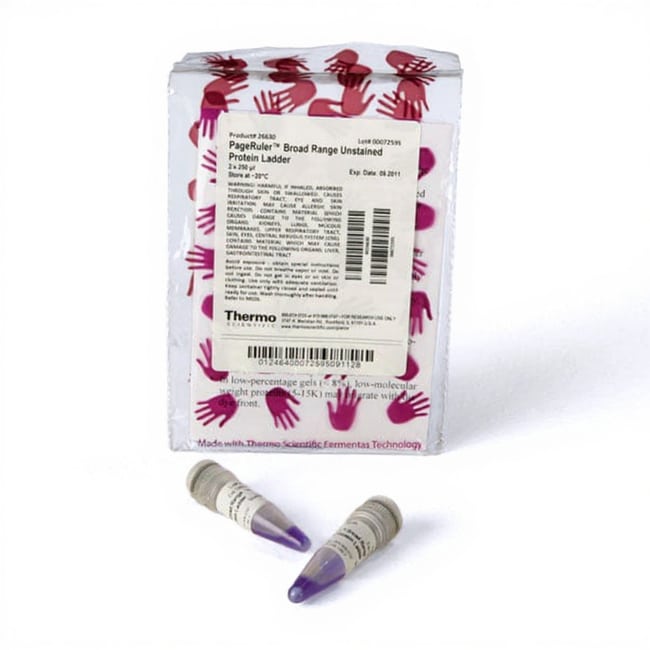
Thermo Scientific™ PageRuler™ Unstained Broad Range Protein Ladder

Catalog No. PI26630
Change view
Click to view available options
Quantity:
2 x 250 μL
8 x 250 μL
2 product options available for selection
Product selection table with 2 available options. Use arrow keys to navigate and Enter or Space to select.
Catalog No. Quantity
PI26630 2 x 250 μL
26-630-X4 8 x 250 μL
Use arrow keys to navigate between rows. Press Enter or Space to select a product option. 2 options available.
2 options
Catalog No. PI26630 Supplier Thermo Scientific™ Supplier No. 26630
Only null left
Add to Cart
Edge
Add to Cart

A mixture of 11 proteins (5 to 250kDa) for use as size standards in protein electrophoresis (SDS-PAGE) and Western blotting.

Thermo Scientific™ PageRuler Unstained Broad Range Protein Ladder is a mixture of 11 proteins (5 to 250kDa) for use as size standards in protein electrophoresis (SDS-PAGE) and Western blotting.

The protein MW markers in this ladder resolve into clearly identifiable sharp bands ranging in size from 5kDa to 250kDa when analyzed by SDS-PAGE and stained with coomassie dye or silver. The 100, 50 and 20kDa protein bands are of greater intensity and serve as reference bands. Proteins can be detected on Western blots by staining with Ponceau S, coomassie blue or other protein stains. In addition, the ladder proteins (except for the 5kDa peptide) contain an integral Strep-tag™ II Sequence and may be detected on Western blots using Strep-Tactin™ Conjugates. The PageRuler Unstained Broad Range Protein Ladder is supplied ready-to-use: no heating, dilution or addition of a reducing agent is required before use.

Highlights:

  • Size range – eleven proteins spanning 5 to 250kDa
  • Ready-to-use – supplied in a loading buffer for direct loading on gels; no need to boil
  • Sharp bands – excellent accuracy for detection in with coomassie or silver stains
  • Reference bands – the 100, 50 and 20kDa bands are more intense for easy orientation
  • Tagged – each protein in the ladder contains an integral Strep-tag™ II Sequence
  • Quality tested – each lot evaluated by SDS-PAGE and Western blotting

Includes:

Proteins in 62.5 mM Tris-H3PO4 (pH 7.5 at 25°C), 1 mM EDTA, 2% SDS, 100 mM DTT, 1 mM NaN3, 0.01% bromophenol blue and 33% glycerol.

Recommended for:

Accurate protein sizing on SDS-polyacrylamide gels and Western blots

TRUSTED_SUSTAINABILITY

Specifications

Content And Storage Contents: two vials of 250 μL each

Storage buffer: 62.5 mM Tris-H3PO4 (pH 7.5 at 25°C), 1 mM EDTA, 2% SDS, 10 mM DTT, 1 mM NaN3, 0.01% bromophenol blue and 33% glycerol

Storage: Upon receipt store at -20°C

Number of Markers 11
Ready to Load Yes
Size Range 5 to 250 kDa
Gel Compatibility Bolt™ Bis-Tris Plus Gels, Novex™ Tricine Gels, Novex™ Tris-Glycine Gels, NuPAGE™ Bis-Tris Gels, NuPAGE™ Tris-Acetate Gels, SDS-PAGE Gels
Molecular Weight (g/mol) 250, 150, 100, 70, 50, 40, 30, 20, 15, 10, 5 kDa
Quantity 2 x 250 μL
Shipping Condition Approved for shipment on Wet or Dry Ice
Product Line PageRuler
Product Type Protein Ladder
Stain Type Unstained
System Type Western Blotting, SDS-PAGE
Show More Show Less
The upper bands of the ladder are missing. What could be the reason?

The upper bands of the ladder may be degraded by proteases. Ladder, gel, buffer, pipettes, pipette tips, or equipment can be contaminated by proteases during usage. A general recommendation would be to avoid working with proteases in the same room. We would recommend preparing fresh solutions, cleaning the equipment, and using clean pipettes and tips. If the ladder itself is contaminated, please use a new tube of the ladder.

Some additional bands or smears were observed on the gel when using a PageRuler unstained ladder. What may have caused this?

Additional bands can appear due to dithiothreitol (DTT) oxidation in the storage buffer. Please add newly prepared DTT solution to the final concentration of 100 mM and boil for 5 min at 95 degrees C. This should solve the issue. Addition of DTT is NOT recommended for prestained protein ladders, since too high a concentration of reducing agents can cause protein destaining.

Do the proteins in Thermo Scientific protein ladders have a His-Tag or would otherwise react with an anti-His-Tag antibody?

No, proteins in Thermo Scientific protein ladders are not His tagged. However, non-specific interaction between the ladder proteins and primary or secondary antibodies is possible and some His-Tag detection systems, such as Thermo Scientific 6xHis Protein Tag Stain Reagent Kit, show non-specific interaction. The protein ladder bands are more readily detected when using high antibody concentrations. The non-specific cross-reactivity is difficult to predict, it often has a different pattern dependent on the antibodies used in each individual experiment. The most general way to handle this problem would be to use lower concentrations of antibodies and to use lower amount of protein ladders. It may also be useful to leave one empty well between the ladder and the sample to overcome a possible leakage of the signal to the nearby sample lane.

Can Thermo Scientific protein ladders be detected by Strep-Tactin conjugates?

PageRuler Unstained protein ladders can be detected directly on Western blots by using Strep-Tactin conjugates or an antibody against the Strep-tag II sequence. All PageRuler and Spectra ladder proteins contain an integral Strep-tag II sequence, however the prestained ladders cannot be detected by Strep-Tactin conjugates.

Why is non-specific binding detected after Western blot?

Protein ladder bands can sometimes be detected with chemiluminescent techniques due to non-specific interactions of ladder proteins with either primary or secondary antibodies (or with both). The ladder bands are only rarely detected by chromogenic substrates. The extremely high sensitivity of the chemiluminescent assays is needed to see the bands, so the actual degree of cross-reactivity is low. The non-specific cross-reactivity is difficult to predict, it often has a different pattern depending on the antibodies used. If antibodies recognize a linear epitope, the cross-reactivity may be due to sequence homology. If antibodies react with a denaturation-resistant conformational epitope it could be impossible to identify the exact reason for detected cross-reactivity. The most general way to handle this problem would be to use lower concentrations of antibodies.

Do Thermo Scientific protein ladders have glycosylated proteins?

No. Thermo Scientific protein ladders contain a mix of recombinant prokaryotic proteins purified from E. coli cells. E. coli does not have native glycosylation pathways, so none of the ladder proteins are glycosylated.

What are the concentrations of the individual proteins in the Thermo Scientific protein ladders? Is it possible to use the ladders as a standard for protein quantification?

Thermo Scientific ladders are not designed for protein quantification. For quantification, we would recommend to use a protein of known concentration as a reference.

Do you have protein ladders for fluorescence imaging?

Yes, PageRuler Prestained NIR Protein Ladder (Cat. No. 26635) contains proteins that are blue-stained and fluor-labeled for near-IR fluorescent visualization and protein sizing following electrophoresis.

Could a protein ladder be used on 6% Tris-glycine SDS-PAGE, although 4-20% gel is recommended? What effect would it have if the ladder is run on such a low concentration gel?

Protein ladders can be run on lower percentage gels than we recommend, however it should be expected that several bands of lower molecular weight proteins will run out of the gel if the gel is run until the dye front reaches the bottom of the gel. In case of shorter electrophoresis time it is also possible that some lower bands will not separate and will be covered by the dye front. In addition, lower molecular weight protein bands may look diffused. The lower percentage gels can be used in cases when the customer is interested in visualization of large proteins only.

What gel running buffer should I use: Tris-glycine, Tris-tricine, or Tris-acetate?

Most of the common gel running buffers are composed of Tris-glycine or Tris-tricine. Tris-glycine buffer systems are useful for separation of proteins over a wide range of molecular weights (5-300 kDa) and are compatible with denaturing or non-denaturing conditions. Tris-tricine buffer is generally recommended for the electrophoresis of low molecular weight proteins and peptides (<10 kDa) that need to be reduced and denatured prior to loading. Tris-acetate buffer system is used for separation of larger proteins (>200 kDa).

When should unstained or prestained ladder/marker be used?

Prestained ladders/markers are recommended for approximate determination of molecular weight and for monitoring the progress of the electrophoresis run and the efficiency of protein transfer to membranes during Western blotting procedures. Unstained ladders/markers are used for precise determination of molecular weights in any denaturing buffer system.

Can you provide the precise concentration of the proteins in Thermo Scientific ladders?

We do not provide the exact or approximate concentration of proteins in Thermo Scientific protein ladders, and they are not meant to be used for quantifying the protein concentration of a band. For densitometry assessment, we recommend loading a known amount of a protein standard and determining the linear range according to the gel or membrane stain used.

I used one of your PageRuler unstained protein ladders and did not get good separation of the bands. What could have happened?

Here are possible causes and solutions:

- Ladder was boiled: Discard boiled aliquot.
- Too much volume of ladder used: Add less volume or dilute the ladder in protein loading buffer prior to use.
- DTT oxidation in storage buffer: Add freshly prepared DTT solution to a final concentration of 100 mM.

Are any animal-derived proteins present in the different PageRuler Unstained Protein Ladders?

The PageRuler Unstained Protein Ladder, PageRuler Unstained Broad Range Protein Ladder, and PageRuler Unstained Low Range Protein Ladder contain recombinant prokaryotic proteins and do not contain any animal-derived proteins.

Can the PageRuler Unstained Protein Ladder, PageRuler Unstained Broad Range Protein Ladder, and PageRuler Unstained Low Range Protein Ladder be detected using Strep-Tactin Conjugates?

The proteins in the different PageRuler Unstained Protein Ladders (except for the 3.4 and 5 kDa peptides in the PageRuler Unstained Low Range Protein Ladder and the PageRuler Unstained Protein Ladder, and the 5 kDa peptide in the PageRuler Unstained Broad Range Protein Ladder) contain an integral Strep-tag II Sequence and may be detected on western blots using Strep-Tactin Conjugates.

What is the composition of the PageRuler Unstained Broad Range Protein Ladder?

The PageRuler Unstained Broad Range Protein Ladder is a mixture of eleven recombinant, highly purified proteins ranging from 5 kDa to 250 kDa. For easy reference, the 100 kDa, 50 kDa and 20 kDa protein bands have greater intensity than the other proteins in the ladder.

What are the storage conditions and shelf life for the PageRuler Unstained Protein Ladders?

We recommend storing the PageRuler Unstained Protein Ladders at -20 degrees C where they are stable for a year.


WARNING: Cancer - www.P65Warnings.ca.gov

For Research Use Only. Not for use in diagnostic procedures.

Product Title
Select an issue

By clicking Submit, you acknowledge that you may be contacted by Fisher Scientific in regards to the feedback you have provided in this form. We will not share your information for any other purposes. All contact information provided shall also be maintained in accordance with our Privacy Policy.