Which Thermo Scientific protein assay is the best or the most reliable?
The choice of protein assay is dependent on preferences related to assay speed, accuracy and sensitivity, as well as interfering substances in the sample to be assayed. BCA has less protein-to-protein variation, is compatible with most detergents, and has larger working range. Pierce Bradford Plus Protein Assay Kit (Cat. No. 23236) is compatible with reducing sugars, is more sensitive and is faster and easier to use. For a comparison of different protein assays and compatible reagents, see our Tech Tip: Protein Quantitation Assay Compatibility Table (https://assets.thermofisher.com/TFS-Assets/LSG/Application-Notes/TR0068-Protein-assay-compatibility.pdf).
Can the compatibility reagent in the BCA-RACE kit be stored after reconstitution and reused?
The reconstituted compatibility reagent is stable for 8 hours when stored at 4 degrees C protected from light.
How many assays can be performed with each BCA-RAC kit?
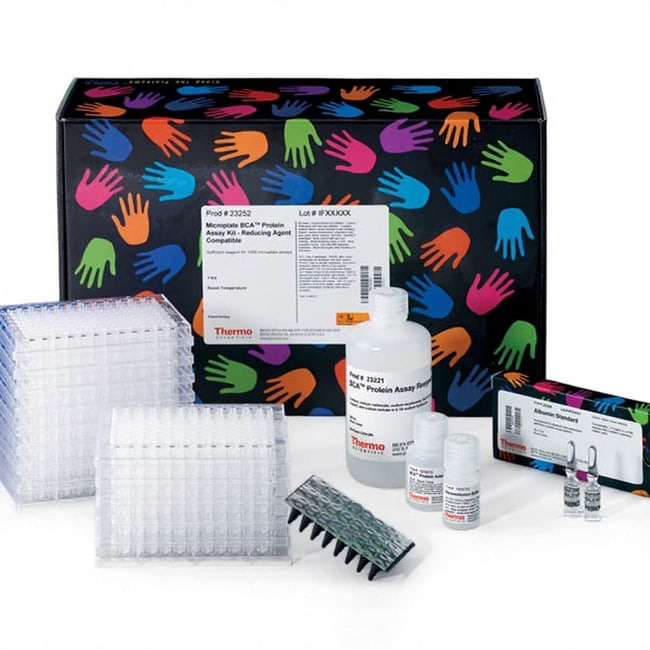
The BCA Protein Assay Kit - Reducing Agent Compatible (Cat. No. 23250) has sufficient reagents for 250 samples or standards of 25µL each, and the Microplate BCA Protein Assay Kit - Reducing Agent Compatible (Cat. No. 23252) can be used to assay 1,000 samples or standards of 9µL each.
Can I increase the volumes of the sample and compatibility reagent in the microplate assay when using the BCA-RAC?
No. Increasing the sample and compatibility reagent volumes will require increasing the BCA working reagent, resulting in a volume that exceeds the well capacity. There must be space remaining in the well to allow mixing and prevent the solution from contacting the sealing tape.
What formats are available for the BCA-RAC?
There are two different formats: the BCA Protein Assay Kit - Reducing Agent Compatible (Cat. No. 23250) for microcentrifuge tube (1.5ml) assays and Microplate BCA Protein Assay Kit - Reducing Agent Compatible (Cat. No. 23252) for 96-well plates. The tube assay is compatible with 5mM DTT, 10mM TCEP and 35mM 2ME, and the microplate assay is compatible with 5mM DTT, 10mM TCEP and 25mM 2ME.
How does the BCA-RAC compare with the original BCA assay?
The BCA-RAC provides the advantages of the original BCA assay (compatibility with detergents, buffer/salts and solvents) combined with reducing agent compatibility at concentrations routinely used in protein sample buffers. The BCA assay is based on reduction of Cu+2 to Cu+1 by proteins in an alkaline solution and the subsequent complexing of the Cu+1 to BCA reagent, yielding a purple color detectable at 562nm. Disulfide reducing agents such as DTT, 2ME and TCEP are also capable of reducing Cu+2 to Cu+1. To minimize their reducing effect, a compatibility reagent that modifies disulfide reducing agents is added to the sample before performing the assay.
Is Pierce Microplate BCA Protein Assay Kit compatible with SERVA Blue G?
SERVA Blue G is not compatible with most of our protein assays. SERVA Blue G has a max absorbance at 598 nm which will interfere with our assays reading near 562 nm.
Is Pierce Microplate BCA Protein Assay Kit compatible with LDS?
We have not tested the Pierce Microplate BCA Protein Assay Kit with LDS and therefore cannot recommend using them together.
Can you provide the shelf-life for the Pierce Microplate BCA Protein Assay Kit-Reducing Agent Compatible?
The Pierce Microplate BCA Protein Assay Kit-Reducing Agent Compatible is covered under our general 1-year warranty and is guaranteed to be fully functional for 12 months from the date of shipment, if stored as recommended (room temperature). Please see section 8.1 of our Terms & Conditions of Sale (https://www.thermofisher.com/content/dam/LifeTech/Documents/PDFs/Terms-and-Conditions-of-Sale.pdf) for more details.
I assayed two protein samples, each containing a different mixture of proteins of same concentration and observed very different color responses in the assay. What is the cause?
Each of the commonly used total protein assay methods exhibits some degree of varying response toward different proteins. These differences relate to amino acid sequence, pI, structure and the presence of certain side chains or prosthetic groups that can dramatically alter the protein’s color response. Most protein assay methods use BSA or immunoglobulin (IgG) as the standard against which the concentration of protein in the sample is determined. However, if great accuracy is required, prepare the standard curve from a pure sample of the target protein.
My buffer or components of my buffer are not listed in the compatibility table for my protein assay. What should I do?
You can test the tolerance of the assay for your specific buffer formulation. For in-house generated compatibility information, substances were considered compatible at the indicated concentration in the Standard Test Tube Protocol (found in the manual for each protein assay) if the error in protein concentration estimation caused by the presence of the substance was less than or equal to 10%. The substances were tested using WR prepared immediately before each experiment. Blank-corrected 562nm absorbance measurements (for a 1000µg/mL BSA standard + substance) were compared to the net 562nm measurements of the same standard prepared in 0.9% saline.
All the components of my sample buffer are at or below the indicated compatible concentration for my protein assay, but I am still seeing too much/too little color development. What could be the problem?
It is possible to have a substance additive affect such that even though a single component is present at a concentration below its listed compatibility, a sample buffer containing a combination of substances could interfere with the assay. You should take steps to eliminate or minimize the effects of the interfering substance(s) by diluting or removing the substance.
Are there any reagents/chemicals I should avoid in my protein assay sample buffer?
Each protein assay method has its particular sensitivities. Generally, the following substances should be avoided for the given protein assay method:
- BCA and Micro BCA Assays: reducing agents and chelators, and strong acids and bases
- BCA Reducing Agent Compatible Assay: chelators
- 660 nm Assay: ionic detergents
- Pierce Bradford Protein Assay Kit and Pierce Bradford Plus Protein Assay Kit: detergents
- Modified Lowry Assay: detergents, reducing agents, and chelators
A component of my lysis buffer is known to interfere with my protein assay of choice. How can I remove it?
Several strategies exist for overcoming or eliminating sample incompatibility with protein assays. The simplest method is to assay the sample after diluting it several-fold in a compatible buffer. If the starting concentration of protein is sufficient to remain within the protein assay working range upon its dilution, then this method will often reduce the amount of interfering substance in the sample to the point where it no longer interferes. Another method is to dialyze or desalt samples into a buffer that is compatible with the assay.
Precipitation can be used to eliminate interfering substances. After causing the protein to precipitate with acetone or trichloroacetic acid (TCA), the supernatant containing the interfering substance can be removed. Then the protein pellet is dissolved in the assay working reagent, and the protein assayed performed as usual. A general protocol for protein precipitation is provided in our Tech Tip.
My protein assay is not developing color or is developing too much color. What can I do?
Refer to the information in the product-specific instruction booklet or our Tech Tip: Protein Quantitation Assay Compatibility Table (https://assets.thermofisher.com/TFS-Assets/LSG/Application-Notes/TR0068-Protein-assay-compatibility.pdf).
My spectrophotometer doesn’t have a filter set for the absorbance maximum. Can I use an alternate wavelength to read the protein assay?
Often, an alternative wavelength can be used, although the slope of the standard curve and the overall assay sensitivity will most likely be reduced. Our Tech Tip (https://tools.thermofisher.com/content/sfs/brochures/TR0025-Protein-assay-spectra.pdf) offers additional information on determining acceptable wavelengths for measuring protein assays.
Which protein assay is my lysis buffer compatible with?
Each method has its particular sensitivities. Apart from the information presented in the product-specific instruction booklet, we offer an expanded protein assay compatibility table in this Tech Tip.
I have cell lysates that were extracted with detergent, which kit should I use for protein quantitation?
The EZQ Protein Quantitation Kit is the most tolerant of non-protein components. It is compatible with samples in SDS-PAGE sample buffer, urea- or guanidine-containing buffers, and detergents. After the protein component is bound to the paper filter, any tracking dyes, detergents, and salts are removed by a methanol wash, so they are no longer present to affect protein quantitation.
Other protein assays that are compatible with detergents are colorimetric BCA assays, Detergent Compatible Bradford Assay Kit, and the 660 nm Protein Assay Kit.
What other factors affect the protein assay accuracy and precision?
Several factors affect protein assay accuracy and precision:
Replicates: The only way to evaluate the extent of random error is to include replicates of each standard and test sample. Because all test samples are evaluated by comparison to the standard curve, it is especially important to run the standards in at least triplicate. The standard deviation (SD) and coefficient of variation (CV) can then be calculated, providing a degree of confidence in your pipetting precision. If replicates are used, curve-fitting is done with the average values (minus obvious outliers).
Blank correction: It is common practice to subtract the absorbance of the zero assay standard(s) from the all other sample absorbance values. However, if replicate zero-assay standards will be used to calculate error statistics, then another independent value may be required for blank-correction. If the standards were prepared in a buffer to match that of the test samples, and this buffer contains components that may interfere with the assay chemistry, it is informative to blank the absorbances with a "water reference" (i.e., a zero-protein, water sample). Differences between the water reference and zero standard sample are then indicative of buffer effects.
Standard curve slope: The standard curve slope is directly related to assay accuracy and sensitivity. All else being equal, the steepest part of the curve is the most reliable. For most protein assays, the standard curve is steepest (i.e., has the greatest positive slope) in the bottom half of the assay range. In fact, the upper limit of an assay range is determined by the point at which the slope approaches zero; the line there is so flat that even a tiny difference in measured absorbance translates to a large difference in calculated concentration.
Measurement wavelength: The measurement wavelengths that are recommended for each protein assay method are optimal because they yield standard curves with maximal slope. This usually, but not always, corresponds to the absorbance maximum. (In certain circumstances, other considerations are also important in choosing the best possible measurement wavelength, such as avoiding interference from sample components that absorb at similar wavelengths). In fact, for most protein assays, depending on the precision required, acceptable results can be obtained using any measurement wavelengths within a certain range.
When does a dilution factor need to be applied in a protein assay?
One situation in which the dilution factor is important to consider is when the original sample has been pre-diluted relative to the standard sample. Suppose the original protein sample is actually known to be approximately 5 mg/mL. This is too concentrated to be assayed by the Pierce Bradford Plus Protein Assay Kit, for example, whose assay range in the standard microplate protocol is 100-1500 µg/mL. However, you could dilute it 5-fold in buffer (i.e., 1 part sample plus 4 parts buffer) and then use that diluted sample as the test sample in the protein assay. If the test sample produces the same absorbance as the 1000 µg/mL standard sample, then you can conclude that the test (5-fold diluted) sample is 1000 µg/mL, and therefore the original (undiluted) sample is 5 x 1000 µg/mL = 5000 µg/mL = 5 mg/mL.
Do I need to know the protein concentration in the assay reagent for my protein assay?
No. It is neither necessary nor helpful to know the protein concentration as it exists when the samples are diluted in assay reagent. The protein concentration when diluted by assay reagent is almost certainly not the value of interest; instead, one wants to know the protein concentration of the original test sample.
Do I need to know the amount of protein per well for my protein assay?
No. Contrary to what many people assume, it is neither necessary nor even helpful to know the actual amount (e.g., micrograms) of protein applied to each well or cuvette of the assay. The amount of protein per well is almost certainly not the value of interest; instead, one usually wants to know the protein concentration of the original test sample.
How can I utilize Excel software to plot and apply the standard curve for my protein assay?
Enter the concentration values for the standards in Column A and their corresponding absorbance data in Column B. Highlight both columns and from the Insert menu select Chart and XY (Scatter). Click on the resulting graph and select Add Trendline from the Chart menu. While viewing the graph next to the open Format Trendline window, choose Polynomial and set the Order to 2, 3 or 4 until the best-fit appears. Check the box near the bottom called Display Equation on Chart; then close the Format Trendline window. Use the resulting equation to determine protein concentration (y) of an unknown sample by inserting the sample’s absorbance value (x).
How can I interpolate my protein assay data?
Most modern plate readers and spectrophotometers have associated software that automatically plots a linear or curvilinear regression line through the standard points, interpolates the test samples on that regression line, and reports the calculated value. However, there are different methods for making the calculations “by hand”. You can find a detailed explanation and example in our Tech Tip.
How can I accurately analyze my protein assay data?
With most protein assays, sample protein concentrations are determined by comparing their assay responses to that of a dilution-series of standards whose concentrations are known. The responses of the standards are used to plot or calculate a standard curve. Absorbance values of unknown samples are then interpolated onto the plot or formula for the standard curve to determine their concentrations. The most accurate results are possible only when unknown and standard samples are treated identically. This includes assaying them at the same time and in the same buffer conditions, if possible. Because different pipetting steps are involved, replicates are necessary if you wish to calculate statistics (e.g., standard deviation, coefficient of variation) to account for random error. It is imperative to run a new standard curve for each set of samples to be tested
It was necessary to dilute my sample in order to run the protein assay (i.e,. due to an incompatible substance). How do I account for this when determining the concentration?
Simply multiply the calculated concentration of the diluted sample by the dilution factor. For example: A protein sample is known to be approximately 5 mg/mL. This is too concentrated to be assayed by the Pierce Bradford Plus Protein Assay Kit, whose assay range in the standard microplate protocol is 100-1500 µg/mL. However, you could dilute it 5-fold in buffer (i.e., 1 part sample plus 4 parts buffer) and then use that diluted sample as the test sample in the protein assay. If the test sample produces the same absorbance as the 1000 µg/mL standard sample, then you can conclude that the test (5-fold diluted) sample is 1000 µg/mL, and therefore the original (undiluted) sample is 5 × 1000 µg/mL = 5000 µg/mL = 5 mg/mL.
In my protein assay, what unit of measurement will my sample concentration be in after calculating the concentration?
The unit of measure used to express the standards is by definition the same unit of measure associated with the calculated value for the unknown sample (i.e., final results for unknown samples will be expressed in the same unit of measure as was used for the standards). For example, if the standard concentrations are expressed as micrograms per milliliter, then the concentrations for the unknown samples, which are determined by comparison to the standard curve, are also expressed as micrograms per milliliter.
Can I re-use my protein standard curve dilutions that I prepared?
Yes, we recommend storing at -20 degrees C and they will likely be good for 2-3 months, or about 2 freeze/thaws. Samples subjected to more than ˜2 freeze/thaw cycles may give variable results in most assays
What should I dilute my protein standard in for my protein assay?
Protein standards should preferably be diluted using the same diluent as the sample(s). Sample assay responses are directly comparable to each other if they are processed in exactly the same manner. Variance in protein quantity is the only possible cause for differences in final absorbance (color intensity) if samples are dissolved in the same buffer and the same stock solution of assay reagent is used for all samples.
However, if only a “rough” estimate of protein concentration is needed, a blank-only correction can be used. In this case, a blank is prepared in the diluent of the sample to correct for its raw absorbance. The concentration of the sample is then determined from a standard curve obtained from a series of dilutions of the protein of known concentration prepared in water or saline solution.
What proteins do you offer as standards for your protein assays?
We offer BSA and BGG as protein standards for protein assays.
What protein should I use to generate my standard curve?
Protein concentrations are generally determined and reported with reference to standards of a common protein, such as bovine serum albumin (BSA). If precise quantitation of an unknown protein is required, it is advisable to select a protein standard that is similar in quality to the unknown; for example, a bovine gamma globulin (BGG) standard may be used when assaying immunoglobulin samples.
Why is the choice of protein standard important in a protein assay?
Because proteins differ in their amino acid compositions, each one responds somewhat differently in each type of protein assay. Therefore, the best choice for a reference standard is a purified, known concentration of the most abundant protein in the samples. This is usually not possible to achieve, and it is seldom convenient or necessary. If a highly purified version of the protein of interest is not available or it is too expensive to use as the standard, the alternative is to choose a protein that will produce a very similar color response curve in the selected protein assay method and is readily available to any laboratory at any time. Generally, bovine serum albumin (BSA) works well as a protein standard because it is widely available in high purity and relatively inexpensive. Alternatively, bovine gamma globulin (BGG) is a good standard when determining the concentration of antibodies because BGG produces a color response curve that is very similar to that of immunoglobulin G (IgG).
What are the basic principles of standard curve assays?
- Identically assayed samples are directly comparable: Sample assay responses are directly comparable to each other if they are processed in exactly the same manner. Variation in amount of protein is the only possible cause for differences in final absorbance (color intensity) if the samples are dissolved in the same buffer, the same lot and stock solution of assay reagent is used, all samples are mixed and incubated at the same time and temperature, and no pipetting errors were introduced.
- Units in equals the units out: The unit of measure used to express the standards is by definition the same unit of measure associated with the calculated value for the unknown sample (i.e., final results for unknown samples will be expressed in the same unit of measure as was used for the standards).
What protein assays are copper-based chemistries?
Copper-based protein assays, including the BCA and Lowry methods, depend on the well-known “biuret reaction”, whereby peptides containing three or more amino acid residues form a colored chelate complex with cupric ions (Cu2+) in an alkaline environment containing sodium potassium tartrate.
What is the chemistry behind protein assays?
Most colorimetric protein assay methods can be divided into two groups based on the type of chemistry involved: those involving protein-copper chelation with secondary detection of the reduced copper and those based on protein-dye binding with direct detection of the color change associated with the bound dye.
What is protein-to-protein variation?
Each protein in a sample responds uniquely in a given protein assay, and this protein-to-protein variation is observed as differences in the amount of color (absorbance) obtained when the same mass of various proteins is assayed concurrently by the same method. These differences in color response relate to differences in amino acid sequence, isoelectric point (pI), secondary structure, and the presence of certain side chains or prosthetic groups.
Depending on the sample type and purpose for performing an assay, protein-to-protein variation is an important consideration in selecting a protein assay method and in selecting an appropriate assay standard (e.g., BSA vs. BGG). Protein assay methods based on similar chemistry have similar protein-to-protein variation.
How should a sample be prepared before a protein assay?
Before the sample is analyzed, it must be solubilized in a buffered aqueous solution. Depending on the source material and the procedures involved before performing the protein assay, the sample will likely contain a variety of non-protein components. Awareness of these components is critical for choosing an appropriate assay method and evaluating the cause of anomalous results. Every type of protein assay is adversely affected by substances of one sort or another. Components of a protein solution are considered interfering substances in a protein assay if they artificially suppress the response, enhance the response, or cause elevated background by an arbitrarily chosen degree (e.g., 10% compared to control). Additional components can include reducing agents, chelators, crowding agents, and protease inhibitors.
What should I consider when choosing a protein assay?
There are several criteria that should be considered, including compatibility with the sample type and components, assay range and required sample volume, protein-to-protein uniformity, speed and convenience for the number of samples to be tested, and the availability of spectrophotometer or plate reader necessary to measure the color produced (absorbance) by the assay.
Why does the protein assay method matter?
Unfortunately, no protein assay method exists that is either perfectly specific to proteins (i.e., not affected by any nonprotein components) or uniformly sensitive to all protein types (i.e., not affected by differences in protein composition). Therefore, successful use of protein assays involves selecting the method that is most compatible with the samples to be analyzed, choosing an appropriate assay standard, and understanding and controlling the particular assumptions and limitations that remain. The objective is to select a method that requires the least manipulation or pre-treatment of the samples to accommodate substances that interfere with the assay. Each method has its particular advantages and disadvantages. Because no one reagent can be considered the ideal or best protein assay method for all circumstances, most researchers have more than one type of protein assay available in their laboratories.
What protein assay is best?
Unfortunately, no protein assay method exists that isn’t affected by any non-protein component or uniformly sensitive to all protein types. One must select an appropriate assay method based on compatibility with the sample type or one that requires the least manipulation of the sample to accommodate the assay. Most researchers will have more than one type of assay available in their laboratories.
What protein assays do you offer for total protein quantitation?
We offer several types of protein assays including the: BCA Assay, BCA-RAC (Reducing Agent Compatible) Assay, Micro BCA Assay, 660 nm Protein Assay, Pierce Bradford Plus Protein Assay Kit, Pierce Bradford Protein Assay Kit, Modified Lowry Assay, colorimetric and fluorometric Peptide Assays, CBQCA kit, EZQ kit, Quant-iT kits, NanoOrange, and the Qubit kits.
Which protein assay is my lysis compatible with?
Please check the Protein Assay Compatibility Table in this Tech Tip (https://assets.thermofisher.com/TFS-Assets/LSG/Application-Notes/TR0068-Protein-assay-compatibility.pdf) to determine which protein assay would be most effective with your sample type.