Promotional price valid on web orders only. Your contract pricing may differ. Interested in signing up for a dedicated account number?
Learn More

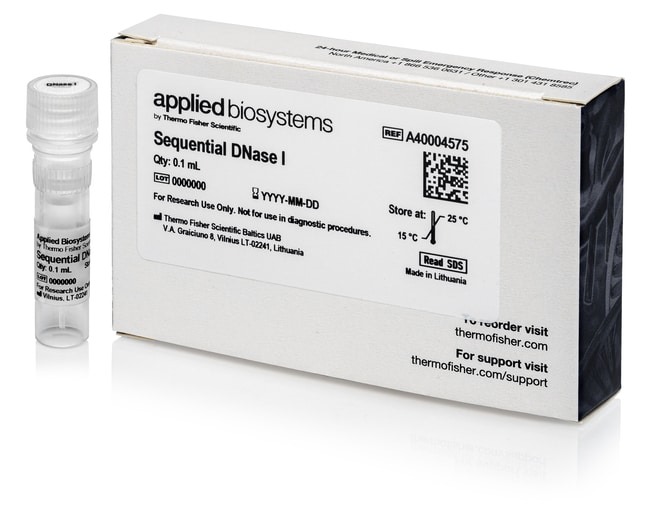
Applied Biosystems™ Sequential DNase I, 100 rxns

Catalog No. A40004575
Encompass_Preferred
Change view
Click to view available options
Quantity:
1 Vial
1 product options available for selection
Product selection table with 1 available options. Use arrow keys to navigate and Enter or Space to select.
Catalog No. Quantity
A40004575 1 Vial
Use arrow keys to navigate between rows. Press Enter or Space to select a product option. 1 options available.
1 options
Catalog No. A40004575 Supplier Applied Biosystems™ Supplier No. A40004575
Only null left
Add to Cart
Add to Cart

Sequential DNase I is a component of the Sequential Protein/DNA/RNA Extraction Kit (Cat. No. 50000D) used for DNA digestion in the RNA purification step.

Applied Biosystems Sequential DNase I is a component of the Sequential Protein/DNA/RNA Extraction Kit used for DNA digestion in the RNA purification step.

Features of the Sequential Protein/DNA/RNA Extraction Kit include:

  • High sensitivity—supports scalable extractions from precious or low sample volumes down to 1,000 cells or 0.005 mg tissue (tissue dependent)
  • Direct compatibility—extracted analytes down to 100,000 cells or 1-2 mg tissue are validated and suitable for mass spectrometry and NGS applications
  • Automated high-throughput—compatible with KingFisher instruments for scalable processing
  • Enhanced reproducibility—standardized protocol reduces variability

The kit employs a bead-based sequential extraction methodology utilizing protein isolation prior to nucleic acid extraction, resulting in enhanced protein yields that are directly compatible with mass spectrometry analysis. This approach enables researchers to obtain analytes suitable for diverse downstream applications including SDS-PAGE, western blotting, mass spectrometry, sequencing, genotyping, and qPCR from sample inputs as small as 1-2 mg of tissue or 100,000 cells while maintaining quality standards required for both next-generation sequencing (NGS) and MS platforms. The Dynabeads and MagMAX magnetic bead-based purification technology helps enable high reproducibility and scalable, high-throughput processing when integrated with automation systems such as the KingFisher Sample Purification System.

This kit combines the advantages of multi-analyte extraction with the precision and efficiency required for advanced proteomics and genomics workflows, making it particularly valuable for multi-omics studies where sample conservation and analytical comprehensiveness are paramount.

Verified performance

The kit helps deliver yield and quality metrics comparable to standard single-analyte extraction kits, facilitating efficient multi-analyte recovery from a single sample. While most commercial sequential protocols are optimized for large sample volumes (e.g. 1 million cells or 10–20 mg tissue), this kit offers exceptional versatility across a wider range. Validated for 100,000 cells and 1–2 mg tissue, it has also been successfully used with as few as 1,000 cells and 5 μg tissue while maintaining linear yields and preserving nucleic acid integrity suitable for qPCR analysis. This broad dynamic range provides greater flexibility and enables efficient processing of precious or limited samples that are difficult to analyze with conventional methods.

Streamlined three-step sequential extraction

The extraction procedure follows a systematic three-step process designed to support a high recovery of each biomolecule class. Initially, Dynabeads Protein Beads are introduced to the lysed sample and incubated to facilitate protein binding, after which they are transferred to a separate tube for washing and protein processing compatible with downstream western blot or mass-spectrometry applications. Subsequently, MagMAX DNA/RNA Binding beads are added to the original tube, now depleted of proteins, to enable DNA binding and extraction using proprietary buffer formulations before transferring to a new tube for further preparation. Finally, MagMAX DNA/RNA Binding beads are again introduced to the original tube, now depleted of both proteins and DNA, to facilitate RNA binding and extraction using specialized proprietary buffers and solutions, with subsequent transfer to a dedicated tube for final preparation. The resulting extracted proteins are suitable for WB or MS analysis, while the recovered DNA and RNA are compatible with quantitative PCR (qPCR) and next-generation sequencing (NGS) applications.

TRUSTED_SUSTAINABILITY

Specifications

Bead Type DNase I
Capacity 0.1 mL
Content And Storage •The vial contains Dnase, an enzymatic solution essential for DNA digestion in the RNA purification step.
•Store at room temperature.
Format Reagent
Isolation Technology Magnetic Bead
Sample Type Cell Lines, PBMC, Fresh/Frozen Tissue
Formulation Reagent Solution
For Use With (Equipment) KingFisher™ Duo Prime, Flex, or Apex Purification Systems
For Use With (Application) Mass spectrometry, western blot, qPCR, sequencing
No. of Reactions 100 Reactions
Product Line Dynabeads, MPC
Product Type Sequential Protein/DNA/RNA Extraction
Quantity 1 Vial
Shipping Condition Ambient Temperature
Throughput Flexible
Regulatory Status For Research Use Only
Show More Show Less
How compatible is the kit with different lysis buffers or additives (e.g., protease inhibitors, RNase inhibitors)?

The lysis buffer included in the kit has been specifically optimized for efficient lysis of cells and tissue samples and should not be replaced with another lysis buffer. However, it can be supplemented with protease inhibitors. RNase inhibitors are not necessary, as RNA integrity is well maintained.

What are the carry-over rates between analyte fractions (protein–DNA–RNA)?

The protein, DNA and RNA eluates exhibit high purity with very low carry-over between fractions.

Could the kit be used on exosomes and on serum or plasma samples?

Yes, the kit can be used with a plethora of sample types, provided the sample is sufficiently lysed.

Is there a protocol for on-bead digestion for subsequent proteomics analysis?

There is no available protocol for on-bead digestion, although the kit is theoretically compatible with this process. The kit can be combined with the EasyPep MS Sample Prep Kit by skipping the lysis step.

What is the size and binding capacity of the beads?

Dynabeads Sequential Protein Binding Beads have a diameter of 2.8 µm, while MagMAX Sequential DNA/RNA Binding Beads have a diameter of 1 µm. The binding capacity cannot be disclosed here, as it involves proprietary information regarding the binding principle.

Can the remaining lysed samples be kept for later use?

Yes, the remaining lysate from the sequential workflow can be stored at -80°C and used later without impacting the yield and quality of the analytes.

Can I expect similar yields with this kit versus standard bead-based or column-based kits for single isolation of DNA, RNA, and protein?

Yes, the yields obtained using the kit are comparable to those obtained with single analyte isolation kits. However, the yields of proteins are usually slightly lower than cells lysed directly with RIPA buffer.

As RNA is the last analyte to be isolated, is RNA integrity good enough for downstream analysis?

The buffers and protocols have been optimized to help ensure good RNA integrity.

What is the advantage of the kit over single analyte extraction kits?

The kit enables high sensitivity from small sample input sizes, making it exceptional for precious samples (e.g., patient samples) or samples that cannot be split for separate extraction of protein, DNA, and RNA (e.g., heterogeneous tissue specimens).

What is the duration of the entire workflow?

The manual protocol uses ~2 hours of hands-on time for 10 samples. The automated protocol uses ~1.5 hours of instrument run time and 30–60 minutes of hands-on time for 12 to 96 samples.

Is the kit compatible with liquid handlers?

The kit is magnetic bead-based and thus compatible with liquid handlers (e.g., Hamilton NIMBUS Presto System).

What are the advantages of the kit over column-based extraction?

The kit uses magnetic beads for the specific isolation of protein, DNA, and RNA, which enables automation of the workflow, resulting in higher reproducibility and throughput. Additionally, our optimized buffer chemistry increases sensitivity, allowing the use ofsmaller sample sizes from the start. Lastly, the protein can be directly prepared for mass spectrometry analysis without further desalting.

Is the kit compatible with blood samples?

The kit is developed for cells and is not directly compatible with whole blood samples. We recommend pre-isolating cells from blood, such as peripheral blood mononuclear cells (PBMCs), prior to protein, DNA, and RNA extraction for optimal results.

Is the kit compatible with fungi, plant cells, or yeast?

While these sample types have not been specifically tested with our kit, theoretically they should work, provided the sample is sufficiently lysed. Proper lysis is crucial to help ensure effective isolation of protein, DNA, and RNA from fungi, plant cells, or yeast.

What kind of sequencing methods are compatible?

The kit is compatible with targeted sequencing (e.g., Ion Torrent next-generation-sequencing (NGS) systems and short-read sequencing (e.g., Illumina NGS platforms).

Is the kit compatible with long-read sequencing technologies?

The kit has not been assessed for long-read sequencing.

Is the kit compatible with the Olink (Part of Thermo Fisher Scientific) Proximity Extension Assay (PEA) technology?

The kit is not compatible with the Olink PEA technology, since this requires native proteins for capture by a pair of antibodies, whereas our kit denatures the proteins for mass spectrometry analysis.

Can I use the kit with formalin-fixed, paraffin-embedded (FFPE) samples?

The kit has not been optimized for use with FFPE samples. Additionally, FFPE samples are not ideal for RNA integrity, which may affect the quality and yield of RNA isolated from these samples. For optimal results, we recommend using fresh or frozen tissue samples.

Can I isolate microRNAs with the kit?

Yes, this kit is designed to isolate total RNA, which includes small RNAs like microRNAs.

What is the size range of the proteins that are isolated from the kit? Can I isolate peptides?

The size of the isolated proteins ranges from around 5 to 590 kDa. The isolation of specific peptides has not been assessed.

Is it possible to use a sample of cells or tissue that is already in a buffer? (e.g., sorted cells in PBS)

Yes, the lysis buffer’s effectiveness has been tested by diluting it up to 2 times, with performance like the non-diluted lysis buffer.

What is the maximal number of cells or tissue mass that can be used per extraction?

The kit is optimized for a maximum input of 1,000,000 cells or 10 mg of tissue per extraction.

What is the minimal number of cells or tissue mass that can be used in the workflow?

The kit is optimized for 100,000 cells and 1 mg of tissue. We have tested down to 1,000 cells and 0.005 mg of tissue, demonstrating linearity in the yields of protein, DNA, and RNA.

Can I pause the workflow and freeze my sample after protein/DNA isolation?

Yes, the sequential workflow can be paused after protein isolation and after DNA isolation by freezing the sample plate at -20°C, without impacting the yield and quality of the analytes.


For Research Use Only. Not for use in diagnostic procedures.

Product Title
Select an issue

By clicking Submit, you acknowledge that you may be contacted by Fisher Scientific in regards to the feedback you have provided in this form. We will not share your information for any other purposes. All contact information provided shall also be maintained in accordance with our Privacy Policy.