Learn More
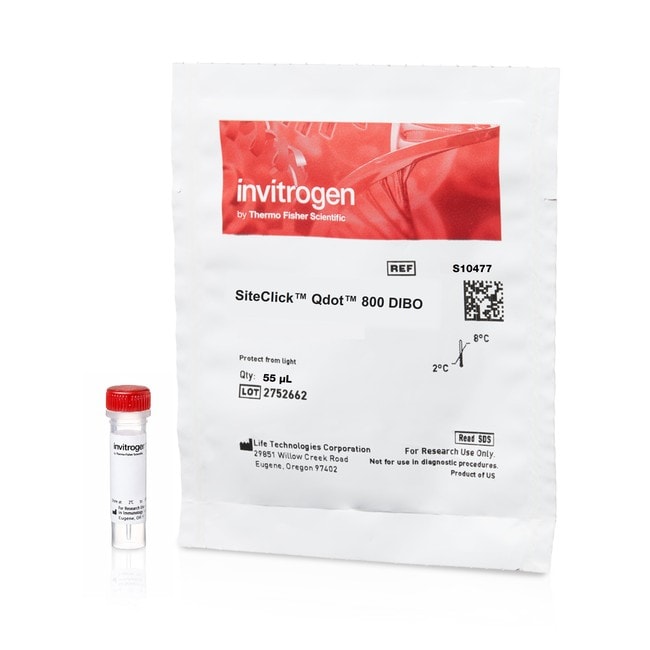
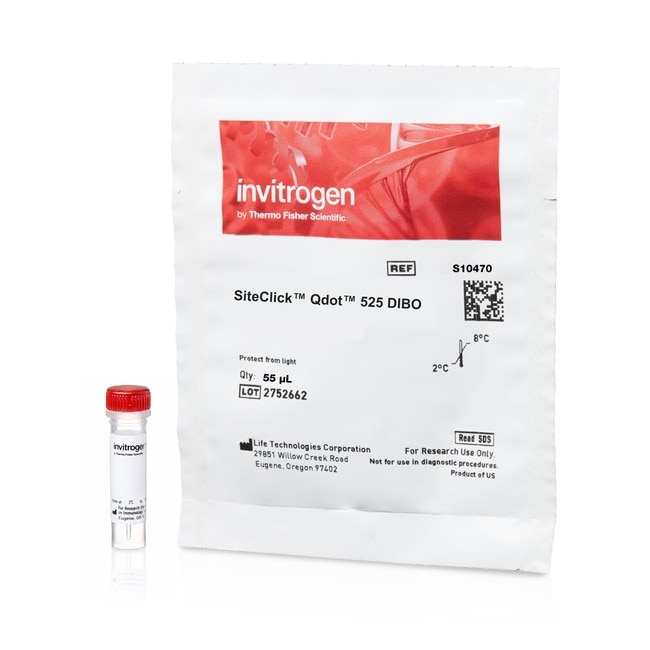
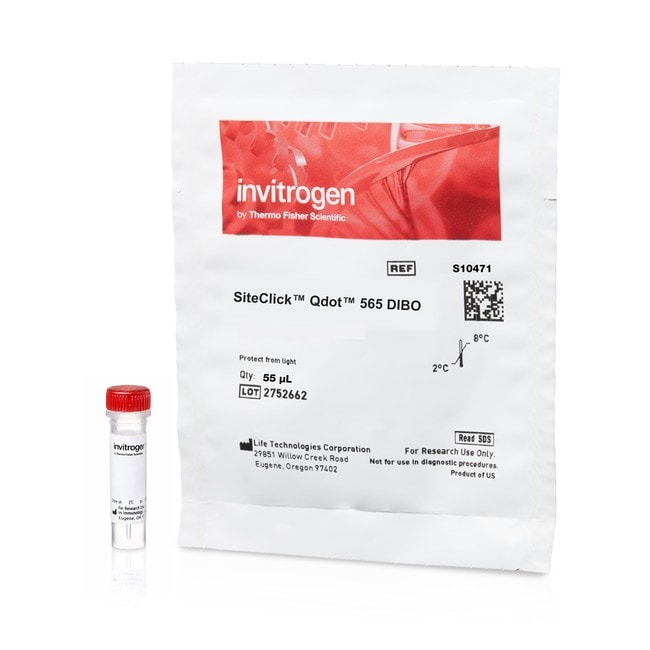
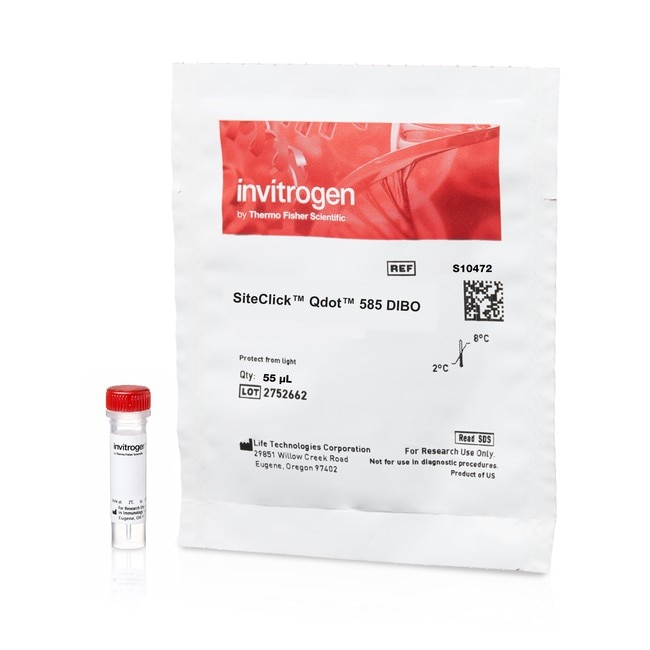
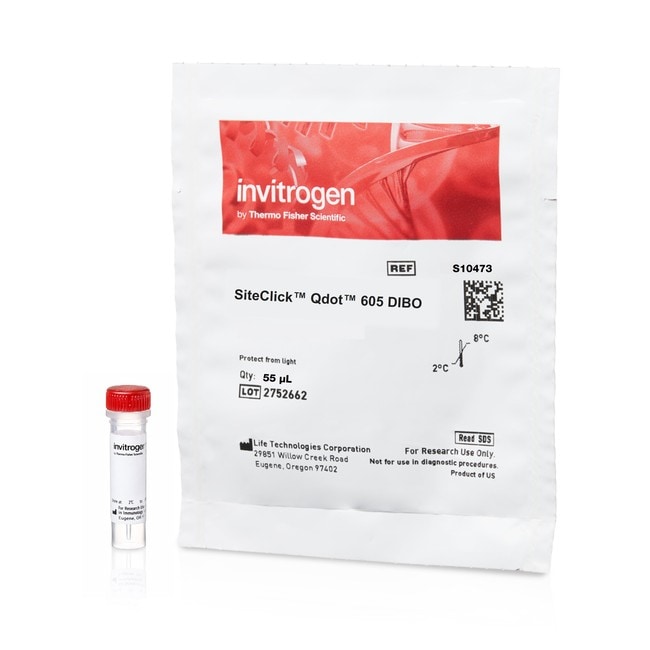
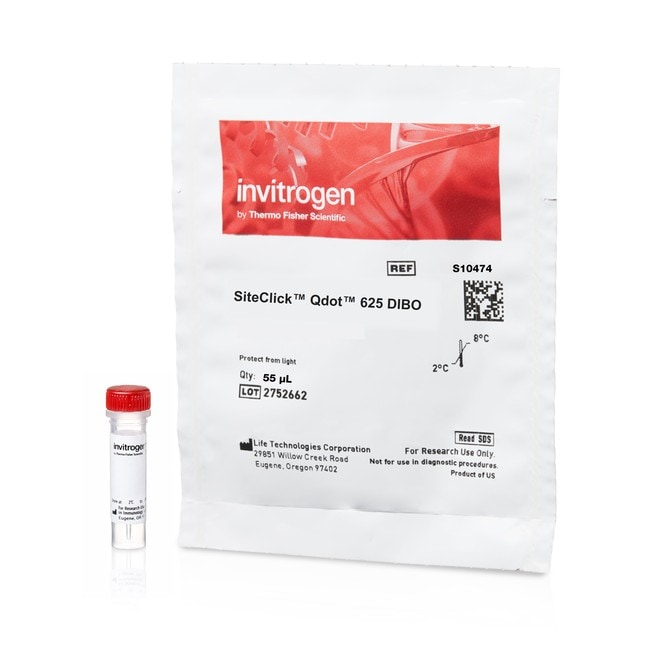
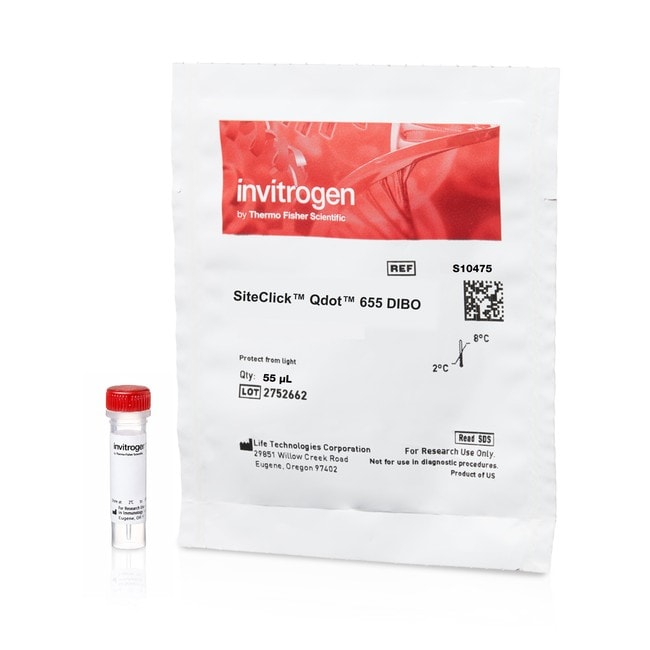
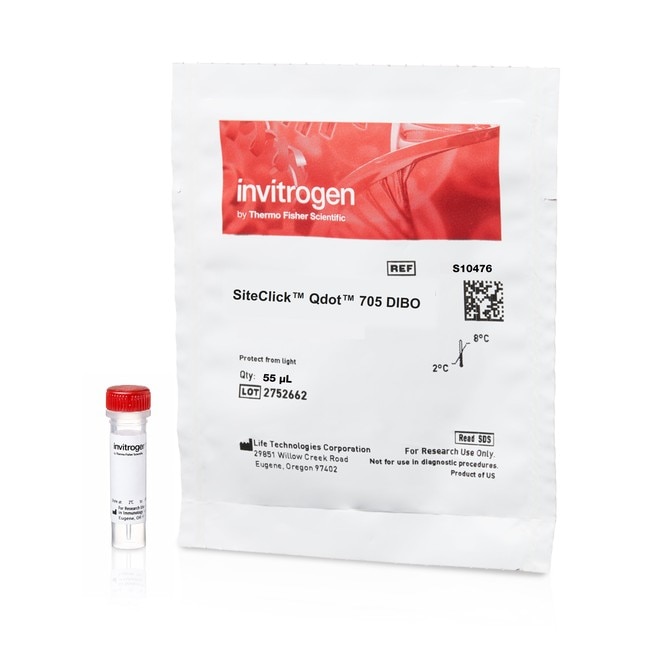
Invitrogen™ SiteClick™ Qdot™ DIBO


Description
Requires
SiteClick Duet or SureClick Conjugation
SiteClick™ Qdot™ DIBO reactive nanocrystals for antibody conjugation
Create bright, photostable, and site-selectively labeled antibody conjugates with Invitrogen™ SiteClick™ Qdot™ DIBO reactive nanocrystals. These reagents support covalent attachment to azide-modified IgG antibodies prepared using SiteClick™ or SureClick™ workflows.
Available across a broad emission range from 525 to 800 nm, SiteClick Qdot DIBO nanocrystals support flexible panel design for fluorescence imaging, multiplex detection, flow cytometry, high-content analysis, and other biological applications.
Why use Qdot DIBO reagents for antibody labeling?
Qdot nanocrystals combine broad excitation spectra, narrow emission profiles, high brightness, and strong resistance to photobleaching. These properties make them well suited for experiments requiring prolonged imaging, sensitive detection, or simultaneous measurement of multiple biological targets.
DIBO functionalization enables strain-promoted azide–alkyne cycloaddition, a copper-free click reaction that proceeds under mild, aqueous conditions. When paired with site-selectively modified IgG antibodies, the reaction helps position the Qdot away from the antigen-binding domains.
Key benefits include:
- Site-selective, covalent antibody conjugation
- Reduced risk of modifying or blocking antigen-binding sites
- Improved conjugate orientation and antibody accessibility
- More consistent labeling than random lysine- or thiol-based methods
- Copper-free reaction conditions compatible with proteins
- Broad Qdot emission range for multiplex assay development
Designed for SiteClick and SureClick antibody workflows
SiteClick technology introduces azide groups at conserved Fc-associated glycans, allowing DIBO-functionalized Qdots to attach away from the Fab antigen-binding regions. This is especially valuable for Qdot labeling because nanocrystals are larger than conventional organic fluorophores and may cause steric interference when attached randomly.
SureClick workflows also enable controlled modification in the Fc region and provide a streamlined route to click-ready antibodies. These site-selective approaches help generate more homogeneous conjugates while preserving antigen recognition.
How to conjugate Qdot DIBO nanocrystals to an antibody
Begin with a purified, azide-modified IgG prepared using a SiteClick or compatible SureClick antibody-modification workflow. Buffer-exchange the antibody as directed to remove free azide-containing reagents and other incompatible components.
Combine the azide-modified antibody with the Qdot DIBO reagent in a suitable aqueous buffer. Mix gently and incubate overnight at room temperature, approximately 20–25°C, to allow the copper-free click reaction to proceed. Avoid vigorous vortexing, which may promote Qdot aggregation.
The resulting conjugate may be used without additional purification when residual unconjugated material will not interfere with the application. When purification is required, centrifugal ultrafiltration with an appropriately selected high-molecular-weight-cutoff membrane can be used to remove excess free antibody and exchange the conjugate into a suitable storage buffer. Size-exclusion chromatography may also be evaluated, depending on sample volume and the required level of purity.
For long-term storage, formulate the purified conjugate in a Qdot-compatible buffered solution containing a protein stabilizer and an antimicrobial preservative, such as sodium azide. Store at 2–8°C and do not freeze, because freezing can cause irreversible Qdot aggregation. Maintain the conjugate at an appropriate stock concentration and prepare working dilutions on the day of use.
Reaction ratios, purification conditions, storage-buffer composition, and antibody compatibility should be optimized for the individual IgG and application and confirmed using the applicable product instructions.
Biological applications
SiteClick Qdot DIBO antibody conjugates are suited for:
- Multiplex cellular and tissue imaging
- Immunofluorescence and immunocytochemistry
- Immunohistochemistry and biomarker detection
- Single-particle tracking
- Flow cytometry
- High-content screening and analysis
- Fluorescence immunoassays and biosensors
- FRET-based assays
- Receptor trafficking and cell-signaling studies
- Near-infrared and deep-tissue imaging research
The broad excitation and spectrally narrow emission of Qdots allow multiple colors to be excited with a common light source while maintaining strong separation between detection channels.

Specifications
Specifications
| Quantity | 1 Ea. |
| Product Type | Reactive Dye |
| Sufficient For | Sufficient Qdot DIBO to label 100 μg of IgG |
| Chemical Reactivity | Click Chemistry |
| Detection Method | Fluorescence |
| EC Extinction Coefficient | 10,600,000 at 405 nm |
| Flow Cytometer Laser Lines | UV, Violet, Blue, Yellow, Red |
| For Use With (Equipment) | SiteClick Duet or SureClick Conjugation |
| Labeling Method | Click Chemistry |
| Labeling Scale | 100 μg of Antibody |
| Show More |
For Research Use Only. Not for use in diagnostic procedures.
By clicking Submit, you acknowledge that you may be contacted by Fisher Scientific in regards to the feedback you have provided in this form. We will not share your information for any other purposes. All contact information provided shall also be maintained in accordance with our Privacy Policy.