Learn More
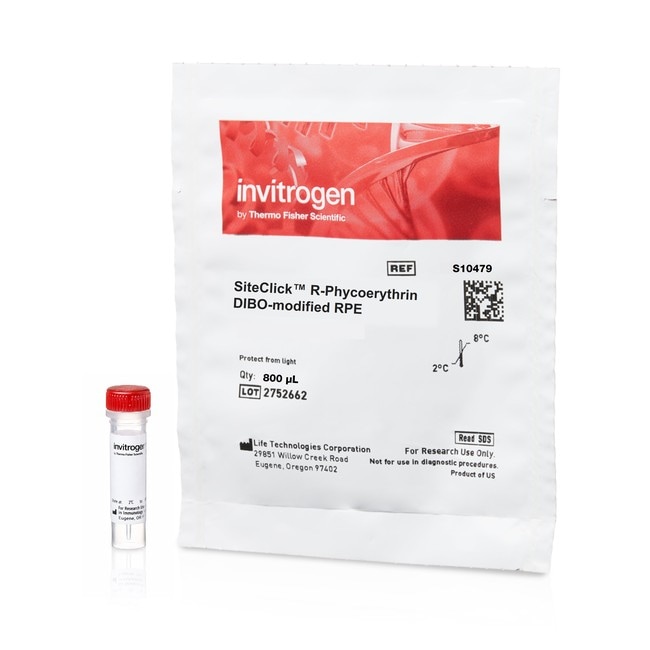
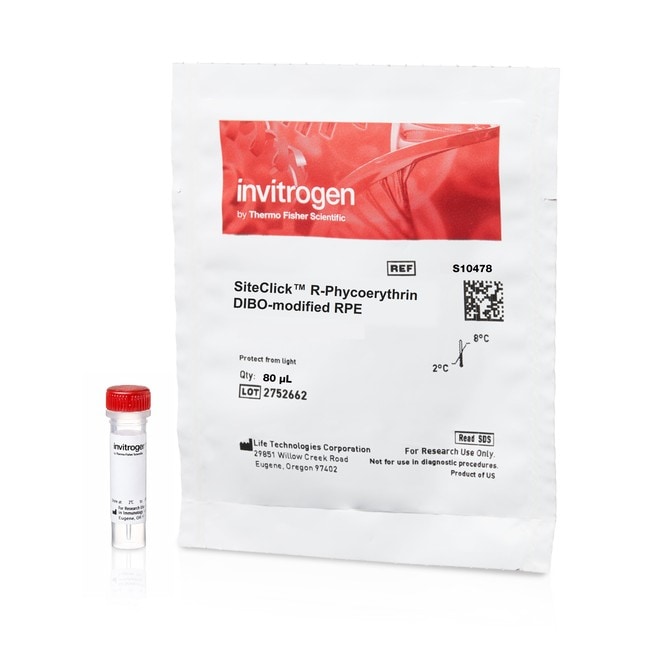
Invitrogen™ SiteClick™ R-PE DIBO


Description
Requires
SiteClick Duet or SureClick Conjugation
SiteClick™ DIBO RPE reagents for antibody labeling
Create bright, site-selectively labeled antibody conjugates with Invitrogen™ SiteClick™ DIBO RPE reagents. These reagents contain DIBO-modified R-Phycoerythrin (R-PE) for covalent attachment to azide-modified primary IgG antibodies prepared using SiteClick™ antibody-modification workflows.
R-PE is an intensely bright red-orange phycobiliprotein with excitation maxima at 496, 546, and 565 nm and an emission maximum at 578 nm. Its strong fluorescence makes SiteClick R-PE DIBO conjugates especially useful for flow cytometry and other applications where sensitive detection is important. The reagents are available under Cat. Nos. S10478 and S10479.
Why use R-PE DIBO reagents for antibody labeling?
R-Phycoerythrin combines high fluorescence intensity with broad visible-light excitation, making it a widely used label for sensitive cell analysis. The DIBO-modified R-PE reagent has a molar extinction coefficient of approximately 1,960,000 M-1 cm-1 at 565 nm, supporting strong signal generation from R-PE-labeled antibodies.
DIBO functionalization enables a copper-free click reaction with azide-modified antibodies under mild conditions. When the antibody is modified through SiteClick chemistry, the reactive azide groups are introduced on Fc-associated glycans, helping position the R-PE label away from the Fab antigen-binding domains.
Key benefits include:
- Site-selective, covalent attachment of R-PE to azide-modified IgG antibodies
- Helps preserve access to antigen-binding domains by directing labeling to Fc-associated glycans
- Bright red-orange fluorescence for sensitive flow cytometry and fluorescence-based detection
- Copper-free reaction conditions that avoid harsh antibody reduction steps
- More controlled and reproducible labeling than random amine- or thiol-reactive approaches
- Simple conjugation workflow with only a few minutes of hands-on setup followed by overnight incubation
Designed for SiteClick antibody-modification workflows
SiteClick technology takes advantage of conserved carbohydrate structures on the antibody heavy-chain Fc domain. The SiteClick™ Quartet and SiteClick™ Duet Antibody Modification Kits can be used to generate azide-modified antibodies that are ready to react with the DIBO-modified R-PE label. The shorter protocol for SiteClick Duet is often preferred. Because modification occurs away from the antigen-binding region, the workflow is designed to maintain antibody recognition while providing a defined site for label attachment.
How to conjugate R-PE DIBO to an antibody
Begin with approximately 100 micrograms of purified, azide-modified IgG. If the antibody concentration is below approximately 0.75 mg/mL or the sample is in a buffer containing azide, concentrate and buffer-exchange the antibody before starting the conjugation reaction. The user guide describes 1X Tris, pH 7.0, for this optional preparation step.
For the 100 microgram reaction, use 100-125 microliters of azide-modified antibody at approximately 0.75 mg/mL and add 75 microliters of R-PE DIBO in a 1.5 mL centrifuge tube. Vortex the reaction mixture, briefly centrifuge, and incubate in the dark for 20-24 hours at 20-25°C to allow the copper-free click reaction to proceed.
After conjugation, store the R-PE-labeled antibody at 2-8°C protected from light. Do not freeze. For long-term storage, sodium azide or thimerosal may be added, if appropriate for the downstream application.
Biological applications
SiteClick R-PE DIBO antibody conjugates are especially well suited for:
- Flow cytometry and multiparameter cell analysis
- Cell-surface antigen and biomarker detection
- Quantitative fluorescence measurements requiring a bright reporter
- Fluorescence microscopy and immunocytochemistry where R-PE detection is appropriate
- Multiplex immunoassays, microarrays, and other fluorescence-based binding assays
R-PE can be excited efficiently across several visible wavelengths and emits strongly near 578 nm, making it compatible with commonly used blue, green, and yellow flow-cytometer excitation lines. Its high brightness is particularly valuable when detecting low-abundance targets or when strong signal separation is needed in multicolor experiments.

Specifications
Specifications
| Quantity | 1 Ea. |
| Product Type | Reactive Dye |
| Sufficient For | Sufficient RPE DIBO to label 1 mg of IgG |
| Chemical Reactivity | Click Chemistry |
| Detection Method | Fluorescence |
| EC Extinction Coefficient | 1,960,000 at 565 nm |
| Flow Cytometer Laser Lines | Yellow |
| For Use With (Equipment) | SiteClick Duet or SureClick Conjugation |
| Labeling Method | Click Chemistry |
| Labeling Scale | 1 mg of Antibody |
| Show More |
For Research Use Only. Not for use in diagnostic procedures.
By clicking Submit, you acknowledge that you may be contacted by Fisher Scientific in regards to the feedback you have provided in this form. We will not share your information for any other purposes. All contact information provided shall also be maintained in accordance with our Privacy Policy.