
Universal Pipette Tips
Disposable pipette tips designed to fit single and multichannel pipettes from most manufacturers; offer acceptable performance compared to pipette specific tips and can be used with a variety of pipette models.
Single-use universal pipette tips are designed for compatibility with most mechanical and electronic single and multichannel pipettors.
Universal pipette tips are available in a range of types, sizes, colors, styles, and packaging configurations and may be designed for specific purposes or tasks.
- Capacity or volume based on the pipettor size
- Filters to reduce contamination and cross-contamination
- Color
- Sterility or autoclavability
- Tip style: beveled, tapered, wide bore, round, flat, or gel-loading
- Length: short or extended
- Purity: metal-free or DNase-, RNase-, ATP-, Bioburden-, PCR inhibitor-, endotoxin-, or pyrogen-free for genomic and biologic applications
- Surface treatments to reduce retention
- Packaging options to help facilitate re-stocking or eliminate waste


ABclonal Technology ACTR10 Rabbit pAb

Predicted to be involved in retrograde axonal transport of mitochondrion. Predicted to be located in cytosol, extracellular region, and secretory granule. Predicted to be part of dynactin complex.


ABclonal Technology INPP1 Rabbit pAb
This gene encodes the enzyme inositol polyphosphate-1-phosphatase, one of the enzymes involved in phosphatidylinositol signaling pathways. This enzyme removes the phosphate group at position 1 of the inositol ring from the polyphosphates inositol 1,4-bisphosphate and inositol 1,3,4-trisphophosphate.
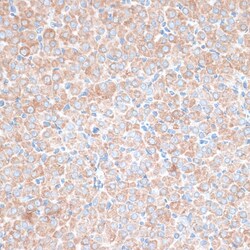
ABclonal Technology PMEPA1 Rabbit pAb
This gene encodes a transmembrane protein that contains a Smad interacting motif (SIM). Expression of this gene is induced by androgens and transforming growth factor beta, and the encoded protein suppresses the androgen receptor and transforming growth factor beta signaling pathways though interactions with Smad proteins. Overexpression of this gene may play a role in multiple types of cancer. Alternatively spliced transcript variants encoding multiple isoforms have been observed for this gene.
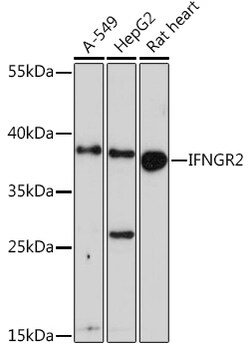
ABclonal Technology IFNGR2 Rabbit pAb
This gene (IFNGR2) encodes the non-ligand-binding beta chain of the gamma interferon receptor. Human interferon-gamma receptor is a heterodimer of IFNGR1 and IFNGR2. Defects in IFNGR2 are a cause of mendelian susceptibility to mycobacterial disease (MSMD), also known as familial disseminated atypical mycobacterial infection. MSMD is a genetically heterogeneous disease with autosomal recessive, autosomal dominant or X-linked inheritance.

ABclonal Technology UQCRFS1 Rabbit pAb
Predicted to enable oxidoreductase activity. Involved in mitochondrial respiratory chain complex III assembly and respiratory electron transport chain. Located in mitochondrion. Part of mitochondrial respiratory chain complex III and mitochondrial respiratory chain complex IV. Implicated in mitochondrial complex III deficiency.

ABclonal Technology MICAL1 Rabbit pAb
This gene encodes an enzyme that oxidizes methionine residues on actin, thereby promoting depolymerization of actin filaments. This protein interacts with and regulates signalling by NEDD9/CAS-L (neural precursor cell expressed, developmentally down-regulated 9). Alternative splicing results in multiple transcript variants.

ABclonal Technology ARHGAP11B Rabbit pAb
Predicted to enable GTPase activator activity. Involved in cerebral cortex development and negative regulation of mitochondrial membrane permeability. Acts upstream of with a positive effect on glutamine catabolic process. Located in mitochondrial matrix.

ABclonal Technology pan-Mono-MethylR(R*GG)Motif Rabbit pAb
Arginine methylation is a common posttranslational modification found on histone and non-histone proteins. Three types exist in mammalian cells: monomethylarginine (MMA), asymmetric dimethylarginine (ADMA), and symmetric dimethylarginine (SDMA). ADMA, the most prevalent, has two methyl groups on one nitrogen of the guanidino group. SDMA and MMA occur at 20-50% of ADMA levels, with SDMA having one methyl group on each nitrogen and MMA having a single methyl group. These modifications are found on various proteins in the cytoplasm, nucleus, and organelles of mammalian cells. Methylated arginine residues are often flanked by glycine residues, though there are many exceptions.
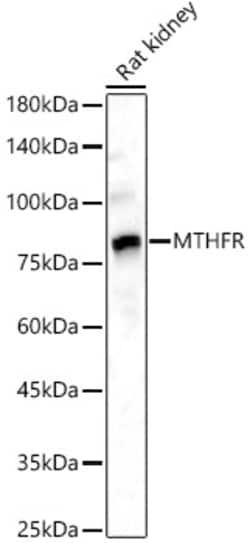
ABclonal Technology MTHFR Rabbit pAb
The protein encoded by this gene catalyzes the conversion of 5,10-methylenetetrahydrofolate to 5-methyltetrahydrofolate, a co-substrate for homocysteine remethylation to methionine. Genetic variation in this gene influences susceptibility to occlusive vascular disease, neural tube defects, colon cancer and acute leukemia, and mutations in this gene are associated with methylenetetrahydrofolate reductase deficiency.

ABclonal Technology SAMD3 Rabbit pAb
SAMD3 (Sterile Alpha Motif Domain Containing 3) is a Protein Coding gene. Diseases associated with SAMD3 include Diaphyseal Medullary Stenosis With Malignant Fibrous Histiocytoma. An important paralog of this gene is CNKSR2.
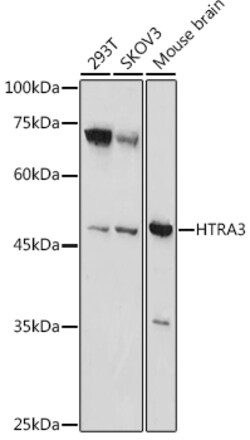
ABclonal Technology HTRA3 Rabbit pAb
Enables endopeptidase activity, identical protein binding activity, and serine-type peptidase activity. Involved in proteolysis. Predicted to be located in extracellular region.

ABclonal Technology NFIC Rabbit pAb
The protein encoded by this gene belongs to the CTF/NF-I family. These are dimeric DNA-binding proteins, and function as cellular transcription factors and as replication factors for adenovirus DNA replication. Alternatively spliced transcript variants encoding different isoforms have been described for this gene.
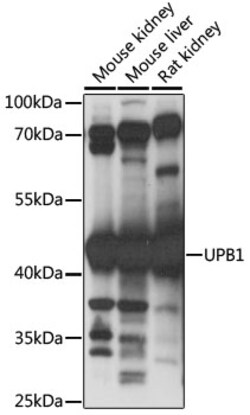
ABclonal Technology UPB1 Rabbit pAb
This gene encodes a protein that belongs to the CN hydrolase family. Beta-ureidopropionase catalyzes the last step in the pyrimidine degradation pathway. The pyrimidine bases uracil and thymine are degraded via the consecutive action of dihydropyrimidine dehydrogenase (DHPDH), dihydropyrimidinase (DHP) and beta-ureidopropionase (UP) to beta-alanine and beta-aminoisobutyric acid, respectively. UP deficiencies are associated with N-carbamyl-beta-amino aciduria and may lead to abnormalities in neurological activity.

ABclonal Technology MRE11 Rabbit pAb
This gene encodes a nuclear protein involved in homologous recombination, telomere length maintenance, and DNA double-strand break repair. By itself, the protein has 3 to 5 exonuclease activity and endonuclease activity. The protein forms a complex with the RAD50 homolog, this complex is required for nonhomologous joining of DNA ends and possesses increased single-stranded DNA endonuclease and 3 to 5 exonuclease activities. In conjunction with a DNA ligase, this protein promotes the joining of noncomplementary ends in vitro using short homologies near the ends of the DNA fragments. This gene has a pseudogene on chromosome 3. Alternative splicing of this gene results in two transcript variants encoding different isoforms.

ABclonal Technology ZFP64 Rabbit pAb
Predicted to enable DNA binding activity and metal ion binding activity. Predicted to be involved in positive regulation of cytokine production and positive regulation of transcription by RNA polymerase II. Predicted to act upstream of or within positive regulation of mRNA splicing, via spliceosome. Predicted to be active in nucleus.