
Protein Molecular Weight Markers

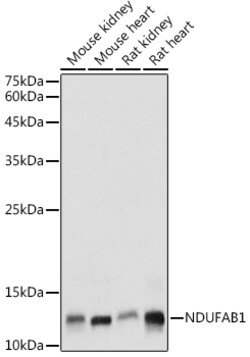
ABclonal Technology NDUFAB1 Rabbit pAb

Predicted to enable acyl binding activity, acyl carrier activity, and fatty acid binding activity. Involved in mitochondrial respiratory chain complex I assembly and protein lipoylation. Located in mitochondrion and nucleoplasm. Part of mitochondrial respiratory chain complex I. Colocalizes with mitochondrial large ribosomal subunit.

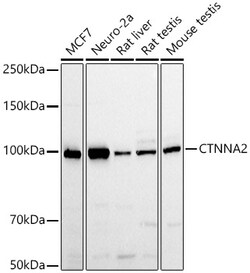
ABclonal Technology CTNNA2 Rabbit pAb
Enables actin filament binding activity. Involved in negative regulation of Arp2/3 complex-mediated actin nucleation, regulation of neuron migration, and regulation of neuron projection development. Located in cytoplasm. Implicated in complex cortical dysplasia with other brain malformations.
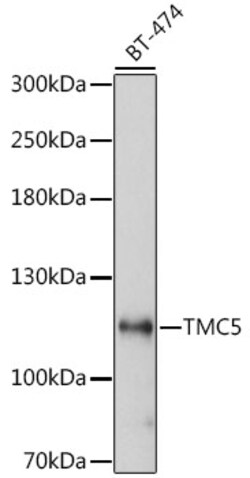
ABclonal Technology TMC5 Rabbit pAb
Predicted to enable mechanosensitive ion channel activity. Predicted to be involved in ion transmembrane transport. Located in extracellular exosome.
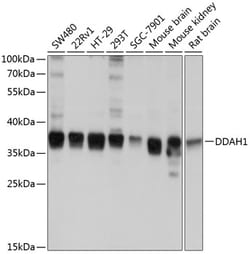
ABclonal Technology DDAH1 Rabbit pAb
This gene belongs to the dimethylarginine dimethylaminohydrolase (DDAH) gene family. The encoded enzyme plays a role in nitric oxide generation by regulating cellular concentrations of methylarginines, which in turn inhibit nitric oxide synthase activity.
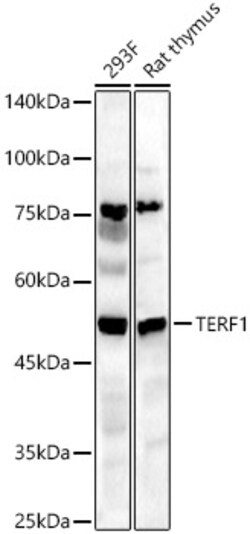
ABclonal Technology TERF1 Rabbit pAb
This gene encodes a telomere specific protein which is a component of the telomere nucleoprotein complex. This protein is present at telomeres throughout the cell cycle and functions as an inhibitor of telomerase, acting in cis to limit the elongation of individual chromosome ends. The protein structure contains a C-terminal Myb motif, a dimerization domain near its N-terminus and an acidic N-terminus. Multiple transcripts of this gene are alternatively spliced products.
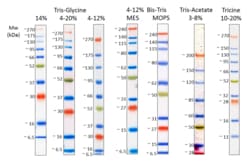
Biolegend Prime-Step™ Prestained Broad Range Protein Ladder
Prime-Step™ Prestained Broad Range Protein Ladder Apps: WB; Size: 50 uL
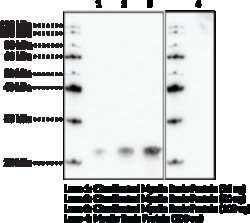
Cayman Chemical CItrulntd Myeln BasIc Pr 500uL
An orally bioavailable broad-spectrum triazole antifungal agent completely inhibits growth of T. rubrum M. audouini M. canis and T. verrucosum as well as some C. albicans and A. fumigatus strains and other fungi (100 g/ml) bacteriostatic against E. coli P. aeruginosa S. aureus and S. pyogenes (100 g/ml) eliminates vaginal C. albicans candidiasis infection in 97 of rats (1 topical) eliminates vaginal C. albicans candidiasis infection in 50 of rats (10 mg/kg oral) decreases synthesis of 14a-desmethyl sterols and increases synthesis of methylated sterols in C. albicans (IC50 3 nM)
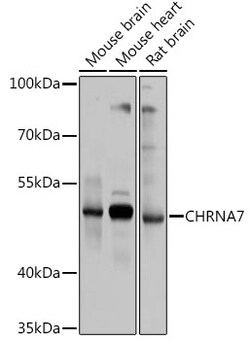
ABclonal Technology CHRNA7 Rabbit pAb
The nicotinic acetylcholine receptors (nAChRs) are ligand-gated ion channels involved in fast synaptic signaling. These receptors are typically hetero-pentamers of homologous subunits, with each subunit containing a conserved extracellular N-terminal domain, three transmembrane domains, a variable cytoplasmic loop, a fourth transmembrane domain, and a short C-terminal extracellular region. The protein encoded by this gene forms a homo-oligomeric channel that is permeable to calcium ions and is a major component of brain nicotinic receptors. This receptor, sensitive to alpha-bungarotoxin, opens upon acetylcholine binding. This gene is linked to juvenile myoclonic epilepsy and schizophrenia. A partial duplication event in this region forms a hybrid gene with the novel FAM7A gene. Alternative splicing results in multiple transcript variants.
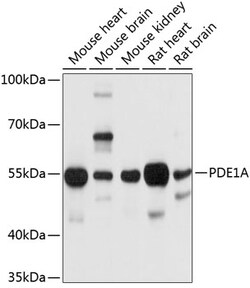
ABclonal Technology PDE1A Rabbit pAb
Cyclic nucleotide phosphodiesterases (PDEs) play a role in signal transduction by regulating intracellular cyclic nucleotide concentrations through hydrolysis of cAMP and/or cGMP to their respective nucleoside 5-prime monophosphates. Members of the PDE1 family, such as PDE1A, are Ca(2+)/calmodulin (see CALM1, MIM 114180)-dependent PDEs (CaM-PDEs) that are activated by calmodulin in the presence of Ca(2+) (Michibata et al., 2001 [PubMed 11342109], Fidock et al., 2002 [PubMed 11747989]).
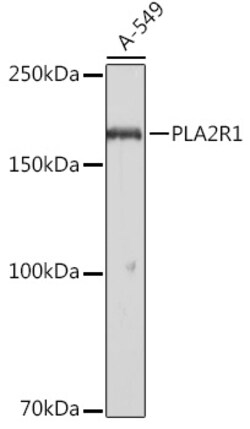
ABclonal Technology PLA2R1 Rabbit pAb
This gene represents a phospholipase A2 receptor. The encoded protein likely exists as both a transmembrane form and a soluble form. The transmembrane receptor may play a role in clearance of phospholipase A2, thereby inhibiting its action. Polymorphisms at this locus have been associated with susceptibility to idiopathic membranous nephropathy. Alternatively spliced transcript variants encoding different isoforms have been identified.
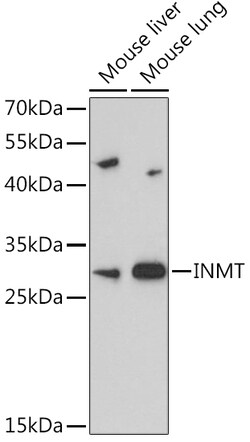
ABclonal Technology INMT Rabbit pAb
N-methylation of endogenous and xenobiotic compounds is a major method by which they are degraded. This gene encodes an enzyme that N-methylates indoles such as tryptamine. Alternative splicing results in multiple transcript variants. Read-through transcription also exists between this gene and the downstream MINDY4 (aka FAM188B) gene. In rodents and other mammals such as cetartiodactyla this gene is in the opposite orientation compared to its orientation in human and other primates and this gene appears to have been lost in carnivora and chiroptera.
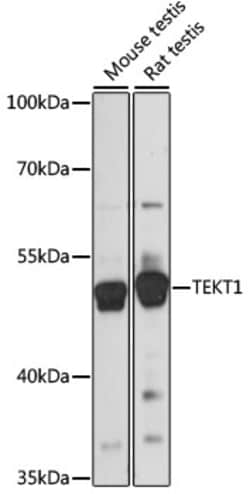
ABclonal Technology TEKT1 Rabbit pAb
This gene product belongs to the tektin family of proteins. Tektins comprise a family of filament-forming proteins that are coassembled with tubulins to form ciliary and flagellar microtubules. This gene is predominantly expressed in the testis and in mouse, tektin 1 mRNA was localized to the spermatocytes and round spermatids in the seminiferous tubules, indicating that it may play a role in spermatogenesis.
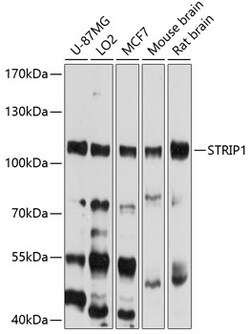
ABclonal Technology STRIP1 Rabbit pAb
This gene encodes a member of the striatin-interacting phosphatase and kinase complex, which is involved in localization of the Golgi body. The encoded protein participates in cytosketelal organization. Alternative splicing results in multiple transcript variants.
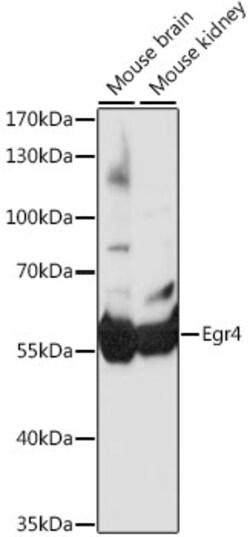
ABclonal Technology Egr4 Rabbit pAb
Predicted to enable DNA-binding transcription activator activity, RNA polymerase II-specific and RNA polymerase II cis-regulatory region sequence-specific DNA binding activity. Predicted to be involved in positive regulation of transcription by RNA polymerase II. Predicted to be located in nucleus. Is expressed in several structures, including central nervous system, genitourinary system, and tooth. Orthologous to human EGR4 (early growth response 4).
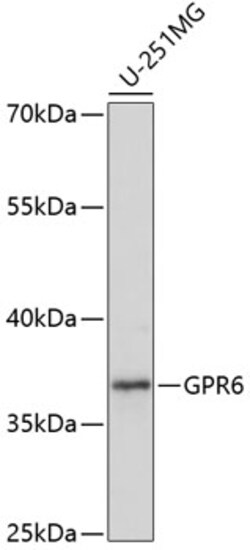
ABclonal Technology GPR6 Rabbit pAb
Predicted to enable sphingosine-1-phosphate receptor activity. Predicted to be involved in adenylate cyclase-activating G protein-coupled receptor signaling pathway and regulation of metabolic process. Predicted to act upstream of or within positive regulation of cytosolic calcium ion concentration. Predicted to be integral component of plasma membrane. Predicted to be active in cytoplasm and plasma membrane.