
Protein Molecular Weight Markers


Sigma Aldrich Fine Chemicals Biosciences Somatotropin from human pi
Somatotropin or growth hormone is a peptide hormone that is secreted by the anterior pituitary gland. It is essential for growth. The hormone increases muscle mass reduces fat mass helps in maintaining normal blood glucose levels and also promotes a balanced lipid profile.

![ABclonal Technology [KO Validated] RhoC Rabbit pAb](https://assets.fishersci.com/TFS-Assets/CCG/product-images/5000137715.jpg-250.jpg)
ABclonal Technology [KO Validated] RhoC Rabbit pAb

This gene encodes a member of the Rho family of small GTPases, which cycle between inactive GDP-bound and active GTP-bound states and function as molecular switches in signal transduction cascades. Rho proteins promote reorganization of the actin cytoskeleton and regulate cell shape, attachment, and motility. The protein encoded by this gene is prenylated at its C-terminus, and localizes to the cytoplasm and plasma membrane. It is thought to be important in cell locomotion. Overexpression of this gene is associated with tumor cell proliferation and metastasis. Multiple alternatively spliced variants, encoding the same protein, have been identified.


Biotium Primary Antibody Mouse IgG1 Fc N2504.M1FC CF660R 1/EA
Anti-Mouse IgG1 (Fc) rVHH (N2504 M1FC) is a recombinant Alpaca VHH antibody that recognizes the Fc fragment of mouse IgG1 and is validated for IF flow and WB Far-red fluorescent photostable CF660R dye has Ex/Em at 663/682 nm Unit size 500 uL at 0 1 mg/mL
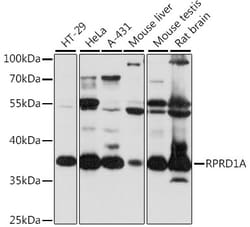
ABclonal Technology RPRD1A Rabbit pAb
This gene encodes a cell-cycle and transcription regulatory protein. The encoded protein interacts with the cell cycle inhibitor cyclin-dependent kinase 4 inhibitor B and may function as a negative regulator of G(1)/S phase progression. This protein also forms homo- and hetrodimers with the protein, regulation of nuclear pre-mRNA domain-containing protein 1B, to form a scaffold that interacts with the C-terminal domain of RNA polymerase II subunit B1 and regulates several aspects of transcription. Alternate splicing results in multiple transcript variants. A pseudogene of this gene is found on chromosome 16.
![ABclonal Technology [KO Validated] EBP1/PA2G4 Rabbit pAb](https://assets.fishersci.com/TFS-Assets/CCG/product-images/5000108961.jpg-250.jpg)
ABclonal Technology [KO Validated] EBP1/PA2G4 Rabbit pAb
This gene encodes an RNA-binding protein that is involved in growth regulation. This protein is present in pre-ribosomal ribonucleoprotein complexes and may be involved in ribosome assembly and the regulation of intermediate and late steps of rRNA processing. This protein can interact with the cytoplasmic domain of the ErbB3 receptor and may contribute to transducing growth regulatory signals. This protein is also a transcriptional co-repressor of androgen receptor-regulated genes and other cell cycle regulatory genes through its interactions with histone deacetylases. This protein has been implicated in growth inhibition and the induction of differentiation of human cancer cells. Six pseudogenes, located on chromosomes 3, 6, 9, 18, 20 and X, have been identified.
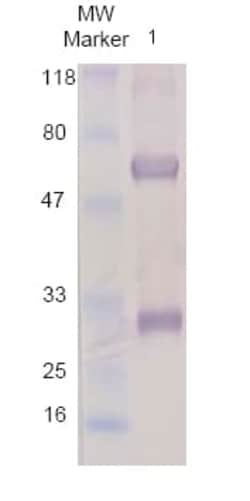
Abcam Chicken Anti-Goat IgG H&L
Chicken Anti-Goat IgG H&L
The product is subject to the following: Abcam Restricted Use Statement
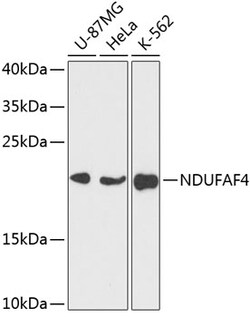
ABclonal Technology NDUFAF4 Rabbit pAb
NADHubiquinone oxidoreductase (complex I) catalyzes the transfer of electrons from NADH to ubiquinone (coenzyme Q) in the first step of the mitochondrial respiratory chain, resulting in the translocation of protons across the inner mitochondrial membrane. This gene encodes a complex I assembly factor. Mutations in this gene are a cause of mitochondrial complex I deficiency.
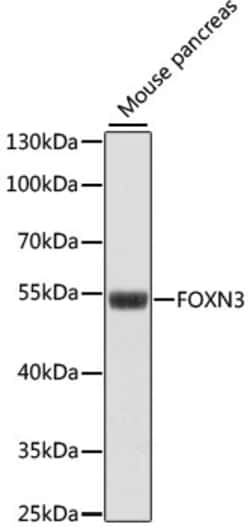
ABclonal Technology FOXN3 Rabbit pAb
This gene is a member of the forkhead/winged helix transcription factor family. Checkpoints are eukaryotic DNA damage-inducible cell cycle arrests at G1 and G2. Checkpoint suppressor 1 suppresses multiple yeast checkpoint mutations including mec1, rad9, rad53 and dun1 by activating a MEC1-independent checkpoint pathway. Alternative splicing is observed at the locus, resulting in distinct isoforms.
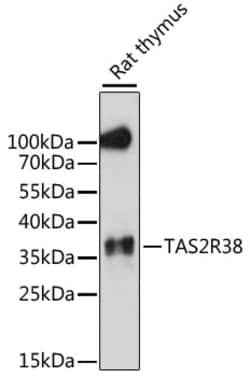
ABclonal Technology TAS2R38 Rabbit pAb
This gene encodes a seven-transmembrane G protein-coupled receptor that controls the ability to taste glucosinolates, a family of bitter-tasting compounds found in plants of the Brassica sp. Synthetic compounds phenylthiocarbamide (PTC) and 6-n-propylthiouracil (PROP) have been identified as ligands for this receptor and have been used to test the genetic diversity of this gene. Although several allelic forms of this gene have been identified worldwide, there are two predominant common forms (taster and non-taster) found outside of Africa. These alleles differ at three nucleotide positions resulting in amino acid changes in the protein (A49P, A262V, and V296I) with the amino acid combination PAV identifying the taster variant (and AVI identifying the non-taster variant).
![ABclonal Technology [KO Validated] NDUFC2 Rabbit pAb](https://assets.fishersci.com/TFS-Assets/CCG/product-images/5000104822.jpg-250.jpg)
ABclonal Technology [KO Validated] NDUFC2 Rabbit pAb
Involved in mitochondrial respiratory chain complex I assembly. Located in mitochondrion. Part of mitochondrial respiratory chain complex I. Implicated in nuclear type mitochondrial complex I deficiency.
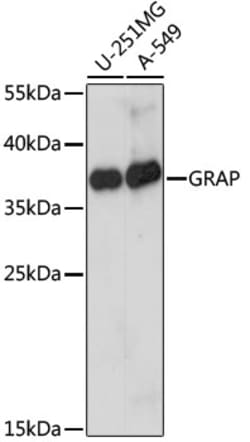
ABclonal Technology GRAP Rabbit pAb
This gene encodes a member of the GRB2/Sem5/Drk family and functions as a cytoplasmic signaling protein which contains an SH2 domain flanked by two SH3 domains. The SH2 domain interacts with ligand-activated receptors for stem cell factor and erythropoietin, and facilitates the formation of a stable complex with the BCR-ABL oncoprotein. This protein also associates with the Ras guanine nucleotide exchange factor SOS1 (son of sevenless homolog 1) through its N-terminal SH3 domain. In general, it couples signals from receptor and cytoplasmic tyrosine kinases to the Ras signaling pathway.
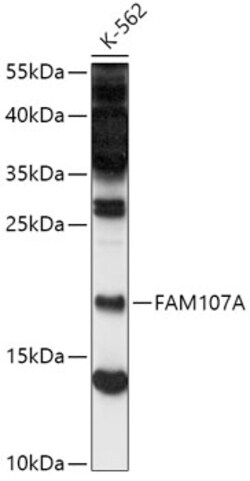
ABclonal Technology FAM107A Rabbit pAb
Predicted to enable actin binding activity. Involved in several processes, including negative regulation of G1/S transition of mitotic cell cycle, negative regulation of focal adhesion assembly, and regulation of cytoskeleton organization. Located in several cellular components, including focal adhesion, ruffle membrane, and stress fiber.
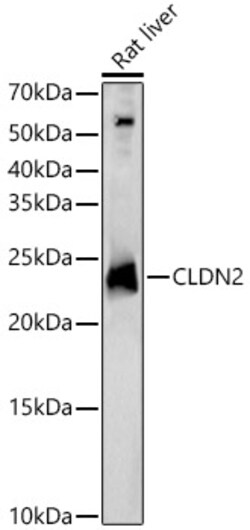
ABclonal Technology CLDN2 Rabbit pAb
This gene product belongs to the claudin protein family whose members have been identified as major integral membrane proteins localized exclusively at tight junctions. Claudins are expressed in an organ-specific manner and regulate tissue-specific physiologic properties of tight junctions. This protein is expressed in the intestine. Alternatively spliced transcript variants with different 5 untranslated region have been found for this gene.
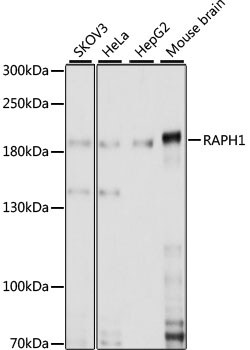
ABclonal Technology RAPH1 Rabbit pAb
This gene encodes a protein that belongs to the Mig10/Rap1-interacting adaptor molecule/Lamellipodin family of adapter proteins, which function in cell migration. Members of this family contain pleckstrin-homology domains, Ras-association domains, and proline-rich C-termini. The protein encoded by this gene regulates actin dynamics through interaction with Ena/Vasodilator proteins as well as direct binding to filamentous actin to regulate actin network assembly. Alternative splicing results in multiple transcript variants.
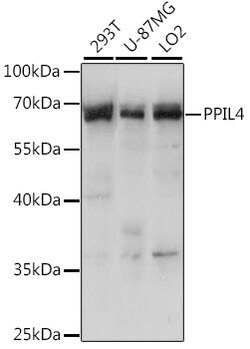
ABclonal Technology PPIL4 Rabbit pAb
This gene is a member of the cyclophilin family of peptidylprolyl isomerases. The cyclophilins are a highly conserved family, members of which play an important role in protein folding, immunosuppression by cyclosporin A, and infection of HIV-1 virions.