
Primary Antibody Matched Pairs



Human L1CAM ELISA Pair Set 15PP (Sino Biological)
Each vial contains 39 ng of recombinant CD171. Reconstitute with 1 mL detection antibody dilution buffer. After reconstitution, store at -20℃ to -80℃ in a manual defrost freezer. A seven-point standard curve using 2-fold serial dilutions in sample dilution buffer, and a high standard of 3 ng/mL is recommended.

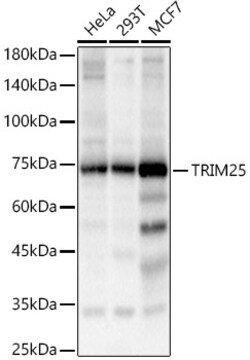
ABclonal Technology TRIM25 Rabbit pAb

The protein encoded by this gene is a member of the tripartite motif (TRIM) family. The TRIM motif includes three zinc-binding domains, a RING, a B-box type 1 and a B-box type 2, and a coiled-coil region. The protein is an RNA binding protein, functions as a ubiquitin E3 ligase and is involved in multiple cellular processes, including regulation of antiviral innate immunity.
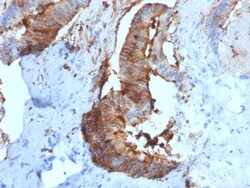
Biotium Cathepsin D (Tumor Marker)(CTSD/2781), 1mg/mL
Cathepsin D is a ubiquitously expressed lysosomal aspartyl protease involved in the normal degradation of proteins. It is synthesized as an inactive 43 kDa preprocathepsin D that is cleaved and glycosylated to form a 46 kDa procathepsin D and then further cleaved to produce 28 kDa and 15 kDa subunits (heavy and light chains, respectively). Cathepsin D exhibits pepsin-like activity and plays a role in protein turnover and in the proteolytic activation of hormones and growth factors. Mutations in this gene play a causal role in neuronal ceroid lipofuscinosis-10 and may be involved in the pathogenesis of several other diseases, including breast cancer and possibly Alzheimer's disease. Primary antibodies are available purified, or with a selection of fluorescent CF Dyes and other labels. CF Dyes offer exceptional brightness and photostability. Note: Conjugates of blue fluorescent dyes like CF405S and CF405M are not recommended for detecting low abundance targets, because blu
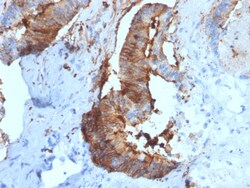
Biotium Cathepsin D (Tumor Marker)(CTSD/2781), Biotin conjugate, 0.1mg/mL
Cathepsin D is a ubiquitously expressed lysosomal aspartyl protease involved in the normal degradation of proteins. It is synthesized as an inactive 43 kDa preprocathepsin D that is cleaved and glycosylated to form a 46 kDa procathepsin D and then further cleaved to produce 28 kDa and 15 kDa subunits (heavy and light chains, respectively). Cathepsin D exhibits pepsin-like activity and plays a role in protein turnover and in the proteolytic activation of hormones and growth factors. Mutations in this gene play a causal role in neuronal ceroid lipofuscinosis-10 and may be involved in the pathogenesis of several other diseases, including breast cancer and possibly Alzheimer's disease. Primary antibodies are available purified, or with a selection of fluorescent CF Dyes and other labels. CF Dyes offer exceptional brightness and photostability. Note: Conjugates of blue fluorescent dyes like CF405S and CF405M are not recommended for detecting low abundance targets, because blu

Human CD93 ELISA Pair Set 15PP (Sino Biological)
Each vial contains 70(KW10AP1104-1) ng of recombinant Human CD93/C1qR. Reconstitute with 1 mL detection antibody dilution buffer. After reconstitution, store at -20℃ to -80℃ in a manual defrost freezer. A seven-point standard curve using 2-fold serial dilutions in sample dilution buffer, and a high standard of 2000 pg/mL is recommended.
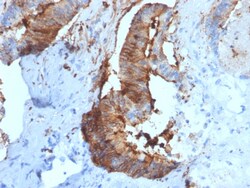
Biotium Cathepsin D (Tumor Marker)(CTSD/2781), Biotin conjugate, 0.1mg/mL
Cathepsin D is a ubiquitously expressed lysosomal aspartyl protease involved in the normal degradation of proteins. It is synthesized as an inactive 43 kDa preprocathepsin D that is cleaved and glycosylated to form a 46 kDa procathepsin D and then further cleaved to produce 28 kDa and 15 kDa subunits (heavy and light chains, respectively). Cathepsin D exhibits pepsin-like activity and plays a role in protein turnover and in the proteolytic activation of hormones and growth factors. Mutations in this gene play a causal role in neuronal ceroid lipofuscinosis-10 and may be involved in the pathogenesis of several other diseases, including breast cancer and possibly Alzheimer's disease. Primary antibodies are available purified, or with a selection of fluorescent CF Dyes and other labels. CF Dyes offer exceptional brightness and photostability. Note: Conjugates of blue fluorescent dyes like CF405S and CF405M are not recommended for detecting low abundance targets, because blu
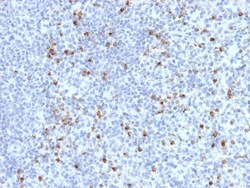
Biotium Perforin-1 (Pore Forming Protein) (Apoptosis Marker)(PRF1/2470), CF488A conjugate, 0.1mg/mL
Perforin is a pore-forming protein that leads to osmotic lysis of the target cells and subsequently enables granzymes to enter the target cells and activate apoptosis. Perforin has structural and functional similarities to complement component 9 (C9). Like C9, this protein creates transmembrane tubules and is capable of lysing non-specifically a variety of target cells. It is one of the main cytolytic proteins of cytolytic granules, and is known to be a key effector molecule for T-cell- and natural killer-cell-mediated cytolysis. Defects in this gene cause familial hemophagocytic lymphohistiocytosis type 2 (HPLH2), a rare and lethal autosomal recessive disorder of early childhood. The expression of perforin is reportedly upregulated in activated CD8 T-cells, natural killer cells and some CD4 T-cells. Primary antibodies are available purified, or with a selection of fluorescent CF Dyes and other labels. CF Dyes offer exceptional brightness and photostability. Note: Conjug
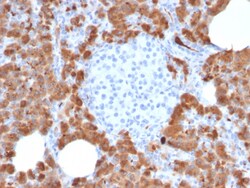
Biotium Carboxypeptidase A1 / CPA1 (Pancreatic Cancer Marker)(CPA1/2714), 0.2mg/mL
Carboxypeptidase A1 (CPA1) is a secreted zinc metalloprotease that is highly expressed in pancreatic tissue. It catalyzes the release of C-terminal amino acids from a variety of proteins, thereby playing a key role in protein digestion and degradation. Human pancreatic procarboxypeptidase A exists as three different active forms, two of which are carboxypeptidase A1 (CPA1) and carboxypeptidase A2 (CPA2). Abnormal levels of CPA1 are associated with pancreatic cancer, suggesting a possible role in either tumor progression or tumor suppression events. Primary antibodies are available purified, or with a selection of fluorescent CF Dyes and other labels. CF Dyes offer exceptional brightness and photostability. Note: Conjugates of blue fluorescent dyes like CF405S and CF405M are not recommended for detecting low abundance targets, because blue dyes have lower fluorescence and can give higher non-specific background than other dye colors.
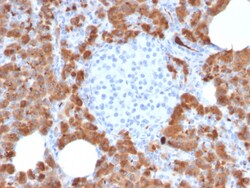
Biotium Carboxypeptidase A1 / CPA1 (Pancreatic Cancer Marker)(CPA1/2714), 0.2mg/mL
Carboxypeptidase A1 (CPA1) is a secreted zinc metalloprotease that is highly expressed in pancreatic tissue. It catalyzes the release of C-terminal amino acids from a variety of proteins, thereby playing a key role in protein digestion and degradation. Human pancreatic procarboxypeptidase A exists as three different active forms, two of which are carboxypeptidase A1 (CPA1) and carboxypeptidase A2 (CPA2). Abnormal levels of CPA1 are associated with pancreatic cancer, suggesting a possible role in either tumor progression or tumor suppression events. Primary antibodies are available purified, or with a selection of fluorescent CF Dyes and other labels. CF Dyes offer exceptional brightness and photostability. Note: Conjugates of blue fluorescent dyes like CF405S and CF405M are not recommended for detecting low abundance targets, because blue dyes have lower fluorescence and can give higher non-specific background than other dye colors.
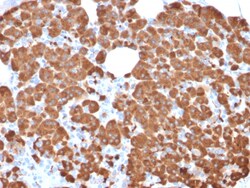
Biotium Carboxypeptidase A1 / CPA1 (Pancreatic Cancer Marker)(CPA1/2711), CF488A conjugate, 0.1mg/mL
Carboxypeptidase A1 (CPA1) is a secreted zinc metalloprotease that is highly expressed in pancreatic tissue. It catalyzes the release of C-terminal amino acids from a variety of proteins, thereby playing a key role in protein digestion and degradation. Human pancreatic procarboxypeptidase A exists as three different active forms, two of which are carboxypeptidase A1 (CPA1) and carboxypeptidase A2 (CPA2). Abnormal levels of CPA1 are associated with pancreatic cancer, suggesting a possible role in either tumor progression or tumor suppression events. Primary antibodies are available purified, or with a selection of fluorescent CF Dyes and other labels. CF Dyes offer exceptional brightness and photostability. Note: Conjugates of blue fluorescent dyes like CF405S and CF405M are not recommended for detecting low abundance targets, because blue dyes have lower fluorescence and can give higher non-specific background than other dye colors.
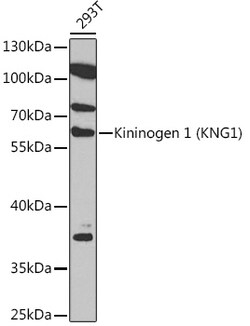
ABclonal Technology Kininogen 1 (KNG1) Rabbit pAb
This gene uses alternative splicing to generate two different proteins- high molecular weight kininogen (HMWK) and low molecular weight kininogen (LMWK). HMWK is essential for blood coagulation and assembly of the kallikrein-kinin system. Also, bradykinin, a peptide causing numerous physiological effects, is released from HMWK. Bradykinin also functions as an antimicrobial peptide with antibacterial and antifungal activity. In contrast to HMWK, LMWK is not involved in blood coagulation. Infection with severe acute respiratory syndrome coronavirus 2 (SARS-CoV-2) reduces or depletes angiotensin converting enzyme 2 (ACE2), which results in an increase in levels of des-Arg(9)-bradykinin, a bioactive metabolite of bradykinin that is associated with lung injury and inflammation. Three transcript variants encoding different isoforms have been found for this gene.
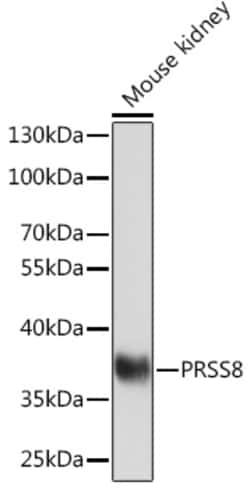
ABclonal Technology PRSS8 Rabbit pAb
This gene encodes a member of the peptidase S1 or chymotrypsin family of serine proteases. The encoded preproprotein is proteolytically processed to generate light and heavy chains that associate via a disulfide bond to form the heterodimeric enzyme. This enzyme is highly expressed in prostate epithelia and is one of several proteolytic enzymes found in seminal fluid. This protease exhibits trypsin-like substrate specificity, cleaving protein substrates at the carboxyl terminus of lysine or arginine residues. The encoded protease partially mediates proteolytic activation of the epithelial sodium channel, a regulator of sodium balance, and may also play a role in epithelial barrier formation.

Human IL7 ELISA Pair Set 5PP (Sino Biological)
Each vial contains 25 ng of recombinant Human IL7/IL-7/Interleukin-7. Reconstitute with 1 mL dilution buffer. After reconstitution, store at -20℃ to -80℃ in a manual defrost freezer. A seven-point standard curve using 2-fold serial dilutions in dilution buffer, and a high standard of 350 pg/mL is recommended.
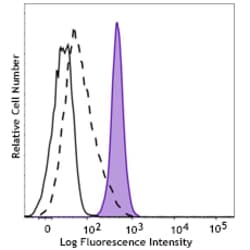
Biolegend Purified anti-IRAK3 IRAK-M
Purified anti-IRAK3 (IRAK-M) [W23096A] Isotype Rat IgG2b Reactivity Human Apps WB ICFC Size 100 g