
Donkey Secondary Antibodies

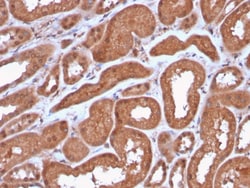
Biotium MTAP (Tumor Suppressor Marker)(MTAP/3137R), CF647 conjugate, 0.1mg/mL
Recognizes a protein of 31 kDa, which is identified as MTAP (5'-deoxy-5'-methylthioadenosine phosphorylase). It catalyzes the reversible phosphorolysis of methylthioadenosine, which is important in polyamine metabolism and for the salvage of adenine and methionine. The gene encoding MTAP is linked to the tumor suppressor gene, p16INK4A. Deficient levels of MTAP can occur in cancers primarily through co-deletion of the MTAP gene and the p16INK4A gene. Cells expressing MTAP and possessing adenine salvage pathway activity may be less susceptible to malignancy due to growth-inhibitory actions of agents (e. g. antifolates), whose mechanism of action, in part, involves this de novo purine pathway. Primary antibodies are available purified, or with a selection of fluorescent CF Dyes and other labels. CF Dyes offer exceptional brightness and photostability. Note: Conjugates of blue fluorescent dyes like CF405S and CF405M are not recommended for detecting low abundance targets, b

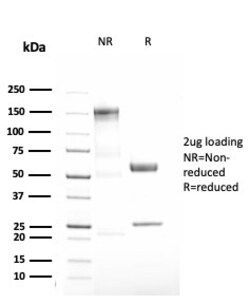
Biotium Alpha-1-Antitrypsin (SERPINA1) (Hepatocellular & Histiocytic Marker)(AAT/3167R), CF647 conjugate, 0.1mg/mL
This antibody recognizes a protein of 54 kDa, which is identified as Alpha-1 antitrypsin (AAT). AAT is secreted and is a serine protease inhibitor whose targets include elastase, plasmin, thrombin, trypsin, chymotrypsin, and plasminogen activator. Defects in this gene can cause emphysema or liver disease. Primary antibodies are available purified, or with a selection of fluorescent CF Dyes and other labels. CF Dyes offer exceptional brightness and photostability. Note: Conjugates of blue fluorescent dyes like CF405S and CF405M are not recommended for detecting low abundance targets, because blue dyes have lower fluorescence and can give higher non-specific background than other dye colors.
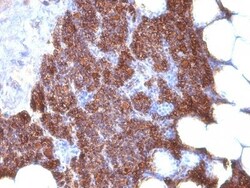
Biotium PTH (Parathyroid Hormone) (N & C Terminal) (3H9 + PTH/1175), CF647 conjugate, 0.1mg/mL
The epitope of this MAb maps in the C-terminus of PTH, a hormone produced by the parathyroid gland that regulates the concentration of calcium and phosphorus in extracellular fluid. This hormone elevates blood calcium levels by dissolving the salts in bone and preventing their renal excretion.It is produced in the parathyroid gland as an 84 amino acid single chain polypeptide. It can also be secreted as N-terminal truncated fragments or C-terminal fragments after intracellular degradation, as in case of hypercalcemia. Defects in this gene are a cause of familial isolated hypoparathyroidism (FIH); also called autosomal dominant hypoparathyroidism or autosomal dominant hypocalcemia. FIH is characterized by hypocalcemia and hyperphosphatemia due to inadequate secretion of parathyroid hormone. Symptoms are seizures, tetany and cramps. FIH exist both as autosomal dominant and recessive forms of hypoparathyroidism.Primary antibodies are available purified, or with a selection of fl

Biotium Neurofilament, phospho (NF-H) (Neuronal Marker)(NE14), CF647 conjugate, 0.1mg/mL
This MAb reacts with a 200 kDa protein, identified as heavy sub-unit of neurofilaments (NF-H). It reacts specifically with the phosphorylated KSP/KEP segment at the C-terminus of the heavy subunit (NF-H) of neurofilaments. After dephosphorylation of neurofilaments with alkaline phosphatase, this Ab no longer binds. Neurofilaments make up the main structural elements of axons and dendrites and are found in neurons, peripheral nerves, and sympathetic ganglion cells. Neurofilaments consist of three major subunits with molecular weights of 68 kDa (NF-L), 160 kDa (NF-M) and 200 kDa (NF-H). Anti-neurofilament stains a number of neural, neuroendocrine, and endocrine tumors. Neuromas, ganglioneuromas, gangliogliomas, ganglioneuroblastomas, and neuroblastomas stain positively for anti-neurofilament. Neurofilaments are also present in paragangliomas as well as adrenal and extra-adrenal pheochromocytomas. Carcinoids, neuroendocrine carcinomas of the skin, and oat cell carcinomas of the
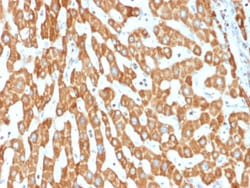
Biotium Prohibitin (Mitochondrial Marker)(PHB/1882), CF647 conjugate, 0.1mg/mL
Recognizes a protein of 30 kDa which is identified as Prohibitin, an evolutionarily conserved protein with homologues found in yeast to man. It is located in the inner membrane of mitochondria. Although prohibitin mRNA and protein expression occurs throughout the cell cycle, maximum levels are detected during the G1/S phase transition and minimum levels are seen in S phase and the G2/mitosis boundary. Prohibitin is located exclusively in the mitochondria with the highest concentration on the inner membrane. Prohibitin is an ideal mitochondrial marker. It shows antiproliferative activity and has been proposed to play a role in normal cell cycle regulation, replicative senescence, cellular immortalization, and tumor suppression. Primary antibodies are available purified, or with a selection of fluorescent CF Dyes and other labels. CF Dyes offer exceptional brightness and photostability. Note: Conjugates of blue fluorescent dyes like CF405S and CF405M are not recommended fo
Biotium CD2(HuLy-m1), CF647 conjugate, 0.1mg/mL
CD2 interacts through its amino-terminal domain with the extracellular domain of CD58 (also designated CD2 ligand) to mediate cell adhesion. CD2/CD58 binding can enhance antigen-specific T cell activation. CD2 is a transmembrane glycoprotein that is expressed on peripheral blood T lymphocytes, NK cells and thymocytes. CD58 is a heavily glycosylated protein with a broad tissue distribution in hematopoietic and other cells, including endothelium. Interaction between CD2 and its counter receptor LFA3 (CD58) on opposing cells optimizes immune system recognition, thereby facilitating communication between helper T lymphocytes and antigen-presenting cells, as well as between cytolytic effectors and target cells.Primary antibodies are available purified, or with a selection of fluorescent CF Dyes and other labels. CF Dyes offer exceptional brightness and photostability. Note: Conjugates of blue fluorescent dyes like CF405S and CF405M are not recommended for detecting low abunda
Biotium Helicobacter pylori(B-53.4), CF647 conjugate, 0.1mg/mL
The spiral shaped bacteriumHelicobacter pyloriis strongly associated with inflammation of the stomach and is also implicated in the development of gastric malignancy.H. pyloriis known to cause peptic ulcers and chronic gastritis in human. It is associated with duodenal ulcers and may be involved in development of adenocarcinoma and low-grade lymphoma of mucosa associated lymphoid tissue in the stomach.This antibody stains the individual H. pylori bacterium when it presents on the surface of the epithelium or in the cytoplasm of the epithelial cells in biopsy tissue sections from the antrum and body of the stomach.
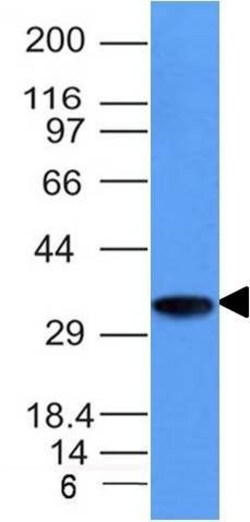
Biotium CD74(CLIP/1133), CF647 conjugate, 0.1mg/mL
Recognizes proteins of 33, 35 and 41 kDa, which are identified as various isoforms of CD74. Its epitope is localized in the extracellular domain of CD74. CD74 is a type II transmembrane protein which binds to the peptide binding groove of newly synthesized MHC class II alpha/beta heterodimers and prevents their premature association with endogenous polypeptides. The CD74 molecule plays a critical role in the presentation of peptides, by the MHC class II antigens, to CD4 positive lymphocytes. CD74 is expressed on MHC class II positive cells including B cells, a subset of activated T cells, monocytes, and dendritic cells and by various types of carcinomas. CD74 is expressed primarily by antigen presenting cells, such as B-lymphocytes (from before the pre-B cell stage to before the plasma cell stage), macrophages, and monocytes, and many epithelial cells. Anti-CD74 stains predominantly germinal center lymphocytes and B-cell lymphomas, but rarely T-cell lymphomas. Anti-CD74 has b

Biotium Primary Antibody GFAP rGA5 CF647 1/EA
GFAP (rGA5) is a recombinant mouse monoclonal antibody that recognizes GFAP This CF647 antibody conjugate has been validated in Immunofluorescence CF and reg dyes are Biotiums line of next-generation fluorescent dyes with advantages in brightness and photostability
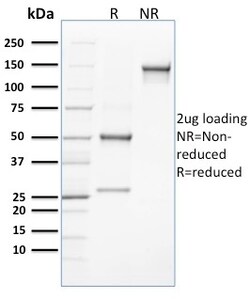
Biotium CLEC9A / DNGR1 (Dendritic Cell Marker)(8F9), CF647 conjugate, 0.1mg/mL
This MAb recognizes a protein of 27 kDa, identified as CLEC9A (C-type lectin domain family 9 member A). Its epitopes maps in aa 50-110. The C-type lectin/C-type lectin-like domain (CTL/CTLD) superfamily consists of a variety of proteins that share a common protein fold and have diverse functions, including cell-cell signaling, cell adhesion, glycoprotein turnover and immune responses. CLEC-9A, also known as DNGR1 (dendritic cell natural killer lectin group receptor 1), is a 241 amino acid single-pass type II membrane protein that contains one C-type lectin domain and belongs to the CTL/CTLD superfamily. Expressed in myeloid lineage cells, brain, spleen and thymus, CLEC-9A is a group V C-type lectin- like receptor (CTLR) that acts as an activation receptor. Primary antibodies are available purified, or with a selection of fluorescent CF Dyes and other labels. CF Dyes offer exceptional brightness and photostability. Note: Conjugates of blue fluorescent dyes like CF405S and

Biotium Secondary Antibody Mouse IgG Donkey CF583R 1/EA
This product is prepared by labeling highly cross-adsorbed donkey anti-mouse IgG (H plus L) with CF and reg 583R dye To minimize cross-reactivity the antibody has been adsorbed against bovine chicken goat guinea pig Syrian hamster horse human rabbit and sheep serum

Biotium Primary Antibody Biotin rBN-34 CF647 1/EA
Biotin (rBN-34) is a recombinant mouse monoclonal antibody that recognizes free biotin and biocytin This CF647 antibody conjugate has been validated in Immunofluorescence CF and reg dyes are Biotiums line of next-generation fluorescent dyes with advantages in brightness and photostability
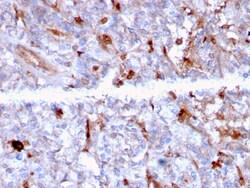
Biotium C1QA / Complement C1q A-Chain(C1QA/2956), CF647 conjugate, 0.1mg/mL
Complement C1q A Chain (C1qa) is a subunit of C1q. C1q is composed of 6 polypeptide chains each of C1qa, C1qb, and C1qc. C1q is a component of the classical complement pathway, and thereby plays an important role in the immune response. Each C1q subunit contains an N-terminal collagen-like region and a C-terminal C1q globular domain. The presence of receptors for C1q on effector cells modulates its activity, which may be antibody-dependent or independent. Macrophages are the primary source of C1q, while anti-inflammatory drugs as well as cytokines differentially regulate expression of the mRNA as well as the protein. C1q deficiency is associated with lupus erythematosus and glomerulonephritis. Primary antibodies are available purified, or with a selection of fluorescent CF Dyes and other labels. CF Dyes offer exceptional brightness and photostability. Note: Conjugates of blue fluorescent dyes like CF405S and CF405M are not recommended for detecting low abundance targets,
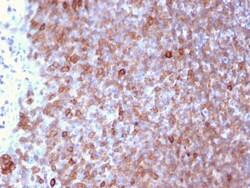
Biotium Lymphocyte Specific Protein 1 (LSP1) / pp52(LSP1/3025), CF647 conjugate, 0.1mg/mL
LSP1 is a hematopoietic-expressed gene that encodes an F-actin-binding, leukocyte-specific (including B and T lymphocytes, granulocytes and macrophages), phosphoprotein. However, mRNA splice variants that do not encode the lympho-specific protein are expressed from this gene in nonlymphoid cell lines as well (myocytes, stromal cells and fibroblasts), suggesting pp52 has a divergent role in signal transduction. The pp52 (LSP1) locus maps to human chromosome 11p15. 5, which is implicated in tumor-related chromosomal translocations found in chronic lymphocytic leukemia. The pp52 promoter contains key elements that control transcriptional activity including an initiator specifying the unique 5' terminus of pp52 mRNA, tandem pairs of Ets and SP1 motifs, and a single C/EBP motif. LSP1 binds the cytoskeleton and has been implicated in affecting cytoskeletal remodeling in a variety of leukocyte functions, including cell motility and chemotaxis. Primary antibodies are available purifi
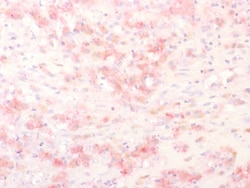
Biotium Tyrosinase-Related Protein-1 (TYRP-1) (Melanoma Marker), CF647 conjugate, 0.1mg/mL
Reacts with a 75 kDa melanocyte-specific gene product, identified as Tyrosinase-related protein-1 (TRP-1). It is involved in melanin synthesis. TRP1 is present on the melanosomal membranes of melanoma, normal melanocytes and nevi. Recent evidence suggests that TRP-1 is involved in maintaining stability of tyrosinase protein and modulating its catalytic activity. TRP-1 is also involved in maintenance of melanosome ultrastructure and affects melanocyte proliferation and cell death. Primary antibodies are available purified, or with a selection of fluorescent CF Dyes and other labels. CF Dyes offer exceptional brightness and photostability. Note: Conjugates of blue fluorescent dyes like CF405S and CF405M are not recommended for detecting low abundance targets, because blue dyes have lower fluorescence and can give higher non-specific background than other dye colors.