
Rabbit Secondary Antibodies


ABclonal Technology 488 Rabbit anti-Rat IgG1 Fc

Predicted to enable antigen binding activity and immunoglobulin receptor binding activity Predicted to act upstream of or within several processes including antibody-dependent cellular cytotoxicity phagocytosis and positive regulation of immune response Predicted to be located in external side of plasma membrane and extracellular space Predicted to be part of immunoglobulin complex circulating Orthologous to human IGHG1 (immunoglobulin heavy constant gamma 1 (G1m marker))

ABclonal Technology 488 Rabbit anti- CD201/EPCR
Predicted to enable protein C-terminus binding activity Predicted to be involved in negative regulation of coagulation Predicted to act upstream of or within blood coagulation Located in centrosome Is expressed in several structures including blastocyst endocardial tissue female reproductive system liver and vascular element Orthologous to human PROCR (protein C receptor)
ABclonal Technology 488 Rabbit anti- CD150/SLAM
Enables identical protein binding activity and signaling receptor activity Involved in natural killer cell activation positive regulation of activated T cell proliferation and regulation of cytokine production Acts upstream of or within several processes including leukocyte chemotaxis involved in inflammatory response positive regulation of leukocyte chemotaxis and regulation of vesicle fusion Located in external side of plasma membrane and phagocytic vesicle Is expressed in liver lobe Orthologous to human SLAMF1 (signaling lymphocytic activation molecule family member 1)
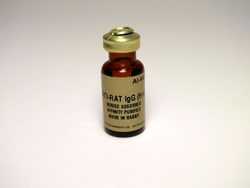
Vector Laboratories Rabbit Anti-Rat IgG Antibody Mouse Adsorbed Unconjugated 0.5 mg
Unconjugated Rabbit Anti-Rat IgG antibodies are purified by an affinity chromatography procedure to remove any low affinity antibodies, then cross-reactive antibodies are removed by solid-phase adsorption. The final product is subjected to rigorous quality control assays including immunodiffusion, solid-phase enzyme immunoassays, gel electrophoresis and solid-phase binding assays. These antibodies will recognize both heavy and light chains. Rabbit Anti-Rat IgG Antibody is supplied in solution. This ultrapure, high affinity antibody is ready for iodination, fluorochrome labeling, or enzyme conjugations. It can also be employed as a capture antibody in enzyme immunoassays or in other assays requiring carrier-free immunoglobulins.

Medchemexpress LLC Hrp-conjugated rabbit anti-rat IgG H&L | 50 UL
HRP-conjugated Rabbit Anti-Rat IgG H&L is a HRP-conjugated rabbit-originated antibody targeting the rat IgG antibody. It is isolated as an intact whole IgG molecule from antisera by immunoaffinity chromatography, featuring an Fc portion and two antigen binding Fab portions. It is suitable for various applications including Western Blot, Immunohistochemistry-Paraffin, and ELISA.
- Targeted to rat IgG antibody
- Isolated as intact whole IgG molecules
- Suitable for Western Blot, IHC-P, and ELISA applications
- Supplied in phosphate buffered saline with BSA and glycerol
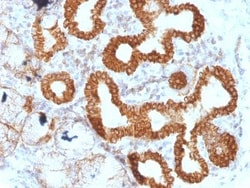
Biotium CD95(B-R18), CF594 conjugate, 0.1mg/mL
MAb B-R18 specifically recognizes CD95, also known as Fas, a transmembrane glycoprotein with a MW of 40-45 kDa, containing 8 kDa of N-glycosidic-linked polysaccharide. It is a receptor for TNFSF6/FASLG, a member of the nerve growth factor receptor/tumor necrosis factor superfamily, mediating receptor-triggered apoptosis. The adapter molecule FADD recruits caspase-8 to the activated receptor. The resulting death-inducing signaling complex (DISC) performs caspase-8 proteolytic activation, which initiates the subsequent cascade of caspases (aspartate-specific cysteine proteases) mediating apoptosis. FAS-mediated apoptosis may have a role in the induction of peripheral tolerance, in the antigen-stimulated suicide of mature T-cells, or both. The secreted isoforms 2 to 6 block apoptosis (in vitro). CD95 antigen is expressed on the surface of various cell types, preferentially on the CD45RAlow CD45ROhigh subset of memory T lymphocytes.Primary antibodies are available purified, or wi
ABclonal Technology 488 Rabbit anti-Rat IgG1 Fc
Predicted to enable antigen binding activity and immunoglobulin receptor binding activity Predicted to act upstream of or within several processes including antibody-dependent cellular cytotoxicity phagocytosis and positive regulation of immune response Predicted to be located in external side of plasma membrane and extracellular space Predicted to be part of immunoglobulin complex circulating Orthologous to human IGHG1 (immunoglobulin heavy constant gamma 1 (G1m marker))
ABclonal Technology 488 Rabbit anti-/Rat CD54
This gene encodes an integral membrane protein that binds leukocyte adhesion protein LFA-1 It participates in the innate immune response
ABclonal Technology 488 Rabbit anti-/Rat CD54
This gene encodes an integral membrane protein that binds leukocyte adhesion protein LFA-1 It participates in the innate immune response
ABclonal Technology 594 Rabbit anti-/Rat CD54
This gene encodes an integral membrane protein that binds leukocyte adhesion protein LFA-1 It participates in the innate immune response
ABclonal Technology 594 Rabbit anti-/Rat CD54
This gene encodes an integral membrane protein that binds leukocyte adhesion protein LFA-1 It participates in the innate immune response
Immunoreagents Inc RABBIT A-RAT IGG HRP
Secondary Antibody: Rabbit anti-rat IgG (H&L) - Affinity Pure, HRP Conjugate, Host: Rabbit, Format: Lyo, Label: HRP, Applications: WB, ELISA, IHC/ICC
ABclonal Technology ABflo 488 Rabbit anti-Rat CD31
Enables protein phosphatase binding activity Involved in several processes including cellular response to interferon-gamma negative regulation of GTPase activity and negative regulation of actin filament polymerization Located in cell surface and ruffle Used to study pulmonary hypertension Biomarker of bacterial pneumonia orchitis and osteoarthritis Human ortholog(s) of this gene implicated in coronary artery disease (multiple) lung non-small cell carcinoma neuroblastoma and psoriatic arthritis Orthologous to human PECAM1 (platelet and endothelial cell adhesion molecule 1)
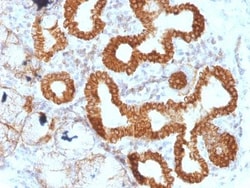
Biotium CD95(B-R18), CF647 conjugate, 0.1mg/mL
MAb B-R18 specifically recognizes CD95, also known as Fas, a transmembrane glycoprotein with a MW of 40-45 kDa, containing 8 kDa of N-glycosidic-linked polysaccharide. It is a receptor for TNFSF6/FASLG, a member of the nerve growth factor receptor/tumor necrosis factor superfamily, mediating receptor-triggered apoptosis. The adapter molecule FADD recruits caspase-8 to the activated receptor. The resulting death-inducing signaling complex (DISC) performs caspase-8 proteolytic activation, which initiates the subsequent cascade of caspases (aspartate-specific cysteine proteases) mediating apoptosis. FAS-mediated apoptosis may have a role in the induction of peripheral tolerance, in the antigen-stimulated suicide of mature T-cells, or both. The secreted isoforms 2 to 6 block apoptosis (in vitro). CD95 antigen is expressed on the surface of various cell types, preferentially on the CD45RAlow CD45ROhigh subset of memory T lymphocytes.Primary antibodies are available purified, or wi
ABclonal Technology 488 Rabbit anti- CD262/TRAILR2
Predicted to enable TRAIL receptor activity identical protein binding activity and protease binding activity Predicted to be involved in TRAIL-activated apoptotic signaling pathway and positive regulation of apoptotic process Predicted to act upstream of or within apoptotic process and regulation of apoptotic process Predicted to be located in Golgi apparatus cytosol and membrane raft Predicted to be active in cell surface and plasma membrane Is expressed in bladder liver renal vasculature urethra of female and urethra of male Human ortholog(s) of this gene implicated in carcinoma (multiple) cervical cancer hematologic cancer (multiple) and urinary bladder cancer Orthologous to several human genes including TNFRSF10A (TNF receptor superfamily member 10a)