
Protein Labeling Reagents

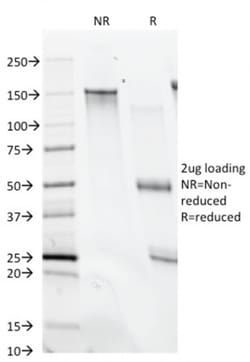
Biotium CD28(C28/74), CF568 conjugate, 0.1mg/mL
Recognizes a glycoprotein of 44-88 kDa, which is identified as CD28. It is the critical T-cell co-stimulatory receptor which provides to the cell the important second activation signal by binding CD80 and CD86 that are expressed by antigen presenting cells. Besides its co-stimulation role, CD28 functions in preventing T-cells from anergic hyporesponsive state or from undergoing premature apoptotic cell death. CD28 is also expressed on human fetal NK cells and some NK cell lines, whereas on murine NK cells the CD28 expression is much broader. Primary antibodies are available purified, or with a selection of fluorescent CF Dyes and other labels. CF Dyes offer exceptional brightness and photostability. Note: Conjugates of blue fluorescent dyes like CF405S and CF405M are not recommended for detecting low abundance targets, because blue dyes have lower fluorescence and can give higher non-specific background than other dye colors.

Biotium PLGF(PLGF93), CF488A conjugate, 0.1mg/mL
The onset of angiogenesis is believed to be an early event in tumorigenesis and may facilitate tumor progression and metastasis. Several growth factors with angiogenic activity have been described. These include Fibroblast Growth Factor (FGF), Platelet Derived Growth Factor (PDGF), Vascular Endothelial Growth Factor (VEGF) and Placenta Growth Factor (PLGF). Placenta growth factor (PLGF) is a secreted protein primarily produced by placental trophoblasts but also expressed in other endothelial cells and tumors. There are three isoforms, PLGF-1, PLGF-2, and PLGF-3. PLGF-2 is expressed up until week 8 in the placenta; the placental tissues continuously express PLGF-1 and PLGF-3 but only PLGF-1 is found in colon and mammary carcinomas. PLGF acts to stimulate angiogenesis, endothelial growth and migration. PLGF is a powerful promoter of tumor growth and is upregulated in some cancers, and PLGF is thought to aid in atherosclerotic lesions and neovascular growth surrounding the lesio

Immunochemistry Technology Magic Red™ Cathepsin B Assay Kit, Detects intracellular cathepsin B activity, 100 Tests, Non-cytotoxic, Cell-permeant
Magic Red™ Cathepsin B Assay Kit, Detects intracellular cathepsin B activity, 100 Tests, Non-cytotoxic, Cell-permeant

Biotium CD2(1E7E8.G4), CF568 conjugate, 0.1mg/mL
CD2 interacts through its amino-terminal domain with the extracellular domain of CD58 (also designated CD2 ligand) to mediate cell adhesion. CD2/CD58 binding can enhance antigen-specific T cell activation. CD2 is a transmembrane glycoprotein that is expressed on peripheral blood T lymphocytes, NK cells and thymocytes. CD58 is a heavily glycosylated protein with a broad tissue distribution in hematopoietic and other cells, including endothelium. Interaction between CD2 and its counter receptor LFA3 (CD58) on opposing cells optimizes immune system recognition, thereby facilitating communication between helper T lymphocytes and antigen-presenting cells, as well as between cytolytic effectors and target cells.Primary antibodies are available purified, or with a selection of fluorescent CF Dyes and other labels. CF Dyes offer exceptional brightness and photostability. Note: Conjugates of blue fluorescent dyes like CF405S and CF405M are not recommended for detecting low abunda
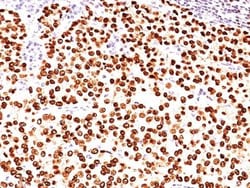
Biotium p53(BP53-12), CF568 conjugate, 0.1mg/mL
This MAb reacts with an N-terminal epitope (aa 16-25) of both wild type and mutated p53. Mutation and/or allelic loss of p53 is one of the causes of a variety of mesenchymal and epithelial tumors. If it occurs in the germ line, such tumors run in families. In most transformed and tumor cells the concentration of p53 is increased 51000 fold over the minute concentrations (1000 molecules cell) in normal cells, principally due to the increased half-life (4 h) compared to that of the wild-type (20 min). p53 Localizes in the nucleus, but is detectable at the plasma membrane during mitosis and when certain mutations modulate cytoplasmic/nuclear distribution. Mutations arise with an average frequency of 70% but incidence varies from zero in carcinoid lung tumors to 97% in primary melanomas. High concentrations of p53 protein are transiently expressed in human epidermis and superficial dermal fibroblasts following mild ultraviolet irradiation. Positive nuclear staining with p53 antib
STEMCELL Technologies GloCell™ Fixable Viability Dye Violet 510, Size: 500 Tests
GloCell™ Fixable Viability Dye Violet 510 is a fluorescent cell viability dye for staining live/dead mammalian cells in applications such as flow cytometry. The dye irreversibly binds intracellular and cell surface amine groups and can be utilized prior to fixation, permeabilization, or cryopreservation. Cells with compromised plasma membranes become permeable to the GloCell™ dye, resulting in a greater fluorescence compared to live cells in a cell viability assay.GloCell™ Fixable Viability Dye Violet 510 is excited by the violet laser at 405 nm and it has a fluorescence emission maximum of 510 nm that can be detected using the 525/50 band pass filter used to detect AmCyan.
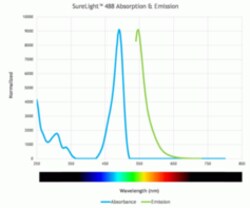
Cayman Chemical SureLIght488 NHS ester 100ug
SureLight™ 488 is a bright green fluorescent dye with excitation suited to the 488 nm laser line, fluorescent microscopy, and flow cytometry. The NHS ester version is an efficient amine reactive probe that can be used to label proteins, antibodies, haptens, and other primary amine containing molecules.[Columbia Biosciences Product No. D44-100]
Biotium MALT-1(MT1/410), CF568 conjugate, 0.1mg/mL
Mucosa associated lymphoid tissue lymphoma translocation gene 1 (MALT1) is found in extranodal low-grade B cell lymphomas. MALT1 encodes two Ig-like C2-type domains and fuses with an API2 gene, which is highly expressed in adult lymphoid tissue. The translocation of this MALT1 gene, which maps to human chromosome 18q21, and the apoptosis-inhibiting API2 gene results in an increased development of MALT lymphomas and apoptosis inhibition. Sites at which this API2-MALT1 (11;18)(q21;q21) translocation commonly occurs are within human lung and kidney tissue. MALT lymphoma expresses nuclear Bcl10, which mediates the oligomerization and activation of a MALT1 caspase-like domain. MALT1 mRNA is found in pre-B cells, mature B cells and plasma cells.Primary antibodies are available purified, or with a selection of fluorescent CF Dyes and other labels. CF Dyes offer exceptional brightness and photostability. Note: Conjugates of blue fluorescent dyes like CF405S and CF405M are not re
Biotium HLA-DRB(LN-3), CF568 conjugate, 0.1mg/mL
This MAb reacts with a 28 kDa chain of HLA-DRB1 antigen, a member of MHC class II molecules. It does not cross react with HLA-DP and HLA-DQ. The L243 antibody recognizes a different epitope than the LN3 monoclonal antibody, and these antibodies do not cross-block binding to each other's respective epitopes. HLA-DR is a heterodimeric cell surface glycoprotein comprised of a 36 kDa alpha (heavy) chain and a 28 kDa beta (light) chain. It is expressed on B-cells, activated T-cells, monocytes/macrophages, dendritic cells and other non-professional APCs. In conjunction with the CD3/TCR complex and CD4 molecules, HLA-DR is critical for efficient peptide presentation to CD4 T cells. It is an excellent histiocytic marker in paraffin sections producing intense staining. True histiocytic neoplasms are similarly positive. HLA-DR antigens also occur on a variety of epithelial cells and their corresponding neoplastic counterparts. Loss of HLA-DR expression is related to tumor microenviron
Biotium CD37(IPO-24), CF488A conjugate, 0.1mg/mL
Recognizes a protein of 33-55 kDa, identified as CD37 (Workshop V; Code CD37.7). CD37 is strongly expressed on normal and neoplastic mature (sIg ) B-lymphocytes. In B-cell ontogeny, CD37 appears after the pre-B-cell stage, is maintained during peripheral B-cell development and is lost upon terminal differentiation into plasma cells.1 CD37 is also present, at low densities, on resting and activated T cells, neutrophils, monocytes, and some myelomonocytic leukemia cells. It is absent from platelets, erythrocytes. CD37 is a member of a family of tetraspan transmembrane proteins, including CD9, CD53, CD63, CD81, and CD82. It associates other tetraspan transmembrane proteins and MHC class II molecules to form a large complex at the surface of B cells and play a role in signal transduction. CD37 is a valuable and stable marker for peripheral mature B-cells and corresponding malignancies like B-cell chronic lymphocytic leukemia (B-CLL), hairy cell leukemia (HCL), and all types of B-
Biotium CD2(BH1), CF568 conjugate, 0.1mg/mL
CD2 interacts through its amino-terminal domain with the extracellular domain of CD58 (also designated CD2 ligand) to mediate cell adhesion. CD2/CD58 binding can enhance antigen-specific T cell activation. CD2 is a transmembrane glycoprotein that is expressed on peripheral blood T lymphocytes, NK cells and thymocytes. CD58 is a heavily glycosylated protein with a broad tissue distribution in hematopoietic and other cells, including endothelium. Interaction between CD2 and its counter receptor LFA3 (CD58) on opposing cells optimizes immune system recognition, thereby facilitating communication between helper T lymphocytes and antigen-presenting cells, as well as between cytolytic effectors and target cells.Primary antibodies are available purified, or with a selection of fluorescent CF Dyes and other labels. CF Dyes offer exceptional brightness and photostability. Note: Conjugates of blue fluorescent dyes like CF405S and CF405M are not recommended for detecting low abunda
Biotium CD19(CVID3/429), CF488A conjugate, 0.1mg/mL
CD19 is a transmembrane glycoprotein that contains two extracellular immunoglobulin-like domains. CD19 is present in both benign and malignant B-cells and is considered to be the most reliable surface marker of this lineage over a wide range of maturational stages. In normal lymphoid tissue, CD19 is observed in germinal centers, in mantle zone cells, and in scattered cells of the inter-follicular areas. Anti-CD19 exhibits an overall immunoreactivity pattern similar to those of the antibodies against CD20 and CD22. However, in contrast to CD20, expression of CD19 is continuous throughout B-cell development and through terminal differentiation of B-cells into plasma cells. Anti-CD19 positivity is seen in the vast majority of B-cell neoplasms commonly at a lower intensity than normal B-cell counterparts. Plasma cell neoplasms are nearly always negative, as are T-cell neoplasms.Primary antibodies are available purified, or with a selection of fluorescent CF Dyes and other la
![eMolecules MB 594 NHS Ester | Broadpharm |941.010 | C42H44N4O15S3 | 0.000 | CN(CCS(O)(=O)=O)C(=O)c1cc(ccc1C1=c2cc3C(CS([O-])(=O)=O)=CC(C)(C)[N+](C)=c3cc2Oc2cc3N(C)C(C)(C)C=C(CS(O)(=O)=O)c3cc12)C(=O)ON1C(=O)CCC1=O | 1mg | 713699924](https://assets.fishersci.com/TFS-Assets/CCG/product-images/502466927.JPG-250.jpg)
eMolecules MB 594 NHS Ester | Broadpharm |941.010 | C42H44N4O15S3 | 0.000 | CN(CCS(O)(=O)=O)C(=O)c1cc(ccc1C1=c2cc3C(CS([O-])(=O)=O)=CC(C)(C)[N+](C)=c3cc2Oc2cc3N(C)C(C)(C)C=C(CS(O)(=O)=O)c3cc12)C(=O)ON1C(=O)CCC1=O | 1mg | 713699924
MB 594 NHS Ester | Broadpharm |941.010 | C42H44N4O15S3 | 0.000 | CN(CCS(O)(=O)=O)C(=O)c1cc(ccc1C1=c2cc3C(CS([O-])(=O)=O)=CC(C)(C)[N+](C)=c3cc2Oc2cc3N(C)C(C)(C)C=C(CS(O)(=O)=O)c3cc12)C(=O)ON1C(=O)CCC1=O | 1mg | 713699924
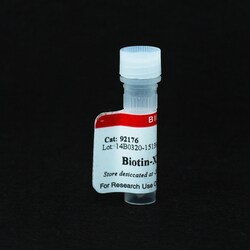
Biotium Biotin-XX Tyramide
CF dye tyramide conjugates can be used for tyramide signal amplification (TSA), which is an enzyme-mediated detection method that uses horseradish peroxidase (HRP) to generate high-density labeling of a target protein or nucleic acid in situ. CF dyes are Biotium's line of next-generation fluorescent dyes with advantages in brightness, photostability, and conjugate specificity compared to other fluorescent dyes. Far-red fluorescent CF640R dye has excitation/emission at 642/662 nm.Also see Biotium's CF Dye Tyramide Amplification Kits.
Biotium CD6(3F7B5), CF568 conjugate, 0.1mg/mL
CD6 is a type I transmembrane glycoprotein that contains a 24-amino acid signal sequence, three extracellular scavenger receptor cysteine-rich (SRCR) domains, a membrane-spanning domain and a 44-amino acid cytoplasmic domain. The CD6 glycoprotein is tyrosine phosphorylated during TCR-mediated T cell activation. CD6 shows significant homology to CD5. CD6 is present on mature thymocytes, peripheral T cells and a subset of B cells. Antibodies to CD6 are used to deplete T cells from bone marrow transplants to prevent graft versus host disease.Primary antibodies are available purified, or with a selection of fluorescent CF Dyes and other labels. CF Dyes offer exceptional brightness and photostability. Note: Conjugates of blue fluorescent dyes like CF405S and CF405M are not recommended for detecting low abundance targets, because blue dyes have lower fluorescence and can give higher non-specific background than other dye colors.