
Protein Labeling Reagents

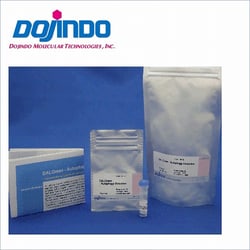
Dojindo Molecular Technologies Inc DAPGreen–Autophagy Detection(5 nmol)
DAPGreen is used to detect autophagy in live cells. Autophagy is an intracellular degradation system, where dysfunctional proteins and organelles are degraded. In this process, aggregated dysfunctional proteins are surrounded by the double membrane to form an autophagosome. The small fluorescent molecule DAPGreen is used to detect autophagosomes and autolysosomes. The mechanism has been suggested to be that the dye is incorporated into the autophagosome during double-membrane formation via structural features and then emits fluorescence under hydrophobic conditions (λex: 450 nm, λem: 535 nm). DALGreen is cell-permeable, has no requirement of transfection method, and enables live-cell imaging with fluorescence microscopy, plate reader, and flow cytometry. For monitoring only autolysosomes, we recommend DALGreen [D675], as it allows the detection of phagosome-lysosome fusion. Dojindo offers various reagents for autophagy research. (https://www.dojindo.com/autophagy-research/#jmp-b)


Biotium CF570 Succinimidyl Ester
CF Dye Succinimidyl Esters (SE, also known as NHS esters) are amine-reactive fluorescent dyes. SE dyes are commonly used to label antibodies and other proteins on free amine groups, such as lysine residues. CF dyes are Biotium's line of next-generation fluorescent dyes with advantages in brightness, photostability, and conjugate specificity compared to other fluorescent dyes. Red fluorescent CF570 dye has excitation/emission at 568/591 nm.

Biotium Cytokeratin, multi(C11), CF568 conjugate, 0.1mg/mL
This MAb recognizes cytokeratin 4, 5, 6, 8, 10, 13, and 18. This is a broad-spectrum antibody, which has been reported to differentiate epithelial tumors from non-epithelial tumors. Many studies have shown the usefulness of keratins as markers in cancer research and tumor diagnosis.Primary antibodies are available purified, or with a selection of fluorescent CF Dyes and other labels. CF Dyes offer exceptional brightness and photostability. Note: Conjugates of blue fluorescent dyes like CF405S and CF405M are not recommended for detecting low abundance targets, because blue dyes have lower fluorescence and can give higher non-specific background than other dye colors.
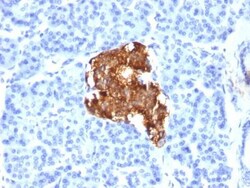
Biotium Insulin(E2-E3), CF488A conjugate, 0.1mg/mL
Recognizes a polypeptide which is identified as insulin, a 51-amino acid polypeptide composed of A and B chains connected through the C-peptide. Proinsulin, which has very little biological activity, is cleaved by proteases within its cell of origin into the insulin molecule and the C-terminal basic residue. Insulin enhances membrane transport of glucose, amino acids, and certain ions. It also promotes glycogen storage, formation of triglycerides, and synthesis of proteins and nucleic acids. Deficiency of insulin results in diabetes mellitus. The main storage site for insulin is the pancreatic islets. Antibodies to insulin are important as beta-cell and insulinoma marker.Primary antibodies are available purified, or with a selection of fluorescent CF Dyes and other labels. CF Dyes offer exceptional brightness and photostability. Note: Conjugates of blue fluorescent dyes like CF405S and CF405M are not recommended for detecting low abundance targets, because blue dyes have

Biotium Phalloidin, CF594, 50 U
Phalloidin conjugates are actin filament stains for fixed and permeabilized cells. CF dyes are Biotium's line of next-generation fluorescent dyes with advantages in brightness, photostability, and conjugate specificity compared to other fluorescent dyes. Deep-red fluorescent CF594 has excitation/emission at 593/614 nm.
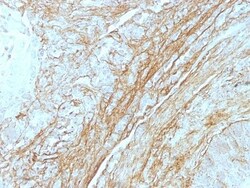
Biotium Tenascin(T2H5), CF568 conjugate, 0.1mg/mL
In Western blotting, this antibody reacts with two bands of ~MW of 210 kDa and 300 kDa, identified as two isoforms of Tenascin C. Specificity of this MAb is validated by sequential immunoprecipitation with a PAb against Tenascin C. Tenascin C is a multifunctional, disulfide-linkedhexameric extracellular matrix glycoprotein expressed in association with mesenchymal epithelial interactions during development and in the neo-vasculature and stroma of undifferentiated tumors. In adults, it is restricted to certain epithelial-stromal interfaces and increases markedly in hyper-proliferative diseases and in stroma of many neoplasms, including gliomas, breast, squamous and lung carcinomas.Primary antibodies are available purified, or with a selection of fluorescent CF Dyes and other labels. CF Dyes offer exceptional brightness and photostability. Note: Conjugates of blue fluorescent dyes like CF405S and CF405M are not recommended for detecting low abundance targets, because blue
Biotium CD22(FR10B4), CF568 conjugate, 0.1mg/mL
Recognizes a protein of 130-140 kDa, identified as CD22 (also known as BL-CAM). CD22 expression is restricted to normal and neoplastic B cells and is absent from other haemopoietic cell types. In B-cell ontogeny, CD22 is first expressed in the cytoplasm of pro-B and pre-B cells, and on the surface as B cells mature to become IgD . It is not expressed by plasma cells, CD22 is found highly expressed in follicular mantle and marginal zone B-cells, and while germinal center B-cells are relatively weak. CD22 is a member of the immunoglobulin superfamily and serves as an adhesion receptor for sialic acid-bearing ligands expressed on erythrocytes and all leukocyte classes. It also associates with tyrosine kinases and play a role in signal transduction and B-cell activation.Primary antibodies are available purified, or with a selection of fluorescent CF Dyes and other labels. CF Dyes offer exceptional brightness and photostability. Note: Conjugates of blue fluorescent dyes like CF
Biotium CD37(IPO-24), CF488A conjugate, 0.1mg/mL
Recognizes a protein of 33-55 kDa, identified as CD37 (Workshop V; Code CD37.7). CD37 is strongly expressed on normal and neoplastic mature (sIg ) B-lymphocytes. In B-cell ontogeny, CD37 appears after the pre-B-cell stage, is maintained during peripheral B-cell development and is lost upon terminal differentiation into plasma cells.1 CD37 is also present, at low densities, on resting and activated T cells, neutrophils, monocytes, and some myelomonocytic leukemia cells. It is absent from platelets, erythrocytes. CD37 is a member of a family of tetraspan transmembrane proteins, including CD9, CD53, CD63, CD81, and CD82. It associates other tetraspan transmembrane proteins and MHC class II molecules to form a large complex at the surface of B cells and play a role in signal transduction. CD37 is a valuable and stable marker for peripheral mature B-cells and corresponding malignancies like B-cell chronic lymphocytic leukemia (B-CLL), hairy cell leukemia (HCL), and all types of B-
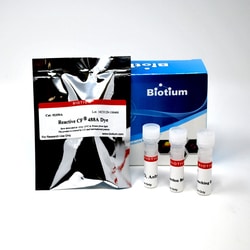
Biotium Mix-n-Stain™ CF594 Small Ligand Labeling Kit
Mix-n-Stain™ Small Ligand Labeling Kits are designed for rapid labeling of low molecular weight (MW 150 -5000) ligands without a purification step. Suitable ligands or substrates include SNAP-tag, CLIP-tag™ and HaloTag ligand derivatives that have an aliphatic amine. CF dyes are Biotium's line of next-generation fluorescent dyes with advantages in brightness, photostability, and conjugate specificity compared to other fluorescent dyes. Deep-red fluorescent CF594 dye has excitation/emission at 593/614 nm. It is suitable for labeling ligands for cell surface staining.
Sigma Aldrich Fine Chemicals Biosciences Phalloidin Atto 390 suitab
Atto 390 Phalloidin is a novel fluorescent label with a coumarin structure. The dye is intended for application in the area of life science e.g. labeling of DNA RNA or proteins. Characteristic features of the label are high fluorescence quantum yield large Stokes-shift good photostability and low molecular weight.Phalloidin is a fungal toxin isolated from the poisonous mushroom Amanita phalloides. Its toxicity is attributed to the ability to bind f actin in liver and muscle cells. As a result of binding phalloidin actin filaments become strongly stabilized. Phalloidin has been found to bind only to polymeric and oligomeric forms of actin and not to monomeric actin. The dissociation constant of the actin-phalloidin complex has been determined to be on the order of 3 x 10⁻⁸. Phalloidin differs from amanitin in rapidity of action at high dose levels death of mice or rats occurs within 1 or 2 hours.


Biotium Lucifer Yellow CH Potassium Salt
Lucifer Yellow CH potassium salt (LY CH potassium salt) is a widely used polar molecular tracer for studying neuronal morphology. The fluorescent molecule contains a carbohydrazide that allow the molecule to be aldehyde-fixable. Properties: Ex/ Em = 428/536 nm; Yellow solid soluble in water; Store at 4°C and protect from light; C13H9K2N5O9S2; MW: 522; [71206-95-6]
Biotium CD66 (CEA)(COL-1), CF568 conjugate, 0.1mg/mL
This antibody recognizes proteins of 80-200 kDa, identified as different members of CEA family. CEA is synthesized during development in the fetal gut and is re-expressed in increased amounts in intestinal carcinomas and several other tumors. This MAb does not react with nonspecific cross-reacting antigen (NCA) and with human polymorphonuclear leucocytes. It shows no reaction with a variety of normal tissues and is suitable for staining of formalin/paraffin tissues. CEA is not found in benign glands, stroma, or malignant prostatic cells. Antibody to CEA is useful in detecting early foci of gastric carcinoma and in distinguishing pulmonary adenocarcinomas (60-70% are CEA positive) from pleural mesotheliomas (rarely or weakly CEA positive). Anti-CEA positivity is seen in adenocarcinomas from the lung, colon, stomach, esophagus, pancreas, gallbadder, urachus, salivary gland, ovary, and endocervix.Primary antibodies are available purified, or with a selection of fluorescent CF
Biotium Human IgM Immunoglobulin(IM373), CF568 conjugate, 0.1mg/mL
Recognizes a protein of 75 kDa, identified as mu heavy chain of human immunoglobulins. It does not cross-react with alpha (IgA), gamma (IgG), epsilon (IgE), or delta (IgD), heavy chains, T-cells, monocytes, granulocytes, or erythrocytes. This MAb is useful in the identification of leukemias, plasmacytomas, and certain non-Hodgkin's lymphomas. The most common feature of these malignancies is the restricted expression of a single heavy chain class. Demonstration of clonality in lymphoid infiltrates indicates that the infiltrate is clonal and therefore malignant.Primary antibodies are available purified, or with a selection of fluorescent CF Dyes and other labels. CF Dyes offer exceptional brightness and photostability. Note: Conjugates of blue fluorescent dyes like CF405S and CF405M are not recommended for detecting low abundance targets, because blue dyes have lower fluorescence and can give higher non-specific background than other dye colors.