
Protein Labeling Reagents

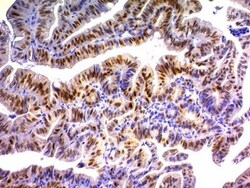
Biotium p21 / WAF1(DCS-60.2), CF568 conjugate, 0.1mg/mL
This MAb recognizes a 21 kDa protein, identified as the p21WAF1 tumor suppressor protein. This MAb is highly specific to p21 and shows no cross-reaction with other closely related mitotic inhibitors. p21WAF1 is a specific inhibitor of cdk s and a tumor suppressor involved in the pathogenesis of a variety of malignancies. The expression of this gene acts as an inhibitor of the cell cycle during G1 phase and is tightly controlled by the tumor suppressor protein p53. Its expression is induced by the wild type, but not mutant, p53 suppressor protein. Normal cells generally display a rather intense nuclear p21 expression. Loss of p21 expression has been reported in many carcinomas (gastric carcinoma, non-small cell lung carcinoma, thyroid carcinoma).Primary antibodies are available purified, or with a selection of fluorescent CF Dyes and other labels. CF Dyes offer exceptional brightness and photostability. Note: Conjugates of blue fluorescent dyes like CF405S and CF405M are

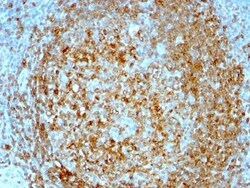
Biotium CD74(BU45), CF488A conjugate, 0.1mg/mL
Recognizes proteins of 33, 35 and 41 kDa, which are identified as various isoforms of CD74. Its epitope is localized in the extracellular domain of CD74. CD74 is a type II transmembrane protein which binds to the peptide binding groove of newly synthesized MHC class II alpha/beta heterodimers and prevents their premature association with endogenous polypeptides. The CD74 molecule plays a critical role in the presentation of peptides, by the MHC class II antigens, to CD4 positive lymphocytes. CD74 is expressed on MHC class II positive cells including B cells, a subset of activated T cells, monocytes, and dendritic cells and by various types of carcinomas. CD74 is expressed primarily by antigen presenting cells, such as B-lymphocytes (from before the pre-B cell stage to before the plasma cell stage), macrophages, and monocytes, and many epithelial cells. Anti-CD74 stains predominantly germinal center lymphocytes and B-cell lymphomas, but rarely T-cell lymphomas. Anti-CD74 has b
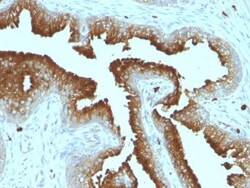
Biotium CD53(161-2), CF568 conjugate, 0.1mg/mL
Recognizes a protein of 33-55 kDa, identified as CD53 (Workshop VI; Code N-L033). It is expressed on monocytes and macrophages, dendritic cells, osteoblasts and osteoclasts, and on T and B cells from every stage of differentiation but is absent from platelets, red blood cells. CD53 appears to be the marker with widest reactivity as well as the marker with the strictest specificity to hematopoietic cells. CD53 is a type III membrane with both termini in the cytoplasm and two loops in the extracellular environment. This molecule, in common with other members of tetraspan family, is involved in cellular activation as part of a signal transduction complex involving other membrane glycoproteins. CD53 crosslinking induces calcium flux on human monocyte and B cells. Cross-linking of CD53 promotes activation of resting human B-lymphocytes. This MAb recognizes CD53 transfected cells and partially inhibits T-cell proliferation induced by CD3 antibody (clone: UCHT1).Primary antibodies a
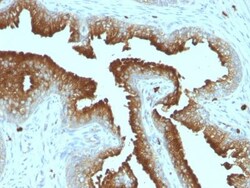
Biotium CD53(161-2), CF568 conjugate, 0.1mg/mL
Recognizes a protein of 33-55 kDa, identified as CD53 (Workshop VI; Code N-L033). It is expressed on monocytes and macrophages, dendritic cells, osteoblasts and osteoclasts, and on T and B cells from every stage of differentiation but is absent from platelets, red blood cells. CD53 appears to be the marker with widest reactivity as well as the marker with the strictest specificity to hematopoietic cells. CD53 is a type III membrane with both termini in the cytoplasm and two loops in the extracellular environment. This molecule, in common with other members of tetraspan family, is involved in cellular activation as part of a signal transduction complex involving other membrane glycoproteins. CD53 crosslinking induces calcium flux on human monocyte and B cells. Cross-linking of CD53 promotes activation of resting human B-lymphocytes. This MAb recognizes CD53 transfected cells and partially inhibits T-cell proliferation induced by CD3 antibody (clone: UCHT1).Primary antibodies a

Medchemexpress LLC IL-17A Mouse CHO 100ug

IL-17A is a homodimeric cytokine and plays a critical role in host defense mechanisms against many bacterial and fungal pathogens as well as allergic and autoimmune responses IL-17A induces the production of antimicrobial peptides cytokines chemokines and matrix metalloproteinases[1][2] IL-17A Protein Mouse (CHO) is a recombinant mouse IL-17A protein and is expressed in CHO cells It consists of 133 amino acids (A26-A158)
C(C)(C)C=C(CS([O-])(=O)=O)c5cc4=C(c4ccc(cc4C(O)=O)C(=O)ON4C(=O)CCC4=O)c3cc2C(CS(O)(=O)=O)=CC1(C)C | 1mg | 599128688](https://assets.fishersci.com/TFS-Assets/CCG/product-images/502467622.JPG-250.jpg)
eMolecules 1638544-48-5 | BP Fluor 594 NHS Ester | Broadpharm819.850 | C39H37N3O13S2 | 0.000 | CN1c2cc3Oc4cc5=[N+](C)C(C)(C)C=C(CS([O-])(=O)=O)c5cc4=C(c4ccc(cc4C(O)=O)C(=O)ON4C(=O)CCC4=O)c3cc2C(CS(O)(=O)=O)=CC1(C)C | 1mg | 599128688
BP Fluor 594 NHS Ester | Broadpharm | 1638544-48-5819.850 | C39H37N3O13S2 | 0.000 | CN1c2cc3Oc4cc5=[N+](C)C(C)(C)C=C(CS([O-])(=O)=O)c5cc4=C(c4ccc(cc4C(O)=O)C(=O)ON4C(=O)CCC4=O)c3cc2C(CS(O)(=O)=O)=CC1(C)C | 1mg | 599128688

Biotium CF488A, Aminooxy
Aminooxy dyes have an aminooxy reactive group, which can be used to label a target molecule with an aldehyde or ketone group. An aminooxy group readily reacts with an aldehyde or ketone group to form a stable linkage without the use of a reducing agent. CF dyes are Biotium's line of next-generation fluorescent dyes with advantages in brightness, photostability, and conjugate specificity compared to other fluorescent dyes. Green fluorescent CF488A dye has excitation/emission at 490/515 nm.
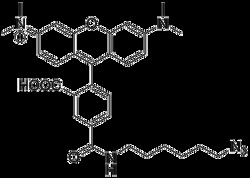
Lumiprobe TAMRA azide, 5-isomer | 825651-66-9 | MFCD18426598 | 25 mg
TAMRA azide, 5-isomer | Purity: 95% | Mol Wt: 512.56 | 825651-66-9 | MFCD18426598 | 25 mg


Lumiprobe Sulfo-Cyanine5 NHS ester | 2230212-27-6 | MFCD30527435 | 50 mg
Sulfo-Cyanine5 NHS ester | Purity: 95% | Mol Wt: 777.95 | 2230212-27-6 | MFCD30527435 | 50 mg
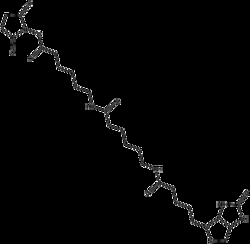

Lumiprobe Cyanine5 maleimide | 1437796-65-0 | MFCD28385511 | 25 mg
Cyanine5 maleimide | Purity: 95% | Mol Wt: 641.24 | 1437796-65-0 | MFCD28385511 | 25 mg
![eMolecules TAMRA-Azide-PEG-Desthiobiotin | Broadpharm |1144.338 | C57H81N11O14 | 93.000 | C[C@@H]1NC(=O)N[C@@H]1CCCCCC(=O)NCCOCCOCCOCCNC(=O)CCN(CCOCCOCCOCCN=[N+]=[N-])C(=O)CCNC(=O)c1ccc(c(c1)C([O-])=O)-c1c2ccc(cc2oc2cc(ccc12)=[N+](C)C)N(C)C | 1mg | 795361329](https://assets.fishersci.com/TFS-Assets/CCG/product-images/502465151.JPG-250.jpg)
eMolecules TAMRA-Azide-PEG-Desthiobiotin | Broadpharm |1144.338 | C57H81N11O14 | 93.000 | C[C@@H]1NC(=O)N[C@@H]1CCCCCC(=O)NCCOCCOCCOCCNC(=O)CCN(CCOCCOCCOCCN=[N+]=[N-])C(=O)CCNC(=O)c1ccc(c(c1)C([O-])=O)-c1c2ccc(cc2oc2cc(ccc12)=[N+](C)C)N(C)C | 1mg | 795361329
TAMRA-Azide-PEG-Desthiobiotin | Broadpharm |1144.338 | C57H81N11O14 | 93.000 | C[C@@H]1NC(=O)N[C@@H]1CCCCCC(=O)NCCOCCOCCOCCNC(=O)CCN(CCOCCOCCOCCN=[N+]=[N-])C(=O)CCNC(=O)c1ccc(c(c1)C([O-])=O)-c1c2ccc(cc2oc2cc(ccc12)=[N+](C)C)N(C)C | 1mg | 795361329
Chem-Impex International, Inc. Fluorescein isothiocyanate isomer I | 3326-32-7 | MFCD00005063 | 250MG
Fluorescein isothiocyanate isomer I, 3326-32-7, MFCD00005063, 250MG