
Protein Labeling Reagents


Biotium c-Myb(MYB286), CF568 conjugate, 0.1mg/mL
The highly leukemogenic avian retrovirus E26 contains two oncogenes, v-Myb and v-Ets, which are expressed together as a fusion protein. The cellular homolog of v-Myb, designated c-Myb, encodes a transcription factor. Deletion or disruption of a negative regulatory domain mapping within the carboxy-terminal domain of c-Myb results in enhanced transactivating capacity and in parallel, leads to activation of its ability to transform hemopoietic cells. c-Myb is expressed preferentially, but not exclusively, in immature hemopoietic cells and its expression decreases as cells differentiate.Primary antibodies are available purified, or with a selection of fluorescent CF Dyes and other labels. CF Dyes offer exceptional brightness and photostability. Note: Conjugates of blue fluorescent dyes like CF405S and CF405M are not recommended for detecting low abundance targets, because blue dyes have lower fluorescence and can give higher non-specific background than other dye colors.

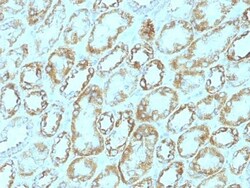
Biotium Laminin(A5), CF568 conjugate, 0.1mg/mL
Laminins are large hetero-trimeric, non-collagenous glycoproteins composed of α, β, and γ chains. This MAb reacts with laminin B2/1 chain of ~210 kDa and does not cross-react with other basement membrane components or fibronectin. Its specificity was established by immunoprecipitation and immunofluorescence of human skeletal muscle and kidney with laminin chain-specific MAbs. Epithelial sheets in vivo are separated from the mesenchymal elements of the stroma by a thin layer of a specialized type of extracellular matrix termed the basement membrane (BM). This structure consists of individual components, some of which are ubiquitous in BMs and some are not. The ubiquitous ones comprise laminin (LN), entactin/nidogen (EN), collagen type IV (CIV), and large heparan sulfate proteoglycan (HSPG), which interact specifically with each other to form a continuous and regular BM. Alterations of BM integrity, from local discontinuities up to complete loss, are describe
Biotium HER-2 / CD340(HRB2/282), CF568 conjugate, 0.1mg/mL
Recognizes a protein of 185 kDa, which is identified as c-erbB-2/HER-2/neu. Its epitope is localized in the extracellular domain. C-erbB-2/HER-2 is a member of the EGFR family. This MAb is specific and shows minimal cross-reaction with other members of the EGFR-family. Receptors of this family are located on the plasma membrane and consist of an extracellular ligand-binding domain that is connected to a large intracellular domain by a single transmembrane sequence. c-erbB-2/HER-2 protein is over-expressed in a variety of carcinomas especially those of breast and ovary.Primary antibodies are available purified, or with a selection of fluorescent CF Dyes and other labels. CF Dyes offer exceptional brightness and photostability. Note: Conjugates of blue fluorescent dyes like CF405S and CF405M are not recommended for detecting low abundance targets, because blue dyes have lower fluorescence and can give higher non-specific background than other dye colors.
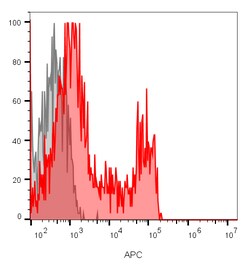
Biotium CD8(RIV11), CF568 conjugate, 0.1mg/mL
Recognizes a protein of 32 kDa, identified as CD8a (also known as CD8 chain, T cell co-receptor, Leu2, and T8). CD8 molecule consists of two chains, termed and chain, which are expressed as a disulphide-linked heterodimer or as an homodimer. CD8 is expressed on T cell subset (cytotoxic/suppressor T cells), thymocytes and NK cells. The majority of CD8 T-cells expresses CD8 as heterodimer. Some subpopulation of CD8 T cells as well as NK cells may express homodimer. CD8 functions as a co-receptor in concert with TCR for binding the MHC class I/peptide complex. The HIV-2 envelope glycoprotein binds CD8 chain (but not chain). The cytoplasmic domain of CD8 associates with p56lck tyrosine kinase.Primary antibodies are available purified, or with a selection of fluorescent CF Dyes and other labels. CF Dyes offer exceptional brightness and photostability. Note: Conjugates of blue fluorescent dyes like CF405S and CF405M are not recommended for detecting low abundance targets,
Biotium Human Kappa Light Chain(L1C1), CF488A conjugate, 0.1mg/mL
This MAb is specific to kappa light chain of immunoglobulin and shows no cross-reaction with lambda light chain or any of the five heavy chains. In mammals, the two light chains in an antibody are always identical, with only one type of light chain, kappa or lambda. The ratio of kappa to lambda is 70:30. However, with the occurrence of multiple myeloma or other B-cell malignancies this ratio is disturbed. Antibody to the kappa light chain is reportedly useful in the identification of leukemias, plasmacytomas, and certain non-Hodgkin's lymphomas. Demonstration of clonality in lymphoid infiltrates indicates that the infiltrate is malignant.Primary antibodies are available purified, or with a selection of fluorescent CF Dyes and other labels. CF Dyes offer exceptional brightness and photostability. Note: Conjugates of blue fluorescent dyes like CF405S and CF405M are not recommended for detecting low abundance targets, because blue dyes have lower fluorescence and can gi
Biotium CD19(CVID3/429), CF488A conjugate, 0.1mg/mL
CD19 is a transmembrane glycoprotein that contains two extracellular immunoglobulin-like domains. CD19 is present in both benign and malignant B-cells and is considered to be the most reliable surface marker of this lineage over a wide range of maturational stages. In normal lymphoid tissue, CD19 is observed in germinal centers, in mantle zone cells, and in scattered cells of the inter-follicular areas. Anti-CD19 exhibits an overall immunoreactivity pattern similar to those of the antibodies against CD20 and CD22. However, in contrast to CD20, expression of CD19 is continuous throughout B-cell development and through terminal differentiation of B-cells into plasma cells. Anti-CD19 positivity is seen in the vast majority of B-cell neoplasms commonly at a lower intensity than normal B-cell counterparts. Plasma cell neoplasms are nearly always negative, as are T-cell neoplasms.Primary antibodies are available purified, or with a selection of fluorescent CF Dyes and other la
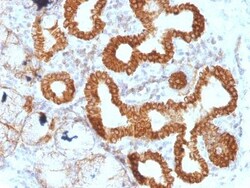
Biotium CD95(B-R18), CF568 conjugate, 0.1mg/mL
MAb B-R18 specifically recognizes CD95, also known as Fas, a transmembrane glycoprotein with a MW of 40-45 kDa, containing 8 kDa of N-glycosidic-linked polysaccharide. It is a receptor for TNFSF6/FASLG, a member of the nerve growth factor receptor/tumor necrosis factor superfamily, mediating receptor-triggered apoptosis. The adapter molecule FADD recruits caspase-8 to the activated receptor. The resulting death-inducing signaling complex (DISC) performs caspase-8 proteolytic activation, which initiates the subsequent cascade of caspases (aspartate-specific cysteine proteases) mediating apoptosis. FAS-mediated apoptosis may have a role in the induction of peripheral tolerance, in the antigen-stimulated suicide of mature T-cells, or both. The secreted isoforms 2 to 6 block apoptosis (in vitro). CD95 antigen is expressed on the surface of various cell types, preferentially on the CD45RAlow CD45ROhigh subset of memory T lymphocytes.Primary antibodies are available purified, or wi


Biotium DI-4-ANEPPS
Di-4-ANEPPS is a fast-responding membrane potential dye. Changes in the membrane potential of the cell correlate with changes in the fluorescence excitation intensity of the dye. Properties: Ex/ Em(MeOH) = 496/705 nm; Orange red solid soluble in DMF, ethanol or DMSO; Store at 4°C and protect from light, especially in solution; C28H36N2O3S; MW: 48; [90134-00-2]

Biotium CF555 Tyramide
CF dye tyramide conjugates can be used for tyramide signal amplification (TSA), which is an enzyme-mediated detection method that uses horseradish peroxidase (HRP) to generate high-density labeling of a target protein or nucleic acid in situ. CF dyes are Biotium's line of next-generation fluorescent dyes with advantages in brightness, photostability, and conjugate specificity compared to other fluorescent dyes. Orange-red fluorescent CF555 dye has excitation/emission at 555/565 nm.
Biotium Fluorescein hexylamine
Fluorescein hexylamine can be coupled to activated carboxy groups or sulfonyl chlorides. This product could be used as a direct replacement to fluorescein cadaverine. Ex / Em (pH9) = 493/517 nm Yellow solid soluble in DMSO, DMF, or pH>6.5 buffers Store at 4°C and protect from light C 29 H 27 F 3 N 2 O 8 MW: 588.54

Bioworld Protein-A Gold™ (5-10 nm), 1 mL
Protein-A Gold Protein-A is a highly stable cell surface receptor produced by several strains of Staphylococcus aureus. It is capable of binding to the Fc portion of immunoglobulins, especially IgG from a large number of species. Protein-A may be conjugated with various reporter molecules, including colloidial gold, without affecting the antibody binding site on the molecule. Specifications:Particle size5-10 nm (monodisperse), nominal 15 nm (colloidal gold) Suspension in 0.01 M phosphate buffered saline, pH 7.4, containing 1% bovine serum albumin, 20% glycerol, and 15 mM sodium azide. Storage: 2-8 C
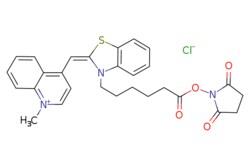
eMolecules Thiazole Orange NHS Ester | Broadpharm |538.060 | C28H28ClN3O4S | 0.000 | [Cl-].C[n+]1ccc(\C=C2\Sc3ccccc3N2CCCCCC(=O)ON2C(=O)CCC2=O)c2ccccc12 | 5mg | 761705615
Thiazole Orange NHS Ester | Broadpharm |538.060 | C28H28ClN3O4S | 0.000 | [Cl-].C[n+]1ccc(\C=C2\Sc3ccccc3N2CCCCCC(=O)ON2C(=O)CCC2=O)c2ccccc12 | 5mg | 761705615