
Protein Labeling Reagents


Biotium HIF1α(HIF1A-84), CF488A conjugate, 0.1mg/mL
HIF1 (hypoxia-inducible factor 1), a heterodimeric transcription factor complex central to cellular response to hypoxia, consists of two subunits (HIF-1 alpha and HIF-1 beta) which are basic helix-loop-helix proteins of the PAS (Per, ARNT, Sim) family. Expression of HIF-1 alpha protein is regulated by cellular oxygen level alterations as well as in oxygen-independent manner via different cytokines (through the PI3K-AKT-mTOR pathway), growth factors, oncogenic activation, or loss of tumor suppressor function etc. In normoxic cells, HIF-1 alpha is proline hydroxylated leading to a conformational change that promotes its binding to the VLH (von Hippel Lindau) protein E3 ligase complex; ubiquitination and followed by rapid proteasomal degradation. Hypoxia as well as chemical hydroxylase inhibitors (desferrioxamine, cobalt etc.) inhibit HIF-1 alpha degradation and lead to its accumulation in the cells, whereas, contrastingly, HIF-1 beta/ARNT (AhR nuclear translocator) remains stab

Biotium CD37(IPO-24), CF568 conjugate, 0.1mg/mL
Recognizes a protein of 33-55 kDa, identified as CD37 (Workshop V; Code CD37.7). CD37 is strongly expressed on normal and neoplastic mature (sIg ) B-lymphocytes. In B-cell ontogeny, CD37 appears after the pre-B-cell stage, is maintained during peripheral B-cell development and is lost upon terminal differentiation into plasma cells.1 CD37 is also present, at low densities, on resting and activated T cells, neutrophils, monocytes, and some myelomonocytic leukemia cells. It is absent from platelets, erythrocytes. CD37 is a member of a family of tetraspan transmembrane proteins, including CD9, CD53, CD63, CD81, and CD82. It associates other tetraspan transmembrane proteins and MHC class II molecules to form a large complex at the surface of B cells and play a role in signal transduction. CD37 is a valuable and stable marker for peripheral mature B-cells and corresponding malignancies like B-cell chronic lymphocytic leukemia (B-CLL), hairy cell leukemia (HCL), and all types of B-
Biotium MUC2(CCP58), CF488A conjugate, 0.1mg/mL
Recognizes a single glycoprotein of 520 kDa, identified as mucin 2 (MUC2). This MAb shows no cross-reaction with human milk fat globule membranes, MUC1, or MUC3. Its epitope has been defined as GTQTP (GlyThrGlnThrPro). Mucins are high molecular weight glycoproteins, which constitute the major component of the mucus layer that protects the gastric epithelium. MUC2 is specifically expressed in goblet cells of the small intestine & colon; in about 65% of colonic carcinomas and about 40% of gastric carcinomas. MUC2 is rarely expressed outside of the GI tract with the exceptions of mucinous carcinoma of breast and clear cell-type carcinomas of the ovary.Primary antibodies are available purified, or with a selection of fluorescent CF Dyes and other labels. CF Dyes offer exceptional brightness and photostability. Note: Conjugates of blue fluorescent dyes like CF405S and CF405M are not recommended for detecting low abundance targets, because blue dyes have lower fluoresc
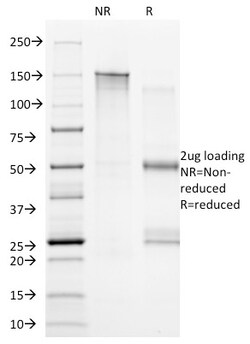
Biotium CD20(B9E9), CF488A conjugate, 0.1mg/mL
Recognizes a protein of 33-37 kDa, identified as CD20 (Workshop V; Code CD20.12). B9E9 recognizes extracellular domain of CD20. The epitope is similar to or identical to that recognized by other CD20 antibodies including Leu-16 and B1. This MAb can be used for immunophenotyping of leukemia and malignant cells, B lymphocyte detection in peripheral blood, B cell localization in tissues and B lymphocyte purification by immunosorbent methods. CD20 is a non-Ig differentiation antigen of B-cells and its expression is restricted to normal and neoplastic B-cells, being absent from all other leukocytes and tissues. CD20 is expressed by pre B-cells and persists during all stages of B-cell maturation but is lost upon terminal differentiation into plasma cells. Protein passes through the membrane 4 times with both ends in cytoplasm and exposes one short and one longer loop to the external environment. CD20 is not glycosylated in resting B cells and its cytoplasmic domains are differentia
Biotium CD13(WM15), CF488A conjugate, 0.1mg/mL
Recognizes an integral membrane glycoprotein of 150 kDa, identified as CD13 (also known as aminopeptidase-N). The antibody recognizes an extracellular epitope. The CD13 antigen is present on most cells of myeloid origin including granulocytes, monocytes, mast cells, and GM-progenitor cells. It is also expressed by the majority of AML, CML in myeloid blast crisis, and in a smaller fraction of lymphoid leukemias. CD13 is absent from normal lymphocytes, platelets and erythrocytes. CD13 is also present on fibroblasts; endothelial cells, epithelial cells from renal proximal tubules and intestinal brush border, bone marrow stromal cells, osteoclasts, and cells lining bile duct canaliculi. CD13 is identical to aminopeptidase N (APN), a prominent membrane-bound metalloprotease present on the surface of intestinal brush border and renal tubules. CD13 plays a role in metabolism of biologically active peptides, in phagocytosis, and in bactericidal/tumoricidal activities. It also serves
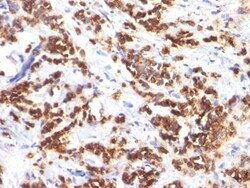
Biotium Milk Fat Globulin(MFG-06), CF488A conjugate, 0.1mg/mL
Recognizes a protein of 40-45 kDa, identified as human milk fat globule membrane protein (HMFG). HMFG is present on normal human breast epithelial cells and cell lines derived from breast carcinomas, as well as to the outer surface of the human milk fat globule. HMFG is considered as a differentiation marker. It is useful as specific breast epithelial marker and can also provide a tool to study the role of the cell surface in normal and neoplastic mammary development.Primary antibodies are available purified, or with a selection of fluorescent CF Dyes and other labels. CF Dyes offer exceptional brightness and photostability. Note: Conjugates of blue fluorescent dyes like CF405S and CF405M are not recommended for detecting low abundance targets, because blue dyes have lower fluorescence and can give higher non-specific background than other dye colors.
Biotium CD13(WM15), CF568 conjugate, 0.1mg/mL
Recognizes an integral membrane glycoprotein of 150 kDa, identified as CD13 (also known as aminopeptidase-N). The antibody recognizes an extracellular epitope. The CD13 antigen is present on most cells of myeloid origin including granulocytes, monocytes, mast cells, and GM-progenitor cells. It is also expressed by the majority of AML, CML in myeloid blast crisis, and in a smaller fraction of lymphoid leukemias. CD13 is absent from normal lymphocytes, platelets and erythrocytes. CD13 is also present on fibroblasts; endothelial cells, epithelial cells from renal proximal tubules and intestinal brush border, bone marrow stromal cells, osteoclasts, and cells lining bile duct canaliculi. CD13 is identical to aminopeptidase N (APN), a prominent membrane-bound metalloprotease present on the surface of intestinal brush border and renal tubules. CD13 plays a role in metabolism of biologically active peptides, in phagocytosis, and in bactericidal/tumoricidal activities. It also serves
Biotium p53(BP53-12), CF568 conjugate, 0.1mg/mL
This MAb reacts with an N-terminal epitope (aa 16-25) of both wild type and mutated p53. Mutation and/or allelic loss of p53 is one of the causes of a variety of mesenchymal and epithelial tumors. If it occurs in the germ line, such tumors run in families. In most transformed and tumor cells the concentration of p53 is increased 51000 fold over the minute concentrations (1000 molecules cell) in normal cells, principally due to the increased half-life (4 h) compared to that of the wild-type (20 min). p53 Localizes in the nucleus, but is detectable at the plasma membrane during mitosis and when certain mutations modulate cytoplasmic/nuclear distribution. Mutations arise with an average frequency of 70% but incidence varies from zero in carcinoid lung tumors to 97% in primary melanomas. High concentrations of p53 protein are transiently expressed in human epidermis and superficial dermal fibroblasts following mild ultraviolet irradiation. Positive nuclear staining with p53 antib
Biotium MALT-1(MT1/410), CF568 conjugate, 0.1mg/mL
Mucosa associated lymphoid tissue lymphoma translocation gene 1 (MALT1) is found in extranodal low-grade B cell lymphomas. MALT1 encodes two Ig-like C2-type domains and fuses with an API2 gene, which is highly expressed in adult lymphoid tissue. The translocation of this MALT1 gene, which maps to human chromosome 18q21, and the apoptosis-inhibiting API2 gene results in an increased development of MALT lymphomas and apoptosis inhibition. Sites at which this API2-MALT1 (11;18)(q21;q21) translocation commonly occurs are within human lung and kidney tissue. MALT lymphoma expresses nuclear Bcl10, which mediates the oligomerization and activation of a MALT1 caspase-like domain. MALT1 mRNA is found in pre-B cells, mature B cells and plasma cells.Primary antibodies are available purified, or with a selection of fluorescent CF Dyes and other labels. CF Dyes offer exceptional brightness and photostability. Note: Conjugates of blue fluorescent dyes like CF405S and CF405M are not re
Biotium CD37(IPO-24), CF488A conjugate, 0.1mg/mL
Recognizes a protein of 33-55 kDa, identified as CD37 (Workshop V; Code CD37.7). CD37 is strongly expressed on normal and neoplastic mature (sIg ) B-lymphocytes. In B-cell ontogeny, CD37 appears after the pre-B-cell stage, is maintained during peripheral B-cell development and is lost upon terminal differentiation into plasma cells.1 CD37 is also present, at low densities, on resting and activated T cells, neutrophils, monocytes, and some myelomonocytic leukemia cells. It is absent from platelets, erythrocytes. CD37 is a member of a family of tetraspan transmembrane proteins, including CD9, CD53, CD63, CD81, and CD82. It associates other tetraspan transmembrane proteins and MHC class II molecules to form a large complex at the surface of B cells and play a role in signal transduction. CD37 is a valuable and stable marker for peripheral mature B-cells and corresponding malignancies like B-cell chronic lymphocytic leukemia (B-CLL), hairy cell leukemia (HCL), and all types of B-
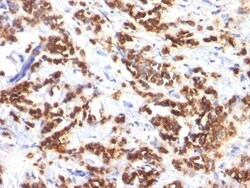
Biotium Milk Fat Globulin(MFG-06), CF568 conjugate, 0.1mg/mL
Recognizes a protein of 40-45 kDa, identified as human milk fat globule membrane protein (HMFG). HMFG is present on normal human breast epithelial cells and cell lines derived from breast carcinomas, as well as to the outer surface of the human milk fat globule. HMFG is considered as a differentiation marker. It is useful as specific breast epithelial marker and can also provide a tool to study the role of the cell surface in normal and neoplastic mammary development.Primary antibodies are available purified, or with a selection of fluorescent CF Dyes and other labels. CF Dyes offer exceptional brightness and photostability. Note: Conjugates of blue fluorescent dyes like CF405S and CF405M are not recommended for detecting low abundance targets, because blue dyes have lower fluorescence and can give higher non-specific background than other dye colors.
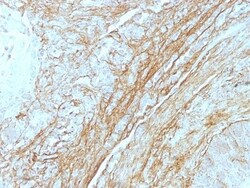
Biotium Tenascin(T2H5), CF488A conjugate, 0.1mg/mL
In Western blotting, this antibody reacts with two bands of ~MW of 210 kDa and 300 kDa, identified as two isoforms of Tenascin C. Specificity of this MAb is validated by sequential immunoprecipitation with a PAb against Tenascin C. Tenascin C is a multifunctional, disulfide-linkedhexameric extracellular matrix glycoprotein expressed in association with mesenchymal epithelial interactions during development and in the neo-vasculature and stroma of undifferentiated tumors. In adults, it is restricted to certain epithelial-stromal interfaces and increases markedly in hyper-proliferative diseases and in stroma of many neoplasms, including gliomas, breast, squamous and lung carcinomas.Primary antibodies are available purified, or with a selection of fluorescent CF Dyes and other labels. CF Dyes offer exceptional brightness and photostability. Note: Conjugates of blue fluorescent dyes like CF405S and CF405M are not recommended for detecting low abundance targets, because blue
Biotium CD30(CD30/412), CF488A conjugate, 0.1mg/mL
Recognizes a single chain glycoprotein of 105/120 kDa, identified as CD30/Ki-1. CD30 is synthesized as a 90 kDa precursor, which is processed in the Golgi complex into a membrane-bound phosphorylated mature 105/120 kDa glycoprotein. In Hodgkin's disease, CD30/Ki-1 antigen is expressed by mononuclear-Hodgkin and multinucleated Reed-Sternberg cells. It is also expressed by the tumor cells of a majority of anaplastic large cell lymphomas as well as by a varying proportion of activated T and B cells. This MAb distinguishes large cell lymphomas derived from activated lymphoid cells from histiocytic malignancies and lymphomas derived from resting and precursor lymphoid cells or from anaplastic carcinomas. About one third of the Ki-1 positive lymphomas lack the leukocyte common antigen (CD45).Primary antibodies are available purified, or with a selection of fluorescent CF Dyes and other labels. CF Dyes offer exceptional brightness and photostability. Note: Conjugates of blue fl
Biotium CD28(C28/75), CF568 conjugate, 0.1mg/mL
Recognizes a glycoprotein of 44-88 kDa, which is identified as CD28. It is the critical T-cell co-stimulatory receptor which provides to the cell the important second activation signal by binding CD80 and CD86 that are expressed by antigen presenting cells. Besides its co-stimulation role, CD28 functions in preventing T-cells from anergic hyporesponsive state or from undergoing premature apoptotic cell death. CD28 is also expressed on human fetal NK cells and some NK cell lines, whereas on murine NK cells the CD28 expression is much broader.Primary antibodies are available purified, or with a selection of fluorescent CF Dyes and other labels. CF Dyes offer exceptional brightness and photostability. Note: Conjugates of blue fluorescent dyes like CF405S and CF405M are not recommended for detecting low abundance targets, because blue dyes have lower fluorescence and can give higher non-specific background than other dye colors.
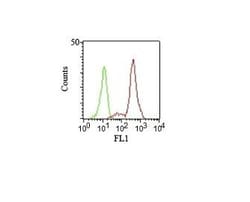
Biotium CD11c(HC1/1), CF568 conjugate, 0.1mg/mL
CD11c, also known as Integrin, alpha X (complement component 3 receptor 4 subunit) (ITGAX), is a type I transmembrane protein found at high levels on most human dendritic cells, but also on monocytes, macrophages, neutrophils, and some B cells. It induces cellular activation and helps trigger neutrophil respiratory burst. It is expressed in hairy cell leukemias, acute non-lymphocytic leukemias, and some B-cell chronic lymphocytic leukemias.Primary antibodies are available purified, or with a selection of fluorescent CF Dyes and other labels. CF Dyes offer exceptional brightness and photostability. Note: Conjugates of blue fluorescent dyes like CF405S and CF405M are not recommended for detecting low abundance targets, because blue dyes have lower fluorescence and can give higher non-specific background than other dye colors.