
Protein Labeling Reagents


Biotium Human Kappa Light Chain(KLC264), CF488A conjugate, 0.1mg/mL
This MAb is specific to kappa light chain of immunoglobulin and shows no cross-reaction with lambda light chain or any of the five heavy chains. In mammals, the two light chains in an antibody are always identical, with only one type of light chain, kappa or lambda. The ratio of Kappa to Lambda is 70:30. However, with the occurrence of multiple myeloma or other B-cell malignancies this ratio is disturbed. Antibody to the kappa light chain is reportedly useful in the identification of leukemias, plasmacytomas, and certain non-Hodgkin's lymphomas. Demonstration of clonality in lymphoid infiltrates indicates that the infiltrate is malignant.Primary antibodies are available purified, or with a selection of fluorescent CF Dyes and other labels. CF Dyes offer exceptional brightness and photostability. Note: Conjugates of blue fluorescent dyes like CF405S and CF405M are not recommended for detecting low abundance targets, because blue dyes have lower fluorescence and can gi


Biotium Phalloidin, CF594, 50 U
Phalloidin conjugates are actin filament stains for fixed and permeabilized cells. CF dyes are Biotium's line of next-generation fluorescent dyes with advantages in brightness, photostability, and conjugate specificity compared to other fluorescent dyes. Deep-red fluorescent CF594 has excitation/emission at 593/614 nm.
Biotium Neurofilament (NF-H)(NF421), CF568 conjugate, 0.1mg/mL
This MAb reacts with a 200 kDa protein, identified as heavy sub-unit of neurofilaments (NF-H). Neurofilaments make up the main structural elements of axons and dendrites and are found in neurons, peripheral nerves, and sympathetic ganglion cells. Neurofilaments consist of three major subunits with molecular weights of 68 kDa (NF-L), 160 kDa (NF-M) and 200 kDa (NF-H). Anti-neurofilament stains a number of neural, neuroendocrine, and endocrine tumors. Neuromas, ganglioneuromas, gangliogliomas, ganglioneuroblastomas, and neuroblastomas stain positively for anti-neurofilament. Neurofilaments are also present in paragangliomas as well as adrenal and extra-adrenal pheochromocytomas. Carcinoids, neuroendocrine carcinomas of the skin, and oat cell carcinomas of the lung also express neurofilament.Primary antibodies are available purified, or with a selection of fluorescent CF Dyes and other labels. CF Dyes offer exceptional brightness and photostability. Note: Conjugates of blue f
Biotium CD66 (CEA)(COL-1), CF568 conjugate, 0.1mg/mL
This antibody recognizes proteins of 80-200 kDa, identified as different members of CEA family. CEA is synthesized during development in the fetal gut and is re-expressed in increased amounts in intestinal carcinomas and several other tumors. This MAb does not react with nonspecific cross-reacting antigen (NCA) and with human polymorphonuclear leucocytes. It shows no reaction with a variety of normal tissues and is suitable for staining of formalin/paraffin tissues. CEA is not found in benign glands, stroma, or malignant prostatic cells. Antibody to CEA is useful in detecting early foci of gastric carcinoma and in distinguishing pulmonary adenocarcinomas (60-70% are CEA positive) from pleural mesotheliomas (rarely or weakly CEA positive). Anti-CEA positivity is seen in adenocarcinomas from the lung, colon, stomach, esophagus, pancreas, gallbadder, urachus, salivary gland, ovary, and endocervix.Primary antibodies are available purified, or with a selection of fluorescent CF
Biotium Phalloidin Conjugate CF488A 50UL
Ready-to-use tyramide amplification buffer can be used for tyramide signal amplification with CF Dye Tyramides or other tyramides without the need to add hydrogen peroxide.
Biotium Phalloidin, CF640R, 50 U
Phalloidin conjugates are actin filament stains for fixed and permeabilized cells. CF dyes are Biotium's line of next-generation fluorescent dyes with advantages in brightness, photostability, and conjugate specificity compared to other fluorescent dyes. Far-red fluorescent CF640R has excitation/emission at 642/662 nm.
Biotium CD22(FR10B4), CF568 conjugate, 0.1mg/mL
Recognizes a protein of 130-140 kDa, identified as CD22 (also known as BL-CAM). CD22 expression is restricted to normal and neoplastic B cells and is absent from other haemopoietic cell types. In B-cell ontogeny, CD22 is first expressed in the cytoplasm of pro-B and pre-B cells, and on the surface as B cells mature to become IgD . It is not expressed by plasma cells, CD22 is found highly expressed in follicular mantle and marginal zone B-cells, and while germinal center B-cells are relatively weak. CD22 is a member of the immunoglobulin superfamily and serves as an adhesion receptor for sialic acid-bearing ligands expressed on erythrocytes and all leukocyte classes. It also associates with tyrosine kinases and play a role in signal transduction and B-cell activation.Primary antibodies are available purified, or with a selection of fluorescent CF Dyes and other labels. CF Dyes offer exceptional brightness and photostability. Note: Conjugates of blue fluorescent dyes like CF
Biotium IgM Immunoglobulin(IM260), CF488A conjugate, 0.1mg/mL
Recognizes a protein of 75 kDa, identified as mu heavy chain of human immunoglobulins. It does not cross-react with alpha (IgA), gamma (IgG), epsilon (IgE), or delta (IgD), heavy chains, T-cells, monocytes, granulocytes, or erythrocytes. This MAb is useful in the identification of leukemias, plasmacytomas, and certain non-Hodgkin's lymphomas. The most common feature of these malignancies is the restricted expression of a single heavy chain class. Demonstration of clonality in lymphoid infiltrates indicates that the infiltrate is clonal and therefore malignant.Primary antibodies are available purified, or with a selection of fluorescent CF Dyes and other labels. CF Dyes offer exceptional brightness and photostability. Note: Conjugates of blue fluorescent dyes like CF405S and CF405M are not recommended for detecting low abundance targets, because blue dyes have lower fluorescence and can give higher non-specific background than other dye colors.
Biotium CF488A, Aminooxy
Aminooxy dyes have an aminooxy reactive group, which can be used to label a target molecule with an aldehyde or ketone group. An aminooxy group readily reacts with an aldehyde or ketone group to form a stable linkage without the use of a reducing agent. CF dyes are Biotium's line of next-generation fluorescent dyes with advantages in brightness, photostability, and conjugate specificity compared to other fluorescent dyes. Green fluorescent CF488A dye has excitation/emission at 490/515 nm.
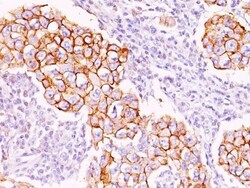
Biotium Phosphotyrosine(PY20), CF488A conjugate, 0.1mg/mL
Protein phosphorylation is a fundamental event in the regulation of a large number of intracellular processes. Phosphorylation of specific tyrosine residues is the result of activation or stimulation of their respective protein tyrosine kinases. The phosphorylated proteins can be auto-phosphorylated kinases or certain cellular protein substrates. Tyrosine-phosphorylated proteins are involved in signal transduction and in the regulation of cell proliferation. Antibody to phosphotyrosine provides an excellent tool for the detection, characterization, and purification of phosphotyrosine containing proteins. This MAb shows no cross-reaction with other phosphoamino acids and is superb for multiple applications including staining of formalin/paraffin tissues.Primary antibodies are available purified, or with a selection of fluorescent CF Dyes and other labels. CF Dyes offer exceptional brightness and photostability. Note: Conjugates of blue fluorescent dyes like CF405S and CF4
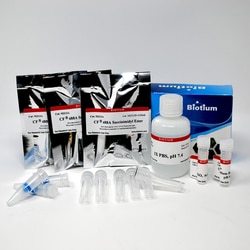
Biotium CF405M Protein Labeling Kit , 3x(1mg) labelings
This kit contains everything you need to label antibodies or other proteins with a fluorescent CF dye succinimidyl ester (CF dye SE). Each kit contains reagents for three labeling reactions of up to 1 mg protein per reaction. CF dyes are Biotium's line of next-generation fluorescent dyes with advantages in brightness, photostability, and conjugate specificity compared to other fluorescent dyes. Blue fluorescent CF405M dye has excitation/emission at 408/452 nm.

Biotium CF488A, Succinimidyl Ester
CF Dye Succinimidyl Esters (SE, also known as NHS esters) are amine-reactive fluorescent dyes. SE dyes are commonly used to label antibodies and other proteins on free amine groups, such as lysine residues. CF dyes are Biotium's line of next-generation fluorescent dyes with advantages in brightness, photostability, and conjugate specificity compared to other fluorescent dyes. Green fluorescent CF488A dye has excitation/emission at 490/515 nm.

Biotium CF640R Hydrazide
Our CF dye hydrazides are bright, extremely water-soluble and nontoxic. These properties make the dyes excellent fixable polar tracers for microinjection into cells. Hydrazides also can be used for labeling aldehyde or ketone groups, however, for this application we recommend using the more reactive CF dye aminooxy forms. CF dyes are Biotium's line of next-generation fluorescent dyes with advantages in brightness, photostability, and conjugate specificity compared to other fluorescent dyes. Far-red fluorescent CF640R dye has excitation/emission at 642/662 nm.
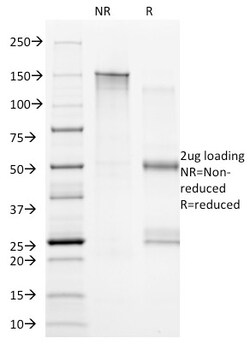
Biotium CD20(B9E9), CF488A conjugate, 0.1mg/mL
Recognizes a protein of 33-37 kDa, identified as CD20 (Workshop V; Code CD20.12). B9E9 recognizes extracellular domain of CD20. The epitope is similar to or identical to that recognized by other CD20 antibodies including Leu-16 and B1. This MAb can be used for immunophenotyping of leukemia and malignant cells, B lymphocyte detection in peripheral blood, B cell localization in tissues and B lymphocyte purification by immunosorbent methods. CD20 is a non-Ig differentiation antigen of B-cells and its expression is restricted to normal and neoplastic B-cells, being absent from all other leukocytes and tissues. CD20 is expressed by pre B-cells and persists during all stages of B-cell maturation but is lost upon terminal differentiation into plasma cells. Protein passes through the membrane 4 times with both ends in cytoplasm and exposes one short and one longer loop to the external environment. CD20 is not glycosylated in resting B cells and its cytoplasmic domains are differentia