
Protein Labeling Reagents


Biotium CF514 Succinimidyl Ester
CF Dye Succinimidyl Esters (SE, also known as NHS esters) are amine-reactive fluorescent dyes. SE dyes are commonly used to label antibodies and other proteins on free amine groups, such as lysine residues. CF dyes are Biotium's line of next-generation fluorescent dyes with advantages in brightness, photostability, and conjugate specificity compared to other fluorescent dyes. Green fluorescent CF514 dye has excitation/emission at 516/548 nm.

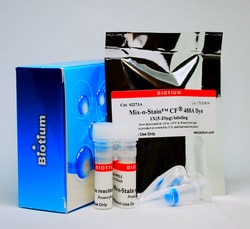
Biotium Mix-n-Stain™ CF640R Antibody Labeling Kit, 1x(50-100ug) labeling
Mix-n-Stain™ Antibody Labeling Kits are a revolutionary antibody labeling technology that allows you to label your antibody with one of our superior CF dyes in 30 minutes without a purification step. The labeling procedure tolerates many common buffer components and antibody stabilizers. Choose from kit sizes to label 5-20 ug, 20-50 ug, or 50-100 ug of your antibody. CF dyes are Biotium's line of next-generation fluorescent dyes with advantages in brightness, photostability, and conjugate specificity compared to other fluorescent dyes. Far-red fluorescent CF640R dye has excitation/emission at 642/662 nm.
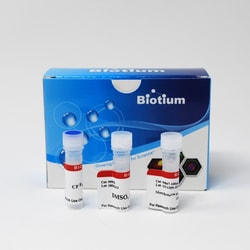
Biotium MemBrite™ Fix 488/515 Cell Surface Staining Kit, 500 Reactions
MemBrite™ Fix Cell Surface Staining Kits are designed for covalently staining the surface of live cells to conveniently visualize cell boundaries in immunofluorescence experiments. MemBrite™ Fix are new covalent cell surface stains that react irreversibly with cell surface proteins for staining that can withstand formaldehyde or alcohol fixation, and detergent permeabilization. Unlike lectins such as WGA, which bind specific targets that may vary between cell types, MemBrite™ Fix dyes react widely with cell surface proteins. MemBrite™ Fix staining is rapid and non-toxic to cells, and because MemBrite™ Fix dyes are highly water soluble, they stain cells much more evenly than traditional lipophilic membrane dyes like DiO, DiI, PKH, Vybrant, or CellMask™. This kit has reagents sufficient for 500 labeling reactions. The kit contains 5 vials of MemBrite™ Fix 488/515. Each vial is sufficient for 20 uL of 1000X dye after DMSO reconstitution.

Biotium Chromogranin A(CGA/414), CF568 conjugate, 0.1mg/mL
Chromogranin A is present in neuroendocrine cells throughout the body, including the neuroendocrine cells of the large and small intestine, adrenal medulla and pancreatic islets. It is an excellent marker for carcinoid tumors, pheochromocytomas, paragangliomas, and other neuroendocrine tumors. Co-expression of chromogranin A and neuron specific enolase (NSE) is common in neuroendocrine neoplasms. Reportedly, co-expression of certain keratins and chromogranin indicates neuroendocrine lineage. The presence of strong anti-chromogranin staining and absence of anti-keratin staining should raise the possibility of paraganglioma. The co-expression of chromogranin and NSE is typical of neuroendocrine neoplasms. Most pituitary adenomas and prolactinomas readily express chromogranin.Primary antibodies are available purified, or with a selection of fluorescent CF Dyes and other labels. CF Dyes offer exceptional brightness and photostability. Note: Conjugates of blue fluorescent dyes
Biotium MALT-1(MT1/410), CF568 conjugate, 0.1mg/mL
Mucosa associated lymphoid tissue lymphoma translocation gene 1 (MALT1) is found in extranodal low-grade B cell lymphomas. MALT1 encodes two Ig-like C2-type domains and fuses with an API2 gene, which is highly expressed in adult lymphoid tissue. The translocation of this MALT1 gene, which maps to human chromosome 18q21, and the apoptosis-inhibiting API2 gene results in an increased development of MALT lymphomas and apoptosis inhibition. Sites at which this API2-MALT1 (11;18)(q21;q21) translocation commonly occurs are within human lung and kidney tissue. MALT lymphoma expresses nuclear Bcl10, which mediates the oligomerization and activation of a MALT1 caspase-like domain. MALT1 mRNA is found in pre-B cells, mature B cells and plasma cells.Primary antibodies are available purified, or with a selection of fluorescent CF Dyes and other labels. CF Dyes offer exceptional brightness and photostability. Note: Conjugates of blue fluorescent dyes like CF405S and CF405M are not re
Biotium CD2(1E7E8.G4), CF488A conjugate, 0.1mg/mL
CD2 interacts through its amino-terminal domain with the extracellular domain of CD58 (also designated CD2 ligand) to mediate cell adhesion. CD2/CD58 binding can enhance antigen-specific T cell activation. CD2 is a transmembrane glycoprotein that is expressed on peripheral blood T lymphocytes, NK cells and thymocytes. CD58 is a heavily glycosylated protein with a broad tissue distribution in hematopoietic and other cells, including endothelium. Interaction between CD2 and its counter receptor LFA3 (CD58) on opposing cells optimizes immune system recognition, thereby facilitating communication between helper T lymphocytes and antigen-presenting cells, as well as between cytolytic effectors and target cells.Primary antibodies are available purified, or with a selection of fluorescent CF Dyes and other labels. CF Dyes offer exceptional brightness and photostability. Note: Conjugates of blue fluorescent dyes like CF405S and CF405M are not recommended for detecting low abunda

Biotium CF568 Hydrazide
Our CF dye hydrazides are bright, extremely water-soluble and nontoxic. These properties make the dyes excellent fixable polar tracers for microinjection into cells. Hydrazides also can be used for labeling aldehyde or ketone groups, however, for this application we recommend using the more reactive CF dye aminooxy forms. CF dyes are Biotium's line of next-generation fluorescent dyes with advantages in brightness, photostability, and conjugate specificity compared to other fluorescent dyes. Red fluorescent CF568 dye has excitation/emission at 562/583 nm.

Biotium Fluo-3, AM Ester, Special Packag, 20x50ug
Membrane-permeant AM ester form of Fluo-3 that can be loaded into cells via incubation. Because of the relatively low water solubility of the AM ester, Pluronic F-127, a mild detergent, is often used as a dispersing agent to facilitate dye loading. Fluo-3 AM ester itself does not bind Ca2 , but it is readily hydrolyzed to Fluo-3 by endogenous esterases once the dye is inside the cells. An important application of Fluo-3 AM ester is its use in high throughput drug screening. Properties: Orange red solid soluble in DMSO; Store -20°C and protect from light, especially when in solution; C51H50Cl2N2O23; MW: 1129.9; [121714-22-5]
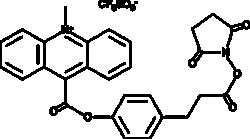
Cayman Chemical Acridinium NHS ester, Purity: ≥95%, CAS: 177332-37-5, 1 mg
The acridinium NHS ester can be used to label proteins and nucleic acids. The covalently bound acridinium NHS ester will produce chemiluminescence in the presence of hydrogen peroxide. Acridinium-labeled proteins can be used as a detection method in immunoassays.{2437,2438}
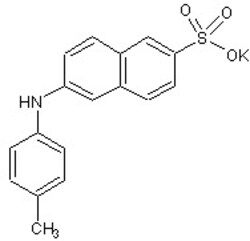
Abcam 6-p-Toluidino-2-naphthalenesulfonic acid, potassium salt (TNS-K+), 100MG
MW 351.5 Da, Purity >98%. Fluorescent probe for measuring protein conformational changes and quantitative measurement of protein hydrophobicity processes that modify the exposure of the probe to water. Essentially nonfluorescent in water. Fluorescent when bound to membranes (q.y. ~0.27) or hydrophobic domains of proteins (q.y. ~0.72). Fluorescence enhanced by cyclodextrins. Can be used to provide a sensitive method for separating and analyzing cyclodextrins by capillary electrophoresis.
The product is subject to the following: Abcam Restricted Use Statement
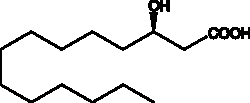
Cayman Chemical (R)-3-hydroxy Myristic Acid, Purity: ≥98%, CAS: 28715-21-1, 100 mg
A form of the myristic acid that is found in the lipid A component of some Gram negative bacteria, including Escherichia, Haemophilus, Actinobacillus, and Campylobacter species.
Sigma Aldrich Fine Chemicals Biosciences Atto 655 NHS ester BioReag1MG
ATTO Atto 655 NHS ester BioReag1MG

Sigma Aldrich Fine Chemicals Biosciences CyR3 Mono NHS Ester Cytiva
The packs contain derivitized CyDyes that carry only one reactive group on each dye molecule for accurate labeling of amine groups for example on antibodies peptides or oligonucleotides.