Evacuated Blood Collection Tubes
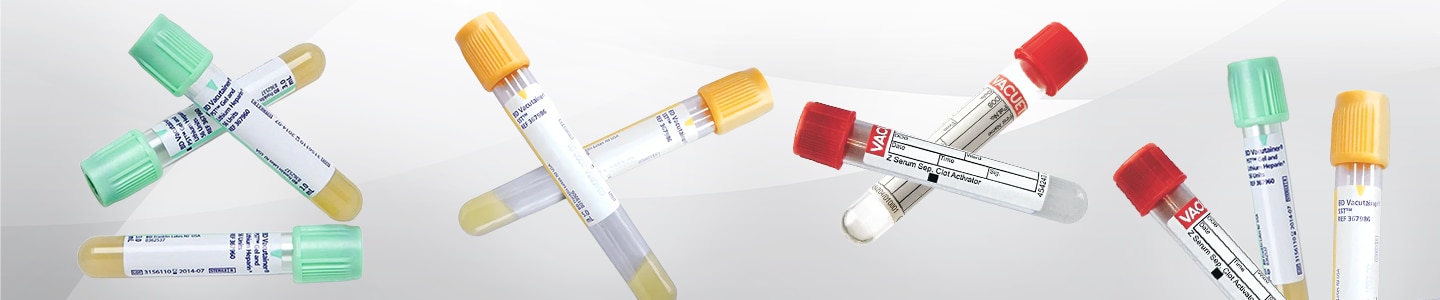
Evacuated blood collection tubes have largely replaced needle and syringe methods for collecting blood specimens. Each evacuated tube is a closed system; the vacuum in the tube dictates the amount of blood that is drawn into the tube. If the tube contains an anticoagulant, the amount is calibrated to match the expected blood volume.
Evacuated collection tubes are available in a range of capacities, tube dimensions, stopper styles, and additives. Find varieties to suit your clinical lab needs.
Featured Products

Catalog Number 0268397

Catalog Number 22040537

Catalog Number 02687100
Color-Coded Closures
Standard color-coding of evacuated blood collection tubes has been adopted by manufacturers based on the anticoagulants or other additives that the tubes contain. Some instrument- or process-specific blood culture bottles have been adapted for evacuated collection methods.
The closure color indicates the tube additives. This table shows the most common types:
| Color | Additive | Specimen | Assays |
|---|---|---|---|
| Red or Red/Gold | None or Clot Activator | Serum | Chemistries, TDM |
| Lavender | EDTA | Whole Blood, Plasma | Hematology |
| Light Blue | Sodium Citrate | Plasma | Coagulation |
| Green | Lithium or Sodium Heparin | Plasma | Chemistries, TDM |
Other Options and Features
Some evacuated collection tubes are designed to easily separate the serum or plasma from the rest of the blood sample. These serum-separator or plasma-separator tubes contain a polymer gel material that migrates during centrifugation to form a barrier between the serum or plasma and the formed elements (cells). This allows the specimens to be more easily decanted and also means that they can be stored in the original tube.
Evacuated collection tube closure styles include plug types, which fit inside the tube, and plugs with plastic caps that help prevent blood splash when the cap is removed.
Tube dimensions range from 10 x 75 millimeters to 16 x 100 millimeters. Capacities range from 1.8 to 8.5 milliliters.
Both sterile and nonsterile glass and plastic evacuated blood specimen collection tubes are available.