Learn More
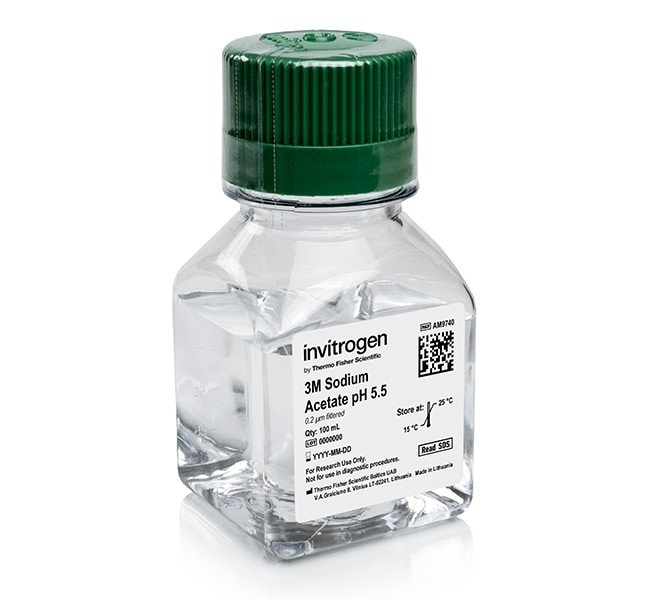
Invitrogen™ Sodium Acetate (3 M), pH 5.5, RNase-free


Description
Invitrogen Molecular biology grade, 3M Sodium Acetate solution is supplied in one bottle containing 100 mL. The solution is certified RNase-free, economical, and ready-to-use. Due to the ubiquitous presence of RNases, manufacturing products for use with RNA is especially challenging. Invitrogen's nuclease-free reagents and buffers are manufactured in facilities specifically designed to prevent the introduction of nucleases. Highly sensitive RNase assays are performed at several different stages of the manufacturing process to ensure the highest quality. These reagents are rigorously tested for contaminating nonspecific endonuclease, exonuclease, and RNase activity.
Order Info
Shipping Condition: Room temperature

Specifications
Specifications
| Chemical Name or Material | Sodium Acetate |
| Content And Storage | Store at room temperature. |
| Concentration | 3 M |
| For Use With (Application) | RNA Applications |
| Packaging Type | Bottle |
| pH | 5.5 |
| Product Line | Ambion |
| Purity | Molecular Biology Grade |
| Quantity | 100 mL |
| Shipping Condition | Room Temperature |
| Show More |
Frequently Asked Questions (FAQs)
Ethanol precipitation is frequently used for concentration of DNA solutions and for removal of protein, salt, and unincorporated nucleotides. The two most common protocols use either 0.3 M sodium acetate (0.1 volume of 3 M) or 2.5 M ammonium acetate (0.5 volume of 7.5 M), along with 2 to 2.5 volumes of ethanol. Studies at Thermo Fisher Scientific (1, 2) have shown these two salts to be equally effective for recovery of small amounts of DNA from small volumes and for removal of unincorporated nucleotides from labeling reactions.
DNA was found to precipitate readily with room temperature ethanol and room temperature centrifugation. For DNA concentrations >0.1 µg/mL, no incubation period is required. For improved recovery of DNA from dilute solutions (10 ng/mL), overnight incubation in the ethanol and extended (30 min) centrifugation is recommended. Addition of ammonium acetate to 2.5 M (without ethanol) has also been shown to be effective in precipitating proteins while leaving the DNA in solution (2).
1. Zeugin, J.A. and Hartley, J.L. (1985) FOCUS 7:4, 1.
2. Crouse, J. and Amorese, D. (1987) FOCUS 9:2, 3.
Safety and Handling
For Research Use Only. Not for use in diagnostic procedures.
By clicking Submit, you acknowledge that you may be contacted by Fisher Scientific in regards to the feedback you have provided in this form. We will not share your information for any other purposes. All contact information provided shall also be maintained in accordance with our Privacy Policy.