Learn More
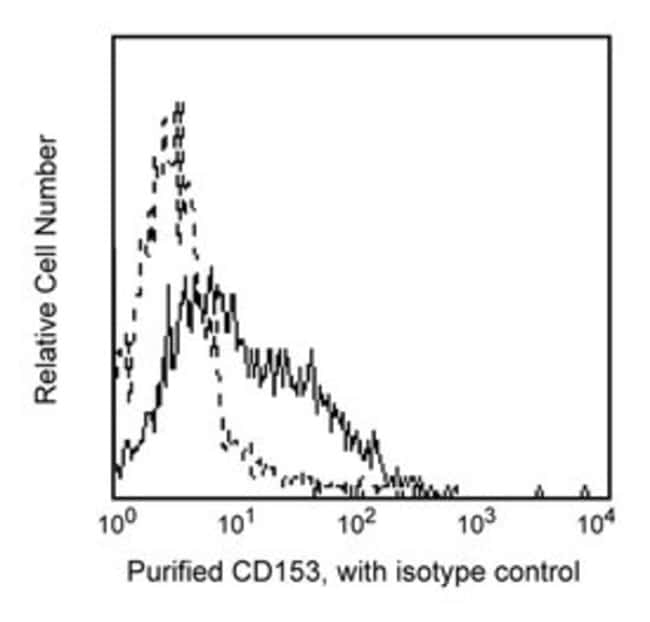
Description
Reacts with CD30 ligand (CD153) a 40 kDa type II membrane glycoprotein expressed mainly on activated T cells, as well as on activated macrophages, neutrophils and both normal and malignant B cells. CD30 ligand is a member of the tumor necrosis factor (TNF) superfamily. In addition to TNF, this family also includes lymphotoxin α (LT α ), LT β , CD154, CD95L, CD70, CD134 ligand, CDw137 ligand, and TRAIL. Results of in vitro studies have shown that CD30 mediates a variety of activation and differentiation, or apoptotic signals. Recently, it has been reported that CD30-deficient mice have elevated numbers of thymocytes and show a gross defect in negative but not positive selection during T cell differentiation, suggesting an important role for CD30/CD30L interactions in the deletion of autoreactive T cells.

Specifications
Specifications
| Antigen | CD153 |
| Applications | Flow Cytometry |
| Classification | Monoclonal |
| Clone | D2-1173 |
| Concentration | 0.5mg/mL |
| Conjugate | Unconjugated |
| Description | CD30L, CD30 ligand |
| Formulation | Aqueous buffered solution containing ≤0.09% sodium azide. |
| Host Species | Mouse |
| Purification Method | Affinity Purified |
| Show More |
Safety and Handling
For Research Use Only.
By clicking Submit, you acknowledge that you may be contacted by Fisher Scientific in regards to the feedback you have provided in this form. We will not share your information for any other purposes. All contact information provided shall also be maintained in accordance with our Privacy Policy.